On the Muppet Wiki, there is a "Random Muppet" button which sends you to the page of one of the thousands of Muppets in existence. I will press the button and discuss the importance of the Muppet that comes up, no matter how obscure. No skips. No redos. This is the Random Muppet Challenge.
Random Muppet #25: Stu
An excitable Frogketeer.
Performer: Dave Golez
Muppet Universe of Origin: Muppets Tonight
Most Significant Appearance: Muppets Tonight, April 5, 1996, "Episode 105: Cindy Crawford"
Yet another recurring element in Muppets Tonight was the "reveal" that the night's current guest had previously appeared with the Muppets in older works of entertainment. Basically, it was an excuse to parody the shows of yesteryear and put the Muppets in funny costumes. None of it could actually pass itself off as Muppet canon, of course (which makes it all a lost opportunity to revisit classic Muppet sketches and motifs). The humor depended on the familiarity with the reference material.
One of the stronger "Classic Muppet" sketches was "The Kermit the Frog Club," which spoofed The Mickey Mouse Club, one of Disney's earliest attempts to make stars out of teenagers who danced, sang, and had good wholesome fun in their creepy, unrelenting devotion to the Mouse. While the Club is currently known for its most recent iteration that spawned our Timberlakes and our Aguileras and our Spears...s, it is the 1955 version that serves as the backdrop for today's sketch.
Guest Cindy Crawford (or as she was originally known, "Cinderella Crawfordopolis") was one of the original Frogketeers on "The Kermit the Frog Club," along with a few other will-be stars.
Including Little Newt Gingrich and Little L. Ron Hubbard!
Various elements are parodied, with the "Kermit Frog Theme Song" ("Where's the 'the'?" cries Kermit during the song) and frighteningly ambitious career plans for the young cast. But it is during the roll call that our little Stu gets to shine. Stu leads the pack. And then comes back. Again. And again. And again.
Let Little Robbie Reiner have a chance!
Why Is He the Most Important Muppet?
Stu suffered from extreme short-term memory loss. Unlike the rest of his Frogketeers, Stu would not go on to bigger and better things. His affliction prevented him from normal interactions, making the transition into society very difficult for him.
But despite his setback, Stu's confidence and happiness did not falter. He excitedly interjected his name into any conversation he could. It was all he knew. It was all he could do. And he had fun.
Stu never went away, though. While the rest of his friends became successful celebrities, Stu remained with the Muppets it seems. At the very end of the episode, he returns to once again shout his name. Strangely, he has remained in his youthful state. It seems that living in this forgetful stasis has kept Stu forever young. Unfortuantely, he doesn't get to enjoy his newfound fame since Cindy Crawford vaporizes him with her laser-vision.
It makes sense in context, I assure you.
The moral of Stu's life? Um, be yourself. And stay away from supermodels.
M! D'Bolo had a much more interesting life. But that is a tale for another day.
On the Muppet Wiki, there is a "Random Muppet" button which sends you to the page of one of the thousands of Muppets in existence. I will press the button and discuss the importance of the Muppet that comes up, no matter how obscure. No skips. No redos. This is the Random Muppet Challenge.
Random Muppet #18: Avocado
An unemployed critic of low art.
Performer: Dave Golez
Muppet Universe of Origin: The Muppet Show
Most Significant Appearance: The Muppet Show, November 11, 1978, "Episode 305: Pearl Bailey"
While Waldorf and Statler usually assume the duties of being The Muppet Show's harshest critics, they cannot always complete the job on their own. One day, Statler invites his friend, a sunglasses-totting avocado, to the show. How Statler met the avocado is never explained, and after Waldorf's brief puzzlement, he grows to accept the presence of the talking fruit.
The avocado is introduced after the opening number in which guest star Pearl Bailey sings "My Soul is a Witness." It's a nice, respectful number that the old men can't really find anything to complain about. Statler suggests they ask the avocado and he responds positively. Apparently he's a huge Pearl Bailey fan.
Well, she is a good actress and singer, I suppose.
While the audience is trying to wrap their head around why an avocado was consulted at all, the show continues without him. Was "Let's ask the avocado!" some sort of pun? He's missing the next time we visit the balcony, but he returns two more times in the episode. The first time, Waldorf asks if he's a professional critic, to which the fruit responds that he's unemployed. Waldorf then suggests that he should try to get into something decent...guacamole!
At the end of the show, the avocado gives his final review of the show. "It was the pits!"
So...an avocado character was introduced basically to make two avocado-related puns? That's a far stretch to go for those jokes. Couldn't they have found some other food-related sketch to fit him into?
It shall remain forever a mystery.
Why is He the Most Important Muppet?
The Muppet Show is no stranger to featuring talking food. What makes the avocado so special? Why isn't he featured alongside his edible brethren?
Well, have you ever really stopped to consider the avocado?
Now's your chance!
The avocado is an anomaly of the fruit world. It is technically a big berry, although it's odd texture and lack of a sweet flavor may convince one otherwise. In some parts of the world, it is known as a "butter fruit" due to the consistency of the innards. It has a high fat content, making it a perfect part of a vegetarian diet (or a substitute for meat in areas where meat and other fatty foods are scarce). Despite this, some culinary artists and cultures do try to include it in sweeter dishes for dessert such as milkshakes, smoothies, and ice cream, infusing a subtle avocado flavor in with the sugary syrup.
But perhaps the most bizarre aspect of the avocado is it's single giant seed. Out of all fruits, the avocado seed is the third largest, following closely behind the mango and the coconut (which is itself served as just the seed). The avocado seed is toxic to ingest, but it's so large that no one will be swallowing it anytime soon.
According to the evolutionary biologist Daniel H. Janzen, the avocado is an "evolutionary anachronism" meaning it basically grew up during the wrong time-period. It's earliest appearance dates back to about 10,000 B.C. which is about 1,000 years short of the 2.5 million year long Pleistocene Epoch where it should have thrived. This was the time that humans as we know them took form, but giant animals were still common place. Only these larger creatures could have ingested avocados whole and spread avocado trees with their droppings serving as a natural fertilizer. The fleshy nature of the fruit suggests that this is the best evolutionary method for seed dispersal, as it would protect both the seed and the animal who swallowed it from harming each other.
And yet, the avocado survives to this day and has made it's way onto The Muppet Show.
And it wears sunglasses indoors for some reason.
The avocado is a fragile creature. One wrong move and it could end up in a dip. Life is difficlut for the lowly plant. So what does it devote it's life to? What is the only thing it is capable of doing? Observing art and critiquing it. The avocado wants to contribute to the world, but it lacks the ability to do anything. The best it can provide is it's opinion so that others may benefit from his wisdom. He is a young avocado, and still has a ways to go. He can only say, "It's the pits!" so many times before the shtick gets old. But the avocado presses on. It perseveres. And the plant that no one thought could last in this world gains immortality.
In action figure form, of course.
Everyone's a critic. Analyzing the crafts of others keeps us entertained, focused, and sane. It gives us life. It reminds us that everyone can contribute to this world, in some way or another.
The spaceship lands, the doors open, and a mysterious figure emerges to speak to Gonzo. Once he is sure that it is in fact the correct Gonzo, he heads back into to the ship so that the aliens can perform "Celebration" by Kool and the Gang.
That's right. There's no deep meaningful introduction or even an original song to commemorate the reunion of Gonzo and his species. Just a cover of "Celebration." Sure, it's a fun little romp, but for all of the mystery and suspense that had been building, the performance seems a little out of place. All of a sudden, here are a bunch of Gonzos singing and dancing and the crowd just goes along with it, without questioning anything. Maybe it's supposed to be campy, but it's a little jarring.
It's interesting to see how many variations of Gonzo they can create.
After the song, the Ubergonzo leader presents Gonzo with a helmet and prepares him for his initiation: being fired out of a giant cannon. See? All of Gonzo's crazy stunts weren't so crazy after all. This was just a traditional custom on his home planet! Okay, I get that, and it is keeping in line with the song "I'm Going to Go Back There Someday," where it is revealed that Gonzo likes to recreate the experience of flying in order to feel at home in the sky.
Although Gonzo would probably prefer to do it without the helmet.
But then, to ruin a happy moment, Mr. Buzzkill Singer shows up with his giant laser gun and threatens the aliens to stay so he can do evil stuff. However, his gun fails to work and everybody laughs at him, causing him to have a meltdown. Then, because this movie makes no sense, the Ubergonzo offers to bring Singer back to their planet with them because they find him funny. Um, the guy just tried to kill you and is clearly mentally unstable. Why are we rewarding him?
Maybe he shouldn't be the leader anymore, guys.
As the aliens prepare to depart, Gonzo says his goodbyes and everyone gets all weepy. Gonzo boards the ship and then decides, no, he's going to stay on Earth. That's his true home and the Muppets are his true family! That...is a sweet message but it really came out of left field. The Muppets didn't really do much in the way of bonding with Gonzo over the course of this film. They were rude to him when he expressed his beliefs, they "rescued" him from the bad guy and still made fun of his beliefs, and it wasn't until the very end that Kermit was like "You should believe what you want to believe and I'll support you." This may be your family, Gonzo, but they don't really treat you very well. You should at least consider traveling with the other Gonzos a bit.
In fact, we don't know anything about the other Gonzos! Where do they come from? How did Gonzo end up on Earth? How did they master interplanetary travel? Why is Gonzo so important to them that they would travel across galaxies to bring him back with them? These are questions that could have been answered had Gonzo stayed with them, but I guess we can't have him leave the cast permanently.
Well, at least they got Jeffrey Tambor.
So the ship blasts off, and we end with many unanswered questions, but the most pressing one on Gonzo's mind, as he sits on the roof with his friends, is "Why did they make me build a jacuzzi?"
Womp womp!
Muppets from Space is quite disappointing!
It's not very deep indeed.
This movie is really all over the place. It has some decent scenes and humor throughout, but the story is cliched, the cameos are obnoxious, and the message is confusing. But there is one thing that this movie did wrong above all else. It may be a little controversial, depending on how attached you are to the Muppet canon, but I believe this is the biggest flaw with the film:
Gonzo should have remained an unclassified species.
Did you know that this film original had an alternate ending? It did, and once I tell you that ending, the movie will make a whole lot of sense.
The aliens that came to Earth were not supposed to be Gonzos. They were supposed to be another species entirely. They just happened to be huge fans of Gonzo's stunts from The Muppet Show and wanted the chance to meet him. Gonzo would spend the whole movie thinking his family would come for him and he'd turn out to be dead wrong.
It was a bleaker ending, yes, but it's also bolder and in keeping with the themes set up in the film (not to mention the Muppets' raison d'être). The Muppets are failures. And whenever they get knocked down, they stick together and try again. And through their resilience, they succeed. Gonzo only has one obstacle during the film: his friends' lack of faith in his beliefs. Sure, he gets kidnapped and everything, but that's all pointless in the grand scheme of the movie.
Gonzo is supposed to be the weird one. The oddball in a clan of oddballs. He is supposed to be lonely and strange. He finally has the chance to find his purpose in the universe. Find a place where he belongs. And in this movie...he gets exactly that. The fact that his friends didn't believe them has absolutely no bearing on the plot because once the aliens come, there is no more argument. Yep, Gonzo has a family. Now what?
By changing to the "happier" ending, characters start doing things that don't make sense. Gonzo decides not to join them without any cause. In a story, once you give your main character the happy ending, there has to be a pretty good reason for them to turn it down. Gonzo doesn't join the aliens because in the original script, the aliens weren't his family. One could argue that Gonzo is having a change of heart and deciding to stick with his true family is better in the long run, but the movie doesn't set that up properly. He has very little interactions with his friends during the film. And even when he's reunited with them after the kidnapping, he still has few interactions. They all treat him like an acquaintance or a co-worker, not a family member.
Had the original ending stayed intact, Gonzo could have still learned the lesson that "your family is who you grow up with." Plus, it would have kept the mystery of Gonzo's origin alive. The possibility that he may have been an alien could still be in effect. But now that it's confirmed...it feels less special. When something stays a mystery for so long, it's best to keep it that way, lest it lose it's significance.
Oh, so now Gonzo isn't special. That's what this movie is telling us.
Gonzo is one of my favorite characters, and having him in a starring role was a smart move. He is capable of exploring complex emotions and storylines. He could have handled an ending that didn't tie everything up in a neat little bow.
This movie had many other problems as well, but the issue of the ending change was the one that irked me the most. But, while I've got you here, let's run down the rest of the reasons this movie failed:
1) No original music - There was a definite theme of '60s and '70s funk music, which is strange because it doesn't have anything to do with the Muppets or space for that matter. If they were trying to make this a period piece, it didn't work. This is the first Muppet movie without original songs and it suffers for it.
2) The movie is trying too hard to stay relevant - Most Muppet movies have a timeless quality to them. This one dates itself in 1999 and refuses to budge. The characters use slang that they wouldn't normally say, references are made to modern day pop culture, and it just feels like a late '90s kids movie. It's hard to put that into words, but the editing, directing, and writing make it feel very similar to other movies of the time like Baby Geniuses, Inspector Gadget, and Dudley Do-Right.
3) The cameos... - The Muppet Movie had Bob Hope.
4) It wasted a good premise - And I don't just mean the whole "Gonzo wasn't really an alien" thing. The idea of making a Muppet movie that focused solely on one of the characters. That could have reinvigorated the whole franchise! While I was watching this movie, I kept getting flashes of The Great Muppet Caper, which only kept it's focus on Kermit, Fozzie, Gonzo, and Piggy. Muppets from Space could have been the start of something great. Each of these characters are deep and complex. They don't need to be regulated to repeating their familiar jokes. After this, we could have had a movie about Fozzie's stand-up career a la The King of Comedy or a Kermit and Piggy romantic comedy or a Spinal-Tap-esque look at the Electric Mayhem. Instead, we have to stuff all the Muppets into a boarding house and act like they're all friends all the time without any personal lives of their own.
5) This movie should have just been Close Encounters of the Third Kind- This movie attempts to parody many shows and movies at once and it results in a muddled affair. In addition to Close Encounters, we get plot points from Men in Black, Independence Day, Alien, E.T., and Star Trek. I say, take out all the other stuff. This movie didn't need a villain. The story of Gonzo trying to reunite with his family is solid enough. It would have allowed for a deeper exploration of Gonzo's character. The tension between the conflicting beliefs of Gonzo and his friends would have been made clearer. And, had the movie kept it's original ending, there would have been a nice distinction between the movie and it's source material to make it a classic in it's own right.
I wanted so badly to enjoy this film. I really did. I enjoyed what dramatic tension there was in the Gonzo story, but it mostly just made me think about what could have been. Dave Golez and Gonzo are great and the perfect choice to lead a Muppet movie. But they didn't deserve this one. During the promotional tour for The Muppets, Kermit mentioned, "with all due respect to Muppets from Space, um, you don't want that to be the last movie you ever do. You want to do a better one."
Indeed Kermit. Indeed.
Gonzo: Forever a Whatever
* * *
On a more positive note, here is the best joke in the entire film.
Kermit enters the living room, muttering to himself: "Hm, I wish I could find my pants."
Low-brow humor gets a bad reputation. Appealing to the lowest-common denominator classifies one as being unintelligent, lazy, or immoral. Yet, this is humor distilled to it's most basic form. Mere slapstick and lewd sounds spark guttural, involuntary laughter because they are unexpected to us. "The Three Stooges" shorts are classics, not because they provided great insight into the human process, but because they speak the universal language of physical comedy.
Two characters that people may point to as a sign that Muppets Tonight paled in comparison to The Muppet Show are Andy and Randy Pig.
He's Andy and he's Randy. I think.
The Muppet Show had unhinged characters and dim-witted characters and one-dimenisonal characters, but they did have pure idiots like Andy and Randy, especially not as their main characters. These pigs were so cartoonishly stupid that they had no semblance of realism. They took every word literally, enjoyed bashing their heads together, forgot who they were or how their body functioned, and refused to complete the most minor of tasks with their catchphrase, "This job's too hard!"
The pigs originally appeared as a duo known as "Kirby and Jeff" in one of Nickelodeon's "Muppet Time segments, where they are two young boys who attempt to prove that they can get dressed all by themselves.
Here, their imbecilic actions are understandable. Little kids still have a lot of growing to do, but they often like to show off what they have learned, even if they still lack the abilities to do so. This song is cute and accurate for their age. But this set the tone for all future appearances.
After Muppet Classic Theaterredubbed them "Andy and Randy," their relation to Miss Piggy was established. In the first episode of Muppets Tonight, Miss Piggy agrees to appear as the guest star if Clifford hires her two nephews. While Piggy would appear less frequently from then on, Andy and Randy were there to stay.
Now played by Steve Whitmire and Dave Golez, Andy and Randy would cause all sorts of trouble for the crew. Their biggest episode was "Episode 104: John Goodman" in which John Goodman saves their lives from being electrocuted, so they decide to repay him by becoming his personal slaves. And of course they only do more harm than help.
It gets worse from here.
This is probably the twin pigs' worst episode because they are so prominent. With pure, unbridled idiocy, small doses are the best. This is why the Ralph-Wiggums of Television Land are usually regulated to bit parts of larger ensembles. Fortunately, the writer's realized this, and soon, Andy and Randy would only appear once per episode. And these moments would be fantastic.
My favorite recurring segment was "The Eagle's Nest," Sam the Eagle's political panel in which he would attempt to discuss important affairs with whomever he was able to scrounge up. Andy and Randy Pig were the only ones dumb enough to participate, and thus appeared in each episode. Having Sam grow increasingly more agitated while he attempted to maintain control was a delight, especially when Andy and Randy would twist his questions into some clever wordplay. The following clip may be the best of the bunch, as only the pigs have shown up this time.
The repetition of "Messrs" at the beginning is innocently adorable (and would carry over into a future episode) but I was particularly fond of the pigs shouting "Yoyoyoyoyoyoyo!" as they tied Sam to his chair, because this was calling back to an earlier episode in which Clifford greeted them with the phrase. It shows that they are learning.
Andy and Randy, in true Andy and Randy fashion, fail to make it past the first line of their script without getting horribly confused about what they had written. They don't understand their own jokes, they fail to solve the mysteries of who their characters are, and five pages consist of doodles. But it ends with Kermit as Godzilla tearing through the scenery. Ed Wood would be proud.
It's clear that when performing the pigs, Golez and Whitmire just set out to have as much fun as possible. Adopting these doofy voices and failing the puppets about whenever they got the chance, the two puppeteers obviously did not care how silly they were being. Andy and Randy could push the limits of low-brow humor and that's what makes them so ceaselessly entertaining. They could mine a joke out of any situation and, unlike most of the elements of Muppets Tonight, it was evident that they weren't trying to hard.
Andy and Randy were comedy popcorn: not intellectually filling, but enjoyable and reliable nonetheless.
On the Muppet Wiki, there is a "Random Muppet" button which sends you to the page of one of the thousands of Muppets in existence. I will press the button and discuss the importance of the Muppet that comes up, no matter how obscure. No skips. No redos. This is the Random Muppet Challenge.
Random Muppet #7: Socks the Cat
A presidential kitty.
Performer: Dave Golez
Muppet Universe of Origin: General "Muppets"
Most Significant Appearance: Larry King Live, April 1, 1994
On April Fools Day, 1994, Kermit the Frog stepped in as guest host of Larry King Live. He interviewed a normal array of guests, including news anchor Ted Koppel, wrestler Hulk Hogan, actress Carol Alt, and presidential advisor David Gergen. The show was peppered with appearances from other Muppets, both visually and calling in, but it wasn't until the very end that a non-human was interviewed.
That "person" was Socks the Cat, First Cat of the United States, owned by the then-current President Clinton. Presidential pets are basically living PR campaigns. They humanize the elected official and allow for the general public to feel closer to the White House. They have a cute puppy or kitty just like us! That makes us like them more!
But Kermit wasn't going to stick with cutesy stuff. He was there to ask the hard hitting questions. In a spoof of presidential "scandals," Kermit analyzes the first missteps of Socks the Cat's term in office.
Socks must explain his uncalled for behavior as the cameras capture his attacks on other cats. Kermit amusingly is shocked and appalled by what he sees and the Cat must come up with valid talking points to remain in the audiences good graces. He eventually works himself into a hairball-hacking frenzy as he is escorted offstage by his advisor.
Why Is He the Best Muppet?
The nature of celebrity is fundamentally absurd. There are three basic types of people who become famous: those in politics, those in the entertainment industry, and those who change the world through science and humanitarian efforts. Yet, despite their roles and validity as human beings, we treat them all the same as the collective "celebrity."
We analyze how they dress, what they eat, who they interact with, where they go, what they do, how they look in a bikini, what they accidentally said to their mistress, how they sneezed, etc. If a non-celebrity meets a celebrity, they get excited because they have interacted with a person they recognize who has no idea who they are. We are in awe of these people. We treat them like royalty.
And we treat them like dirt. Because there is nothing more interesting than a good piece of gossip.
In the high school of life, celebrities are the popular kids that outshine the rest of us. And we love to see them fall. In politics especially, minor gaffes and scandals can be blown out of proportion as evidence to discredit these people's characters. Some scandals are worthy of discussion and important to follow up on, but others are completely ridiculous. If you watch any major news channel, you can tell by the extreme severity of their graphics that we have trouble distinguishing what is actually crucial knowledge in the world of political snafus.
Socks exists to highlight our insatiable need to scrutinize our celebrities. This interview came out before Clinton's career defining scandal, but if anything, that only increases the relevance. Kermit pulls out a piece of damning evidence, trying to put Socks on the spot to explain his actions. He is behaving like a normal cat. He may be misbehaving, but a lot of cats misbehave. He just had the misfortune of being a cat that people looked up to and constantly observed. He has no privacy. Every misstep is added to his permanent record and it tarnishes his reputation and actual service to the country.
Socks is just a cat trying the best he can. Perfection is a terrible burden to place on a little kitty.
On the Muppet Wiki, there is a "Random Muppet" button which sends you to the page of one of the thousands of Muppets in existence. I will press the button and discuss the importance of the Muppet that comes up, no matter how obscure. No skips. No redos. This is the Random Muppet Challenge.
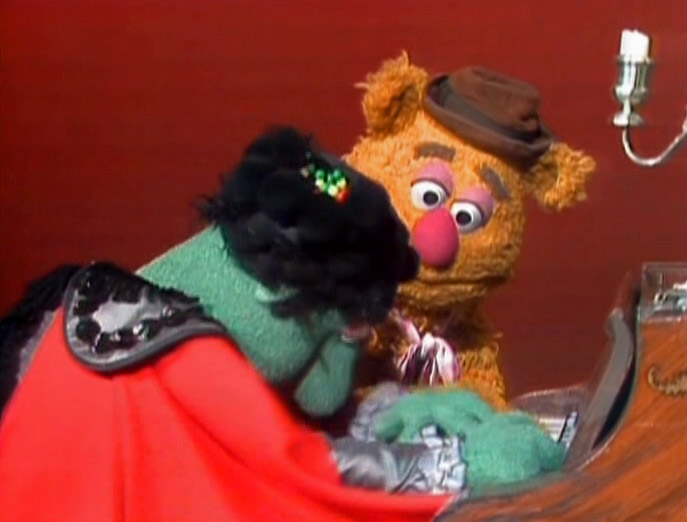
Random Muppet #5: The Matador
The spirit of a bullfighter.
Performer: Dave Golez
Muppet Universe of Origin: The Muppet Show
Most Significant Appearance: The Muppet Show, February 9, 1980, "Episode 418: Christopher Reeve"
In the middle of the show, Fozzie finds himself alone on stage with a piano. Although he is not the resident piano player, he does possess some musical skills, so he begins plinking the keys. Just two simple notes, back and forth, without any reason. Suddenly, the matador arrives and accompanies him on the piano, playing "The Toreador Song" from the opera Carmen. (Clip begins at 7:15, click here to jump straight to it)
The matador fails to get very far in the song, for his presence has attracted a bull, which then proceeds to ram into the piano and piano players, cutting the song short.
When you mess with the piano, you get the horns.
Why Is He the Best Muppet?
The term "matador" is actually a translation failure. In Spain, a bullfighter is actually called a torero, based on the Latin taurus for "bull." Toreador is an older alternative of the word, but outside of Carmen, it is never used. Torero refers to anyone who participates in a bullfight, but the leader of the bullfighters is the matador de toros, or "killer of bulls." This has been shortened to "matador" in popular speech, even though on it's own, the word just means "killer."
The line between life and death is never more apparent than it is in the bullfighting ring. The ritual of bullfighting traditionally ends in the death of the bull, but if the bullfighters are not careful, they may find themselves at death's door. There are three stages of the bullfight, with the first two serving to weaken the bull. The final stage is when the matador enters with his signature red cape. Although the bull is now wounded, it is also angrier, fighting for it's life, making the final round the most dangerous. Skilled matadors often display their talents by getting as close to the bull as possible during their fights.
In the sketch, the entrance of the matador is signified with a set change. The blue background fades to read almost immediately, letting the audience know that death is imminent. Unfortunately, this matador is either very cocky or just extremely unaware of his surroundings, because he turns his back to the danger in order to play his theme song.
Courage or stupidity? It's all the same in the end.
Although the opera is set in Spain, Carmen was composed by Georges Bizet, and so the lyrics are in French. The matador plays the most recognizable snippet from "The Toreador Song":
Toreador, en garde! Toreador, Toreador!
Et songe bien, oui, songe en combattant
Qu'un oeil noir te regarde,
Et que l'amour t'attend,
Toreador, L'amour t'attend!
Translated in English, we have:
Toreador, en guard! Toreador, Toreador!
And dream away, yes, dream in combat,
That a black eye is watching you,
And that love awaits you,
Toreador, love awaits you!
As you can see, this verse exhibits exactly what makes bullfighting so irresistible to the matador. The "black eye" of death is always present, but all he can think about is the adoration that will await him when he succeeds. He is blinded by optimism because the moment he gives into fear, all will be lost.
However, the music, the feeling of fame and fortune, has too strong of a grip on the matador and he fails to avoid the bull almost immediately. One does not become a matador overnight. He must have the appropriate skills to earn his rank. So, when he fails, it is not just a simpleton's slapstick. It is the fall of a great, if arrogant, man. His fate is a punishment worse than death. He is now a failure, and he can no longer receive the love he so craves.
The matador only appears this once, and it appears that Fozzie conjured both him and the bull into existence, simply by playing his theme. We are not seeing an actual bullfight. We are seeing the spectral afterimage of a matador, doomed to repeat his failure in the afterlife, clinging to his song, his one moment of glory.
In life, he sought honor. In death, he seeks dignity.
The less it is embodied in the individual's conscious life,
the blacker and denser it is."
Carl Jung, "Psychology and Religion" (1938). In CW 11: Psychology and Religion: West and East. P.131
Fraggles, like children, run on pure id. While Doozers work, the Fraggles frolic and play all day. It is part of a Fraggle's nature. It's in their blood. So it comes as a shock to many Fraggles when they meet Boober, the Fraggle who hates fun, surprise, and any sort of danger. His concern for safety has branded him as a worrywart, but he is content to be so. As long as people leave him alone, he gets along just fine.
But Boober's repressed Fraggleness wasn't going to stay hidden for long. Sooner or later, Boober's psyche was going to burst, and the side of him he had kept down in the bottom of his mind was going to take over. Thus, Sidebottom was born.
The Hyde to Boober's Jekyll
In Jungian psychology, there are three steps people take when interacting with their shadow and Boober takes this journey over the course of three episodes, each chronicling a different step.
1. The Encounter with the Shadow (Episode 206: "Boober's Dream")
The shadow usually reveals themselves in dreams or visions and this is exactly how Boober first meets Sidebottom. In a series of nightmares, Boober finds himself having fun as the life of the party. He turns to his friend Wembley for help and, through the Fraggle process of shared dreaming, Wembley is introduced to Sidebottom, the fun side of Boober.
He's got a silly hat and everything!
During this stage, the shadow reveals himself to showcase all aspects of the hero that refuse to be acknowledged. Sidebottom is energetic, funny, and playful. He tells great jokes and makes sure everybody has a good time. He makes Boober sick, but Wembley thinks he's a blast! Sidebottom instructs Wembley to bring all of Boober's friends into the dream so he can finally play with them. Wembley obliges, and that night, all Fraggles join in Boober's dream.
Make your own Inception reference here.
All Fraggles have a great time playing with this new side of Boober, but, with the Encounter comes the suggestion that the hero will eventually fall victim to the shadow. Sidebottom begins to hold the rest of the Fraggles hostage, agreeing to only let them escape from the dream if Boober agrees that he'll let Sidebottom come out to play in the real world. In order to save his friends, Boober agrees that he must embrace his fun side from time to time. In the context of the episode, this is treated as a success, for in this case, Boober's shadow is actually the more pleasant of the two. But Sidebottom's sinister tactics should not be ignored.
Sure, everybody's singing in harmony now...
2. The Merger with the Shadow (Episode 223: "Boober's Quiet Day")
Boober didn't stay true to his promise, however. So, on a quiet day, when Boober's mind has been cleared, he drifts back into the dark recesses of his mind, where he runs into Sidebottom once again.
This time Sidebottom "accompanies" Boober as we awakes, affecting the decisions he makes throughout his day. During the Merger, the hero must learn how to integrate the shadow into his life, lest the shadow take complete control and turn the hero into his slave. Here, Sidebottom asserts his power over Boober subtly. As Boober keeps encountering distractions on his quiet day off, Sidebottom feeds him little white lies to keep everyone out of his business. Eventually, all of the lies add up and Boober must rely on Sidebottom to get him out of his increasing problems.
Of course, Boober has to end up pretending he is an old gypsy woman.
Despite the added stress and ridiculous set-up he has to maintain, Boober finds himself enjoying the absurdity of his no-longer-quiet day. Sidebottom is no longer his enemy. He is his ally.
Regular Boober would never have gotten himself into this situation.
Boober now realizes how much fun fun is. And he sees no reason to stop listening to his shadow.
3. The Assimilation of the Shadow (Episode 403: "Sidebottom Blues")
Eventually, the hero will ascent away from his merger with his shadow. Boober will eventually get to this point, but first he must descend to the absolute bottom of his journey. When over hearing his friends talk about a "big goof" who is standing in the way of their fun in the Gorg's garden, Boober assumes it is him they are refering to. He has tried to be more fun but he realizes that it's not enough for his friends. In a desparate moment of weakness, he allows Sidebottom to completely take over his body for the first time ever.
Boober/Sidebottom rounds up all of the Fraggles and proves that he can be the coolest Fraggle in the rock by leading them out to the Gorg garden to play games. However, the Fraggles are worried they'll be captured by Junior Gorg (the "big goof" they were referring to before). Without thinking about any consequences Boober/Sidebottom dubs himself "Dr. Fun" and heads straight into dangerous territory.
Looking danger in the mouth.
There, Boober's newfound courage allows him to convince the Gorg that he is actually a Fraggle and the Gorg becomes a harmless plaything. The other Fraggles remain weary, especially Wembley, whose bonkberry allergies begin acting up due to the recent bonkberry bloom. Boober/Sidebottom throws all caution to the wind, however, and forces the Gorg to make a bonkberry stew. When the hot stew touches the Gorg's lips, the Gorg flips out into a rage and the bonkberries fall on Wembley, rendering him unconscious. Only Boober knows the remedy for Wembley's reaction, but Sidebottom is still in charge. Sidebottom then must turn to his own inner self, Boober and allow him to come back so that Wembley's life can be saved.
It is here that Boober's shadow is assimilated into his whole persona. He learns that there must be a balance between his cautious, rational side and his thrill-seeking, irrational side. This was the last we ever saw of Sidebottom as a separate entity, but his effect on Boober's life was strong.
Boober faced his shadow and is better Fraggle for it.
Sidebottom has finally been accepted. Boober ventured into the darkness and emerged victorious.
In honor of Earth Day, I wanted to look at Henson's specials that promoted environmentalism. I hoped to include all of them, but as my research went further and further, I found far too many examples. Fraggle Rock episodes, such as "The Great Radish Famine" and "The River of Life," are filled with messages promoting care for the eco-system. Sesame Street got on a huge environmental kick in the '90s, featuring Earth-heavy songs, such as "We Are All Earthlings." And then it seemed as if every other episode of Dinosaurs was about saving the environment, including the dramatic final episode that showcases the horrible aftermath of an eco-ignorant society. This is too much to cover in one sitting, so instead I shall focus one one aspect of the Earth that Henson seemed to be the most passionate about: the well-being of frogs.
Because the earth is their home too.
In 1990, ABC produced a two-hour special that brought many celebrities together to promote Earth Day. Many of these appearances were by fictional characters, such as Doogie Howser, Doc Brown, and ET. So of course, Kermit the Frog made an appearance, and his segment of the show was directed and written by Jim Henson. Jump to 3:50 in the video below to watch.
Henson uses Kermit, Robin, and a swamp full of frogs to discuss that while most of the special is focused on the benefits of saving the earth for humans, animals like them are also suffering due to pollution. They point out that human interference has caused their predicament and they have to rely on humans to get them out of their situation, lest they go extinct.
Henson had produced a special that covered the same idea in more detail one year earlier. It was called The Song of the Cloud Forest and it featured puppets and special effects unlike any that had been seen before in a Muppet production.
Using the Bunraku technique that places the puppeteer in the background mixed with a green screen, Henson brought a vibrant world to life, as he took us through his rainforest. The neon colors practically dominate the special, adding a transfixing beauty to the show.
ALL GLORY TO THE HYPNOTOAD!
The story concerns a young Golden Toad named Milton who is the last of his species living in the rainforest. He knows that it's been a lonely couple of years, but he has know idea that his species is on the verge of extinction. Everyday, he sings his mating call from his tree to draw a mate closer to him.
He only succeeds in attracting outrageous looking howler monkeys.
All of the other creatures in the forest worry about Milton, and they grow even more worried when they overhear some humans or "Uprights" who have come to the forest attempting to capture him so they can breed him in captivity with the female they have captured. Although a female is present, they warn Milton not to sing his song so that he does not get captured.
Milton's friends are a colorful bunch.
The gang gets even more fearful when a robin named Ralph who has flown south for the winter, posits his theory that Uprights destroy rainforests so that they can eat all of the plants and animals (he isn't very far off). This leads to the token nightmare-inducing song of the special, where the animals imaginations run wild.
This is how they picture humans, because they have only seen the ancient statues that dot the landscape.
The humans, however, aren't villainous at all. They feel they are doing the right thing, and when they hear Milton's call, they set up traps all around the forest to capture him. Milton runs away to the deepest part of the forest, wondering what to do. If he keeps singing, he'll be captured, but if he doesn't, then he'll never find a mate.
An introspective moment.
A wise alligator hears his plight and tells him that the humans need to hear his music. So Milton sings the best mating call he has ever performed as the entire jungle joins him in song. This manages to convince the humans that they should not interrupt the music and upset the balance of the forest, so they let their female go, so that nature may do its work.
Which is sweet and all, but now the toads are not protected whatsoever. Oh well, let's go build a mall.
Milton and the female finally meet and set to work filling the forest with frog spawn. But first, can they get through the awkward first date?
DUN DUN DUN!!!
While the show may be sending some mixed messages, it is clear that this was one of Henson's more passionate projects. The art-direction is amazing (save for some awkward '80s effects) and the story is really sweet. Dave Golez (Gonzo, Boober Fraggle) plays Milton, so he is able to create a purely sympathetic character with his shy voice, which seems to be his best talent. It may be hard to say if this special helped save the rainforests in anyway, but at least it was well-received critically. If there is one thing this special achieved, it was reminding us how beautiful our Earth is. This is probably the closest he came to showing us how he saw the world every day.
From his very first appearance, it was evident that Gonzo was unique. Whatever his species is, he was the only one of his kind. But he was a man. And a man has needs. He sought companionship and, since he himself was unclear as to what he was, he was not picky about the species of the female. This first became evident when puppeteer Dave Golez decided to ad lib a line during a scene involving dancing chickens. As the performers left the stage, Gonzo noticed that one had "nice legs."
I'd like to taste her eleven herbs and spices....
A flame awakened inside Gonzo's heart. And his passion grew for barnyard animals. A couple episodes later, a cow mysteriously appeared backstage at the Muppet Theater. Gonzo fell head over heels for it and tried to arrange a date.
She was udderly beautiful.
But, being a regular cow and not a Muppet cow, the bovine creature had no idea what was going on and did not return the blue weirdo's advances. Heartbroken and lost, Gonzo began to wonder if anyone would ever love him. And that's when he met her.
Her name was Camilla, and she was the most beautiful chicken he had ever laid eyes on. He started planning his courtship so as to woo her properly. However, being a guy, he often had difficulty focusing his attention on just one girl. He began to find all chickens as attractive as Camilla, because, well, they all looked exactly alike! Henson joked that Gonzo often just assumed that whichever chicken was closest to him at the time was Camilla.
Camilla is in there somewhere.
And again, being a guy, he had trouble hiding his lust for other prospects, even when trying to win over Camilla's heart. In the middle of singing a song he composed specifically for his chicken love, he became distracted by the presence of another curvaceous fowl.
Big Bird always seems to get into trouble during these Muppet crossovers.
Fortunately, Gonzo eventually got his act together and became a loving and devoted boyfriend. Though, this shouldn't really come as much of a surprise. While it took him a while to settle into a committed relationship, it was clear from an early age that he was going to turn out to be a wonderful partner.
When people describe "soulmates," they imply that two people are destined to belong together. All of their lives are leading up to the moment when they meet, and they shall stay together for the rest of their lives. By looking into Gonzo's past, we can see that he always loved Camilla, before he even knew she existed.
In fact, Camilla was not even born yet.
In the Muppet Babies episode, "Faster Than a Speeding Weirdo" (Part 1, Part 2, Part 3), Baby Gonzo carries his stuffed chicken around with him everywhere. And if there is one thing we know about Gonzo, it's that he loves to live dangerously. So, after a spectacular kiddie car crash, the toy Camilla gets badly damaged and has to be taken away from him. In a rare move, the normally light-hearted cartoon show becomes a heart-breaking tale about love and loss. Gonzo becomes instantly regretful of his foolish ways, and prays for a miracle that his beloved Camilla will survive.
As the Toy Story films have taught us, the bond between a child and his favorite toy is unlike any other. Despite being inanimate, the child puts his imagination and soul into the object to bring it to life. A piece of him is forever linked with it, and a lot of weight rests on its well-being. Since we know that the toy Camilla is just a proxy for Gonzo's future sweetheart, this loss is even more unbearable.
Baby Gonzo often flirted with Baby Piggy, but she never took him seriously. He had to retreat to his fictionalized girlfriend in order to cope with the loneliness. It's as if he knew that one day, he would meet the actual Camilla. The faith that his soulmate was out there waiting for him gave him the strength to keep on going. Through some sort of voodoo magic, losing the toy meant losing the girl.
Luckily for Gonzo, he did grow up and he did meet the woman who would change his world forever.
She's a bit hard to read, but I think he loves him too.
As one of the only confirmed relationships in the Muppet franchise, Gonzo and Camilla's courtship represents the greatest idea that love has to offer.
Love doesn't have to make sense. Guys can be complete weirdos, acting like foolish idiots, trying to understand how the world works, and constantly shooting themselves in the foot. Or out of a cannon. And women can be chickens, afraid to try something new, something unexpected, something dangerous. They can fear the uncertainties of a new romance. We all can. It's what makes us human.
But every so often, a weirdo and a chicken will come together because it just feels right.