Showing posts with label random muppet. Show all posts

Saturday, March 2, 2013

Random Muppet #35: The Cat in the Hat

On the Muppet Wiki, there is a "Random Muppet" button which sends you to the page of one of the thousands of Muppets in existence. I will press the button and discuss the importance of the Muppet that comes up, no matter how obscure. No skips. No redos. This is the Random Muppet Challenge.

Random Muppet #35: The Cat in the Hat

The feline in the chapeau.

Performers:  Bruce Lanoil and Martin P. Robinson

Muppet Universe of Origin:  The Wubbulous World of Dr. Seuss

Most Significant Appearance:  The Wubbulous World of Dr. Seuss, November 17, 1996, "The Simplifier"

Dr. Seuss's world-famous 1957 story The Cat in the Hat introduced us to a meddlesome troublemaker whose attempts to entertain and delight result in chaos and destruction, before he is faced to clean up the mess that he has created.

A children's icon is born.

The Cat in the Hat became the face of Seuss's enterprise, because America loves a good story in which horrible disasters are made and then fixed.  There was always something slightly sinister about the Cat, due to the way he shows up out of nowhere to cause mayhem.  He is most likely the corporeal form of Loki the trickster god.

When the Henson Company decided to make The Wubbulous World of Dr. Seuss, all of Seuss's famous creations would be included.  The Grinch, Horton the Elephant, Fox in Socks, Sam-I-Am, and Yertle the Turtle were all featured.  But the star had to be the Cat in the Hat, of course.  Unfortunately, he took more of the host/narrator role as he focused on various new stories around the world of Seussville.

What a place to live.

Unlike Seuss's classic stories, very few of the episodes served as metaphors for mature issues and themes, like environmentalism, racism, and war.  Instead, epsiodes focused on kids show fare like "don't be afraid of the dark" or "let's cure a hiccup."  Each episode still had it's fare share of nonsensical rhyming, but a lot of the heart was missing.

In one episode, however, the Cat returned to his former glory.  In "The Simplifier," a harried husband and father frets over being too busy.  The Cat introduces a new product known as the "Super Deluxe Simplify Machine."  The more parts that are added to the machine, the greater effect it has in simplifying your life.

Ironically, the way it works is quite complicated.

As the father becomes more and more obsessed with building the machine, he begins to neglect his family, his job, and his health.  Finally, our nightmarish becapped-feline from hell has returned with another moralizing warning.

Never let this Cat into your house.

The Cat however makes one last deal, allowing the father to return the machine, thus simplifying his life...back to where it was at the beginning of the story.  But least now he has a newfound appreciation for life.  All thanks to the Cat in the Hat.

Why Is He the Most Important Muppet?

"The greatest trick the devil ever played was convincing the world that he did not exist."
- Charles Baudelaire

As the Cat in the Hat became more commercialized, many begin to forget that his origins were in a cautionary tale about the dangers of letting strangers into your home.  Everyone viewed the Cat as a hero, due to his remorse at causing suffering.  But as this episode reminds us, we should not be fooled by his charming exterior.

The Cat in the Hat is a demonic force and should be avoided at all costs.

The original Slenderman.

Theodor Geisel was an amazing creator, much like Jim Henson, and his characters have stuck with us and will continue to be a part of our culture for generations to come.  As stated before, he did not just create stories for children.  He wrote warnings for adults disguised as children's tales.  Like many folkloric artists before him, Geisel had a gift.  I'm not saying that his story is akin to the legends of Robert Johnson, but there is no denying that the Cat became more powerful than the man.

Who is in control here?

In all seriousness, the fact that Seuss's work can house such deep meanings his a testament to the man's craft.  So grab your favorite picture book today and celebrate the birthday of the man who made reading fun and rewarding.

Happy Birthday, Dr. Seuss!

Random Muppets #33 & #34: Joey and Davey Monkey

On the Muppet Wiki, there is a "Random Muppet" button which sends you to the page of one of the thousands of Muppets in existence. I will press the button and discuss the importance of the Muppet that comes up, no matter how obscure. No skips. No redos. This is the Random Muppet Challenge.

Random Muppets #33 & #34: Joey and Davey

These monkeys are BANANAS!

Performers:  Joey Mazzarino and David Rudman

Muppet Universe of Origin:  Sesame Street

Most Significant Appearance:  Sesame Street, February 8, 1993, "Episode 3071"

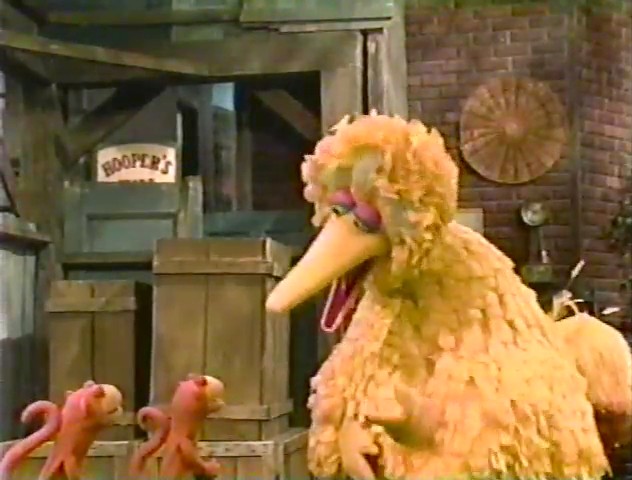
In 1993, a pair of twin monkeys appeared on Sesame Street, and they had a message for us.  Sponsorships by letters and numbers would be a thing of the past.  Instead, episodes would now be brought to us by bananas.

Our unbiased spokesmen.

Named after their relatively new performers, Joey and Davey only cared about bananas, and they usurped the show for a day to make sure only banana-related programming reached the viewers.

Full Version (but really, it's just more of the same)

Their obsession grew to be so great that they managed to steer any conversation to their favorite fruits.  It seems as if the whole reason they even came to the neighborhood was because they assumed Big Bird was of banana-descent.

Add them to the alarmingly growing list of Muppets who want to eat Big Bird.

Why Are They the Most Important Muppets?

Joey and Davey are virtually interchangeable.  At first glance, it seems unnecessary to have two of the exact same character.  They often speak in unison and have absolutely no defining characteristics to set them apart.  That's what makes them tolerable.

It's fun to see them hanging around.

Each one builds upon the other's excitement, forming their own little club that one can't help but want to be a part of.  Much of this steps from their delivery of the word "bananas."  Rather than shout it obnoxiously, the two place an unnatural emphasis on the first syllable rather than the second, turning a single word into their own catchphrase.  Coupled with the brief pause before the word, it seems as if bananas are a lot grander than we had originally intended them to be.

All hail the banana!

They were perfect additions to the supporting cast because, when used sparingly, they could add a great punchline to any scene.  They bring to mind the simple pleasure of making a puppet out of a sock and just popping it out at random moments to say a quick, funny word.  This is comedy distilled to it's basic form.

Unfortunately, characters on Sesame Street only stick around if they are able to grow in complexity.  After 3 years, no one wanted to here them lyrically pronounce "BANANAS" any more.  It's a shame because life could always stand to be a little bit more bananas.

Altogether now...

Random Muppet #32: Tula the Hoob

On the Muppet Wiki, there is a "Random Muppet" button which sends you to the page of one of the thousands of Muppets in existence. I will press the button and discuss the importance of the Muppet that comes up, no matter how obscure. No skips. No redos. This is the Random Muppet Challenge.

Random Muppet #32: Tula the Hoob

An inquisitive, British alien.

Performer:  Julie Westwood

Muppet Universe of Origin:  The Hoobs

Most Significant Appearance:  The Hoobs, 2001, "Smells"

The Hoobs are alien creatures that travel around the Earth in their Hoobmobile, learning about "peeps" and their offspring, the "tiddlypeeps."  All data is gathered into the Hoobepedia.  The show promotes scientific discovery, so whenever a Hoob asks a question, the Motorettes that operate the Hoobmobile sing their question (The Five W's and How) to keep the vehicle moving.  Like the Smurfs, the Hoob language employs many variations of the word "Hoob" in place of verbs, adjectives, and adverbs.  If you are not careful, you can find this show highly annoying.

But they're so adorably British that you can easily forgive them.

In "Smells," Tula laments that she doesn't smell nice enough for an up coming tiddlypeep party.  She isn't sure what smells that tiddlypeeps enjoy, but she knows that it must be something better than her boring old Hoob odor.


The Hoobs decide that cheese has such a strong fragrance that it would make an excellent perfume.  But the Earth children teach Tula the error of her ways and introduce her to proper, pleasant smells.


Why Is She the Most Important Muppet?

The Hoobs has one big issue.  It's too derivative compared to other Henson children's shows.  Sesame Street was groundbreaking in that it made the pre-school curriculum a part of its world.  It manages to combine real-life with basic concepts in a way that didn't talk down to its audience.  Fraggle Rock focused on society, interpersonal relationships and self-worth.  And Bear in the Big Blue House brought exactly what pre-pre-schoolers needed with characters that babies/toddlers could identify with, being nurtured by the parental Bear.

The Hoobs just feels like any other kids show.  It's not terrible, by any means.  But nothing sets it apart from other shows.  It's a hodge-podge of elements we have seen before.

A supernatural educational vehicle?  Seen it.

The only thing that can save the show are the characters.  The three leads are the dim-witted Groove, campy Iver, and Tula the girl.  I'm ashamed to admit it, but Tula is the least developed member of the show.  In the many, many clips available to view, only "Smells" features her as a main role in the story.  And what we learn is that she is concerned with the way she smells.  (Another clip features her concern over her hair.)

Now, she is very intelligent and polite, so she has redeeming qualities.  But what makes her tick?  At least characters like Zoe and Abby Cadabby, who are attacked for being "too girly," have depth and personality quirks.  Even her bland travel mates manage to overshadow her.  In one episode, Groove is upset about something and the mystery of the day is about what's making him so depressed.  That's intriguing!   Tula's issues over perfume and hair care are just disconcerting.

So, why is Tula the most important Muppet?  Well, it's like the interesting number paradox.  If there are  any "non-interesting numbers," then one would have to be the lowest-valued non-interesting number.  And that would make that number interesting, disqualifying it from the non-interesting number list.

Tula is the lowest-valued non-interesting Muppet.  And that's what makes her so important.

Tuesday, February 26, 2013

Random Muppet #31: Clarice Lemons

On the Muppet Wiki, there is a "Random Muppet" button which sends you to the page of one of the thousands of Muppets in existence. I will press the button and discuss the importance of the Muppet that comes up, no matter how obscure. No skips. No redos. This is the Random Muppet Challenge.

Random Muppet #31: Clarice Lemons

A trusty companion.

Performer:  Unknown

Muppet Universe of Origin:  Sesame Street

Most Significant Appearance:  Sesame Street, May 3, 1988, "Episode 2477"

Sesame Street parodied the Boss's "Born to Run," with the similarly named "Born to Add."


This song was also the hit single for the Born to Add album, whose cover mocked the famous pose in which Springsteen leaned on the legendary Clarence Clemons, his saxophone player.


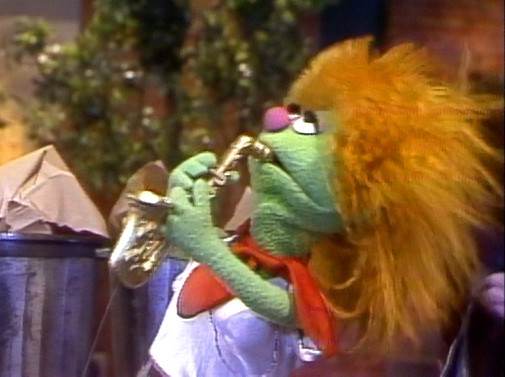
But, as we can see, Bert and Cookie don't appear in the video.  Instead, we get Bruce Stringbean and Clarice Lemons.  Now, the Springsteen parody is pretty spot on, but it seems as if someone made a fact checking error when they went to make a Muppet version of Clemons.

Whoops!

Why Is She the Most Important Muppet?

Eventually, every celebrity will find themselves Muppetized. But some go through a bit of a historical tweaking as they make the transition from human to puppet. Why did Clarence become Clarice?

Well, let's look at the songs.


"Born to Run" takes the perspective of a young adult talking to his girlfriend Wendy, attempting to get out of the horrid life they have found themselves in, living on the streets, moving from place to place.  The aimless spirit of these unprepared individuals is supposed to clash with the notion that America is a magical land that will instantly provide better lives for everyone.  The singer only has Wendy's company to find solace in, because he needs something permanent in his life to hold on to.  Because tramps like them, baby they were born to run.

"Born to Add" is about two kids who like adding, a toddler's greatest fear.

They live on the edge of society.  Mathematical society.

Clarice fulfills the Wendy role of the original. Bruce pleads with her to join him, adding all day long. Apparently, addition is as much of a societal issue as homelessness, because these tramps also have their run-ins with the law.


Addition?!  Not on our street!


Clarice/Clarence are the rocks that the Bruces rely on. Whether during a performance or in the context of the songs, these individuals support each other. Without that connection, the two would be lost, without direction. So yes, Clarence and Wendy had to merge into "Clarice," to become that single pillar of support that you can always...

...COUNT ON!  

Saturday, December 15, 2012

Random Muppet #30: Santa Claus

On the Muppet Wiki, there is a "Random Muppet" button which sends you to the page of one of the thousands of Muppets in existence. I will press the button and discuss the importance of the Muppet that comes up, no matter how obscure. No skips. No redos. This is the Random Muppet Challenge.

(This week is the special Christmas Edition. For Christmas.)

Random Muppet #30: Santa Claus

Must be Santa Claus.

Performer:  Various

Muppet Universe of Origin:  Sesame Street

Most Significant Appearance:  Weihnachten mit Ernie & Bert, December 24, 2008

Santa Claus has appeared in many Muppet-related Christmas specials, but most of those appearances have been in human form.  Occasionally, other established Muppets portray Santa to serve the purposes of the story.  But Santa himself has only appeared as a Muppet a few times.  Outside of a couple Sesame Street News Flashes, Santa Claus (the Muppet) was most prominently featured in 2008's Sesamstraße special Weihnachten mit Ernie & Bert.

Of course there are rubber duckies and paper clips in their tree.

The special is essentially a collection of Sesame Street clips surrounded by a framing story that awkwardly sets up each one.  It'd be fine if they used Christmas related clips but instead they choose traditional holiday topics like "squirrels collecting nuts" or "high-quality fashion."  Anyway, aside from these deviations, the basic story concerns Ernie and Bert preparing their German holiday getaway for the arrival of Santa Claus, as many do on Christmas Eve.

You know, like cleaning the chimney.

Throughout the evening, an old man (dressed in white and red) keeps trying to come inside from the freezing weather, but Ernie keeps turning him away because there is no time for visitors!  So yes, throughout the special, Ernie forbids a slowly dying Santa Claus from entering his house.  Finally, Bert puts an end to this madness and lets Santa inside.

You have made a powerful friend this year, Bert.  Ernie, a powerful enemy.

Ernie revitalizes Santa with a "Christmas nut" (see, now the squirrel segment makes sense) and Santa delivers their gifts: paper clips for Ernie and a rubber ducky for Bert!

...Yeah, they broke Santa Claus.

Why Is He the Most Important Muppet?  What Is the True Meaning of Christmas?

Santa Claus, as you may well know, is an amalgamation of several figures from various European histories and mythologies.  Despite qualms that Santa is a secular figure, his namesake, the gift-giving St. Nicholas, was a very devout Christian.  Combined with pagan traditions and lore, as well as popular works from modern authors (and Coca-Cola campaigns), Santa Claus emerged as the immortal, wish-granting, world-travelling demigod that he is today.

Every story has a different interpretation of the character, and this special highlights Santa's more human qualities.  He is an old man who can succumb to extreme temperatures.  He can suffer brain damage.  He is not as powerful as we once thought.

But at the heart of this story is the truth about Santa Claus and every character like him: he needs people  in order to survive.

Although it is Ernie that nearly sends him to an early grave, he is also the one who saves his life.  Santa may have all the best abilities in the world, but without people around to keep him in existence, he will die away.

Santa is the most well known fictional character that we as a species actually feel the need to convince younger generations that he is real.  There are a lot of reasons as for why this is the case (most of them financial), but none of them matter.  The fact that we can collectively decide to perpetuate a character's existence is astonishing.

What would happen if Santa Claus died?  It would have to be a conscious effort on humanity's part at this point to kill off this god among fictional men.  Ernie and Bert came close.  But fortunately, they are fictional too.

And Muppets never die.

Friday, December 14, 2012

Random Muppet #29: The Grinch

On the Muppet Wiki, there is a "Random Muppet" button which sends you to the page of one of the thousands of Muppets in existence. I will press the button and discuss the importance of the Muppet that comes up, no matter how obscure. No skips. No redos. This is the Random Muppet Challenge.

(This week is the special Christmas Edition. For Christmas.)

Random Muppet #29: The Grinch

He's a mean one.

Performer:  Anthony Asbury

Muppet Universe of Origin:  The Wubbulous World of Dr. Seuss

Most Significant Appearance:  The Wubbulous World of Dr. Seuss, August 17, 1997, "The Grinch Meets His Max"

Unfortunately, as we all know, the Grinch's most significant appearance is in the 1957 Dr. Seuss classic How the Grinch Stole Christmas, or the 1966 animated adaptation of the same name, wherein he attempts to steal Christmas from the Whos in Whoville and, in doing so, learns that Christmas is not a physical object that can simply be stolen.

That was in no way related to Henson, so it must be ignored (save for the backstory it provides the Grinch).  The Grinch in The Wubbulous World of Dr. Seuss seems to be a slightly younger incarnation of the character, before he reformed from his hateful ways.  He still delights in ruining people's fun and is all around a huge bully.  But, as in the original story, there is one character whom he considers his friend, his confidant.  That is his trusty dog Max.

Still a sad sack.

In "The Grinch Meets His Max," we learn of that fateful day in which Max became the Grinch's sole companion.  The Grinch was in severe discomfort.  Not only were his shoes too tight, but he had an itch in the middle of his back that would not go away.  People refused to help the poor soul because he caused them so much strife.  But newcomer Max inadvertently helped the suffering soul and became life-bound to him, whether he liked it or not.

And the rest is history.

Why Is He the Most Important Muppet?  What Is the True Meaning of Christmas?

Just because it is Christmas doesn't mean the world stops.  Awful, tragic events can still occur and they don't take a break because it is the holiday season.  In Whoville/Seussville, all of these negative occurrences are embodied in the Grinch.  He is a force of mayhem and havoc.

As seen in his original story (and in a very similar episode "The Cat in the Hat's Flower Power") when the Grinch attempts to thwart his neighbors, and remove everything they love about the holiday, they still find reason to band together and sing merry tunes.

Ain't nothin' gonna break our stride.

The Grinch learns from this display that try all he might, he cannot completely tarnish the human spirit. We have a way of bouncing back and getting through the toughest of situations.

Since he is now a physical character, he can learn, grow, and more importantly, love.  Max is his last lingering connection with humanity before his small heart grows three times sizes.  It is evidence that he is capable of reform.  And what better time to change for the better than at Christmas, the yearly reminder that we need to keep things positive and not let the bad in the world keep us down.

Thursday, December 13, 2012

Random Muppet #28: Lo-Co

On the Muppet Wiki, there is a "Random Muppet" button which sends you to the page of one of the thousands of Muppets in existence. I will press the button and discuss the importance of the Muppet that comes up, no matter how obscure. No skips. No redos. This is the Random Muppet Challenge.

(This week is the special Christmas Edition. For Christmas.)

Random Muppet #28: Lo-Co

Wait, which one is the Muppet?

Performer:  Bill Barretta

Muppet Universe of Origin:  General "Muppets"

Most Significant Appearance:  "All I Need is Love" music video, November 26, 2012

Cee Lo Green is about the closest thing we have to a human Muppet these days.  His style, his fashion, and his personality are so cartoonish that you can't help but enjoy his presence.  Ever since his Elton-John-Muppet-Show-inspired performance of "The Song Alternatively Known as 'Forget You'" at the 2011 Grammys, it became clear that the man needed to collaborate with Kermit and the gang at some point.


And that point came this very year, when Cee Lo ended up at the Muppets' Christmas party and introduced his new holiday song, "All I Need Is Love."

Complete with a sample from "Mahna Mahna."

Halfway through the music video, a new Muppet named Lo-Co is introduced.  He bears a striking resemblance to Cee Lo, and even performs in his stead at some live appearances of the song.  He is a curious figure, indeed.


Why Is He the Most Important Muppet?  What Is the True Meaning of Christmas?

As Santa (played by Craig Robinson) joins the party, we see that Christmas isn't the same for everybody.  Despite the fact that he looks and acts like Craig Robinson, he is treated like Santa Claus all the same.  There is no debate about it.  He is Santa Claus.

There goes that "tech-savvy Muppet" with his iPhone again.

This is a perfect addition to the song.  It has nothing to do with love in the romantic sense, but it is totally about acceptance.  What Cee Lo wants most for Christmas is to feel loved for who he is.

The man with the Muppet 'fro.

Everyone wants to know their place in this world.  We are attracted to like-minded individuals in order to make our lives bearable.  Some people take time to develop their personas, and struggle to find where exactly they fit in.

A Henson Company tradition is to provide special people with Muppet caricatures of themselves.  These are highly prized puppets that signify that a person is accepted by the Muppets.  It is their way of saying, "You are one of us," literally.

Cee Lo earned his wings this year.  He received the greatest gift a Muppet could receive.

Sesame Street Parody Muppets, notwithstanding.

Wednesday, December 12, 2012

Random Muppet #27: The Reindeer

On the Muppet Wiki, there is a "Random Muppet" button which sends you to the page of one of the thousands of Muppets in existence. I will press the button and discuss the importance of the Muppet that comes up, no matter how obscure. No skips. No redos. This is the Random Muppet Challenge.

(This week is the special Christmas Edition. For Christmas.)

Random Muppet #27: The Reindeer

But do you recall the least famous reindeer of all?

Performers:  Jim Henson, Frank Oz, Jerry Juhl, Bob Payne

Muppet Universe of Origin:  General "Muppets"

Most Significant Appearance:  Perry Como's Kraft Music Hall, December 20, 1965

Henson and his young crew had an appearance coming up for the Perry Como Christmas special, making this Henson's first foray into Christmas-related hijinks.  Jerry Juhl came up with a skit that involved a group of five reindeer, Dasher/Charlie, Dancer, Prancer, Donner, and Blitzen.  But what would five reindeer do without Santa or Rudolph there to give them material to work with?  Why, they would attempt to make snow fall with a "snow dance."

Socks + Twigs = Reindeer Puppets

Dasher/Charlie was the leader of the group and he command his platoon like a drill sergant, insulting them with antler-related puns (while the rest sang songs and had a lot of snow wordplay).  By the end of the tomfoolery, the reindeer succeeded in bringing about... rain.

Get it?!

Oh, but don't worry.  They continued to dance harder and eventually a large pile of snow came crashing to the stage, burying them.

Dasher (1823-1965).  He is survived by that one reindeer who could fly better than Rudolph.

Why Are They the Most Important Muppets?  What Is the True Meaning of Christmas?

Everybody dreams of a perfect, white Christmas.  But few are willing to put in the effort necessary to achieve this endeavor.  Many see the reindeer as Santa's transportation, but as we see, they are also in charge of bringing about the snowfall.  And, judging by previous years, their efforts don't always work.

Christmas is associated with high expectations that often come crashing down when they aren't met.  Food, family, gifts, decorations.  It's a lot of work.  But it's all worth it to see the smiles on the faces come Christmas morn.

Every year, the reindeer sacrifice themselves to bring about our happiness.  If they succeed, they are killed, knowing they have done their duty.  If they fail, they must live with the shame.

Three years later, on The Ed Sullivan Show, another group of reindeer attempt the same feat.  They too "succeed."

Christmas is dark, people.

Tuesday, December 11, 2012

Random Muppet #26: Original Grover

On the Muppet Wiki, there is a "Random Muppet" button which sends you to the page of one of the thousands of Muppets in existence. I will press the button and discuss the importance of the Muppet that comes up, no matter how obscure. No skips. No redos. This is the Random Muppet Challenge.

(This week is the special Christmas Edition. For Christmas.)

Random Muppet #26: Original Grover

Grover, a.k.a. Gleep, a.k.a. Fuzzyface, a.k.a Grover's Mommy?

Performer:  Frank Oz

Muppet Universe of Origin:  General "Muppets"

Most Significant Appearance:  The Ed Sullivan Show, December 24, 1967

Grover, as we know him today, had to go through an awkward green phase to become the character we know and love.  It's hard to determine whether or not this character is actually Grover, since he was never referred to by that name.  He appeared as a general Muppet monster in early variety show sketches as well as in the first season of Sesame Street.  While on the show, he appeared in a couple sketches that were definitely "Grover-ish" in tone.  In one, he helped Kermit the Frog demonstrate "in" and "out," all while the frog insulted his intelligence, and referred to him as "Fuzzyface."

Old Kermit was a jerk.

In another sketch, he taught us about "first" and "last" as he gets trampled by a multitude of other Muppet monsters.  In neither appearance does he actually sound Grover (his voice is more like that of a teenaged Cookie Monster), but his constant suffering paved the way for the puppet who eventually became Grover.  In fact, in the second season, when traditional blue Grover made his introduction, the old Grover was used to play Grover's mommy.

Freud would have a field day.

But, his introductory appearance is his most important.  Because it has to do with Christmas.


Old Grover, then known as Gleep, appeared with a few other Muppets, crashing Santa's workshop at the North Pole.  They demanded that Santa (Arthur Godfrey) hand over all of his toys but, in a shocking twist, the toys were actually intended to be the monsters' Christmas gifts anyway.

Don't we feel sheepish?

Why Is He the Most Important Muppet?  What Is the True Meaning of Christmas?

Original Grover learned a valuable lesson that day.  Society had placed him and his peers into a category of criminals.  Because of their prejudiced labeling, the monsters took a path in life that became a self-fulfilling prophecy.  If they were going to be called monsters, then they were going to act like monsters.

But Santa knows all and sees all.  He knows that at the heart of these monsters lie scared children who are just trying to figure out their place in the world.  And so, he created toys for them.  They had turned into the very monsters they feared, but fortunately, Santa was kind enough to let them keep their gifts.

Everyone deserves to have a happy Christmas.  Even the monsters.  Because at Christmas, we should celebrate our virtues and personalities without fear of judgment.

Original Grover learned a lesson in humility.  And that is where Grover we know and love was born.

Tuesday, November 13, 2012

Random Muppet #25: Stu!

On the Muppet Wiki, there is a "Random Muppet" button which sends you to the page of one of the thousands of Muppets in existence. I will press the button and discuss the importance of the Muppet that comes up, no matter how obscure. No skips. No redos. This is the Random Muppet Challenge.

Random Muppet #25: Stu

An excitable Frogketeer.

Performer:  Dave Golez

Muppet Universe of Origin:  Muppets Tonight

Most Significant Appearance:  Muppets Tonight, April 5, 1996, "Episode 105: Cindy Crawford"

Yet another recurring element in Muppets Tonight was the "reveal" that the night's current guest had previously appeared with the Muppets in older works of entertainment.  Basically, it was an excuse to parody the shows of yesteryear and put the Muppets in funny costumes.  None of it could actually pass itself off as Muppet canon, of course (which makes it all a lost opportunity to revisit classic Muppet sketches and motifs).  The humor depended on the familiarity with the reference material.

One of the stronger "Classic Muppet" sketches was "The Kermit the Frog Club," which spoofed The Mickey Mouse Club, one of Disney's earliest attempts to make stars out of teenagers who danced, sang, and had good wholesome fun in their creepy, unrelenting devotion to the Mouse.  While the Club is currently known for its most recent iteration that spawned our Timberlakes and our Aguileras and our Spears...s, it is the 1955 version that serves as the backdrop for today's sketch.

Guest Cindy Crawford (or as she was originally known, "Cinderella Crawfordopolis") was one of the original Frogketeers on "The Kermit the Frog Club," along with a few other will-be stars.

Including Little Newt Gingrich and Little L. Ron Hubbard!

Various elements are parodied, with the "Kermit Frog Theme Song" ("Where's the 'the'?" cries Kermit during the song) and frighteningly ambitious career plans for the young cast.  But it is during the roll call that our little Stu gets to shine.  Stu leads the pack.  And then comes back.  Again.  And again.  And again.

Let Little Robbie Reiner have a chance!

Why Is He the Most Important Muppet?

Stu suffered from extreme short-term memory loss.  Unlike the rest of his Frogketeers, Stu would not go on to bigger and better things.  His affliction prevented him from normal interactions, making the transition into society very difficult for him.

But despite his setback, Stu's confidence and happiness did not falter.  He excitedly interjected his name into any conversation he could.  It was all he knew.  It was all he could do.  And he had fun.

Stu never went away, though.  While the rest of his friends became successful celebrities, Stu remained with the Muppets it seems.  At the very end of the episode, he returns to once again shout his name.  Strangely, he has remained in his youthful state.  It seems that living in this forgetful stasis has kept Stu forever young.  Unfortuantely, he doesn't get to enjoy his newfound fame since Cindy Crawford vaporizes him with her laser-vision.

It makes sense in context, I assure you.

The moral of Stu's life?  Um, be yourself.  And stay away from supermodels.

M! D'Bolo had a much more interesting life.  But that is a tale for another day.