Sunday, May 13, 2012

What's a Muppet? - Part 3: The Jedi Link Between Muppets and Creatures

As I previously established in my review of The Dark Crystal, Jim Henson wanted to break away from his Muppet background and move onto new innovative forms of puppetry.  He wanted to combine technology and realism to create animatronic lifeforms that could do things no puppet had ever done before.  Eventually, the London-based crew assigned to this project became known as the Jim Henson Creature Shop and it served as a kind of antithesis of the Muppet Workshop in America.  The Dark Crystal, Labyrinth, and The Storyteller were the first few major productions associated with the new types of Henson puppets, known as "Creatures."

Henson, surrounded by a variety of Creatures.

The distinction between Muppets and Creatures, as Henson saw it, was that Muppets were supposed to be exaggerated and cartoony, whereas Creatures could be mistaken for real-life creatures.  Even those that were meant to look like monsters or other supernatural beings could pass for something found in an intergalactic zoo.  Some lovely person made up this handy-dandy guide to differentiate between the two styles and it can be seen over at the Muppet Wiki.

A Muppet Frog, a Creature Lion, a Muppet Monster, and a Creature Monster

Officially, every Henson production would be classified as "Muppet" or "Creature" based on this a appearance.  This means that the characters on Sesame Street and Fraggle Rock are officially Muppets. This didn't mean that each workshop was limited to one visual style.  Sometimes the Muppet Workshop could create realistic puppets and the Creature Shop could create non-realistic puppets.  But the general rule of thumb is, if it looks real, it's a Creature.

The Creature Shop was so devoted to realistic animatronics that they became the go-to company for the film world's special effects needs.  Starting with the Wonderland characters for the movie Dreamchild in 1985, the Creature Shop continues to supply animals and creatures for many movies to this day.  You may be surprised that Henson and his staff are behind some of your favorite childhood movies.  Babe, Harry Potter and the Sorcerer's Stone, even Batman Begins have the Henson stamp of approval.  And where would we be with out the original live-action Teenage Mutant Ninja Turtles.

One of the 3 best photographs ever taken.

And, due to Maurice Sendak's recent passing, I'd be remiss not to mention the marvelous Creatures that Henson's Creature Shop created for the 2009 adaptation of Where the Wild Things Are.

Seriously, these may be the most impressive Creatures the company ever produced.

But there is one character that predates all of the Henson Creatures.  This one can be viewed as the granddaddy of them all.  I mean, he was born a long time ago in a galaxy far, far away.

"A puppet, I am."

First, before you start nitpicking, let me make this clear:  Yoda is NOT a Muppet.  He is NOT a Creature.  He is NOT even a Henson creation.  But, he is, for lack of a better term, the missing link between Henson's puppets before the '80s and after the '80s.

You may know that George Lucas co-produced 1986's Labyrinth with Henson, but their relationship started long before that.  See, during the late '70s, both were working in London on their own projects.  As Lucas wrapped up Star Wars in 1977, Henson was just beginning production on The Dark Crystal. Both men admired each other's craft and would often use each other's staff for ideas and help.

They would also simultaneously leer at anyone who insulted their attire.

For the sequel, The Empire Strikes Back, Lucas knew he wanted Henson to play the character that would eventually be known as "Yoda."  Henson, however was too wrapped up in The Dark Crystal and other productions to devote his full time to Yoda, so he suggested Frank Oz to play the part.  Along with an additional puppeteer Kathryn Mullen (Mokey Fraggle), the two would perform Yoda and turn him into the iconic character he is today.  Jim was still on board for consultations and design, however, so Yoda still has that authentic Henson touch.

Makin' magic.

The ultra-realistic Yoda was the first Henson sanctioned puppet that broke away from his traditional Muppet style and it was a good precursor of the puppets that were to follow.  Yoda premiered to audiences two years before the first Creature Shop production The Dark Crystal so he really had to connect with audiences to convince the world that they were ready for realistic puppets.  Yoda could have easily fallen into the territory of "goofy" and "fake" in the hands of a lesser man.

Behind the scenes on the Empire set, Frank Oz made sure to keep Henson's presence alive.  Mark Hamill (Luke Skywalker) was a huge Muppet fan and he often tried to imitate Miss Piggy's voice on the set.  Eventually, Piggy had to show up to the Dagobah System and put Luke in his place.

This actually happened!  Somewhere there is footage of the Muppets in a Star Wars movie!

As if to pass the torch, Kermit and Piggy were on hand to witness a new era of puppets.   Yoda won the hearts of audiences, both adults and children alike.  And it was clear that realistic puppets were the wave of the future.  And the rest, as they say is history.

Worlds had been colliding.

Tomorrow, the concept of a "Muppet" gets blurrier as Henson strikes a deal with a powerful corporate entity.

Saturday, May 12, 2012

What's a Muppet? - Part 2: Not Quite a Mop, Not Quite a Puppet

By 1968, Henson had already established the Muppet brand through his various variety show appearances. It now came time to show the world a little bit of what goes on behind the scenes with the Muppet folks.  Henson and his crew created an hour-long special called The Muppets on Puppets for a public broadcasting channel.  This special explored the history of puppetry, provided some examples of puppet types, showed how to make your own puppets, and explained what sets the Muppets apart from the rest.

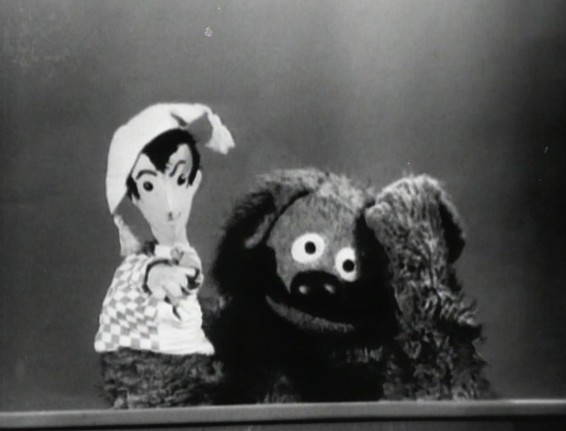
Rowlf struggles to control a simple puppet.

Right from the beginning, we see Rowlf interacting with the audience with his own puppet.  As is the case with the Muppets, it's easy to lose yourself in the fantasy.  You forget that Rowlf is a puppet, and that is exactly Henson's intention.  By emphasizing how lifeless Rowlf's puppet is, the audience begins to assume that "puppets" are just a primitive parlor trick.


Eventually, after showing off the different styles of puppets (hand, string and rod), Henson explains to Rowlf that he too is a puppet, which he doesn't take too well.  But even while this explicit line is drawn between reality and fiction, Rowlf is still alive.  When he exits the stage, we assume he is still going about his day, living his life.

This stands in contrast to the Punch and Judy puppets, whose voices and personalities are so exaggerated that you can "see" right through to the puppeteer beneath.  There is no interconnection between the two.  Anyone can put on a Punch puppet and do the Punch routine.  It is a pale imitation of life.  (Not to say that this portion is not informative.  I like how the crocodile puppet is used to explain the tendency for carnivorous Muppets, and the origin of the term "slapstick" is enlightening.)

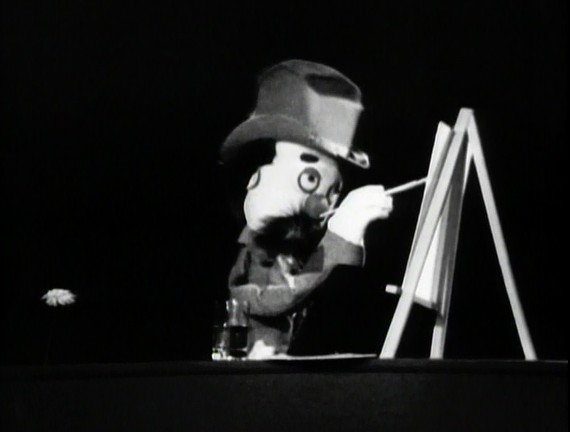
Henson then introduces Frank Oz and has him perform his signature piece "The Sunday Painter."  Unlike the previous examples, this one feels more like a Muppet piece.  It's not completely there, as it lacks humor.  But the puppet's movements have that natural flow that doesn't feel hindered by strings and rods.

The face is a puppet, but the hand is all Muppet.


Afterwards, Rowlf having come to terms with his puppet nature introduces us to the other Muppets.  These include a turtlenecked Kermit (whose flimsy arm rods may not be anything special, but his jaws are powerful), Wontkins, the witch Taminella Grinderfall, King Goshposh (here named Louie), some monsters, and Splurge.  A few of these would become the main cast of Muppet fairy tale specials such as Hey, Cinderella! and The Frog Prince, but, as we all know, only Rowlf and Kermit remain core Muppets to this day.

Speaking of fairy tales, Henson found that his Muppets were often best suited for providing their own spins on these classic stories.  Predating elements from Tales from Muppetland, Sesame Street's News Flashes, and The Storyteller, the Muppets come together to show why they are unique as they present a fractured version of "Cinderella."


As you can see, all the humor we've come to expect from the group is there.  In a rare turn of events, Henson then shows us what the skit looked like from the back.  It's always disconcerting seeing our beloved Muppets out of action, and having Rowlf hung upside down on his hook is particularly jarring after his performance mere seconds ago.  Still, this is a great look into the Henson process, one that has stayed the same in the company for years.

Finally, we get to see how Muppets are actually made.  Don Sahlin, Muppet designer, walks us through a new character, from Henson sketch to foam to fabric.  For anyone who has tried making their own puppets, this is a must-watch.  The Muppet style is so simple in concept, yet Sahlin has perfected it so that amateurs who attempt the signature appearance of a Henson puppet will find that theirs fails by comparison.  He points out how Henson specifically created a style of craft which he calls "the Henson Stitch" because he had never see it done before.


One aspect that was not mentioned in this piece was the importance of the Muppet's eyes.  To me, this is what makes or breaks a "Muppet."  If you look at almost all of a Henson character's eyes, you'll notice there is something similar about them that you can't quite put your finger on.

They are white with black pupils?

If you haven't spotted it yet, try looking at this random assortment of "plain" "Muppet eyes."

Is it the colored eyelids?

Despite the simple appearance of these basic cartoon eyes, there is a purposefully crafted decision that changes them from regular to Muppet.  The pupils of Muppet eyes are almost always placed slightly inwards, creating a subtle "cross-eyed" effect.  This creates the illusion of focus and it's the reason why adults and children alike fall into the habit of forgetting there is a puppeteer attached to the Muppet.  We are naturally drawn to a Muppet's face because they look as if they are actually looking at something.  When they look us, we feel as if they are capable of sight.  They look us in the eyes.

The rest of the special is worth watching and I've posted it here.  In the remaining clips, you'll see Henson and company mix-and-match attributes to create a variety of characters out of a Whatnot puppet, find new inventive ways of creating complex puppets, and perform a new fairy tale performed with puppets made from simple arts and crafts.  This latter skit is great because the "Muppet" feeling comes across solely through the voices and dialogue rather than the appearance.


If there is one thing to take away from this special, it's that Muppets are improved puppets.  Henson took all of the knowledge he learned about puppetry, borrowed the best elements, and invented new construction methods in order to develop characters that move beyond basic puppetry.  These characters are plush toys come to life.  This style, created back in the '60s, has continued through Sesame Street, The Muppet Show, and Fraggle Rock with each show's cast comprised of cartoonishly abstract characters that were unquestionably Muppets.

However, not every Jim Henson puppet can be considered a Muppet.  Where is that line drawn?  Find out tomorrow when we look at the "Creatures."

Friday, May 11, 2012

What's a Muppet? - Part 1: A Frog is Born

Quick!  Who was the first Muppet ever created?

Chances are your mind went to Kermit the Frog, and that would be a pretty good guess.  He's certainly had the largest legacy out of any of the Muppets, and he was in the original line-up of 1955's Sam and Friends, Henson's first television gig.

No, not Sam the Eagle.  He has no friends.

Okay, you might be thinking, if the show was called "Sam and Friends" then Sam must have been the first Muppet. Again, that's a good idea. While Sam was the "lead" of the program, all of the Sam and Friends puppets were created around the same time and it's hard to definitively prove which came first (although we like to believe it was Kermit).

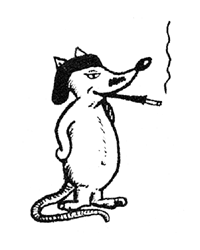
The first Muppet (as far as we can tell) was actually based on a high school cartoon that Henson drew for his school paper known as "Pierre the French Rat."

Oui, oui!

Looking at the earliest work of an artist is a very strange experience. While they probably hoped to present their work to a mass audience at some point, their craft has yet to find what would later become their signature voice. The doodles of a teenager are hardly going to be high-brow art. So, to read the adventures of Pierre the French Rat, one has to remind oneself that Henson as we know him did not exist yet.

This could have been the work of any kid in the '50s, really.  Especially Art Spiegelman.

Henson's dreams were to be a television star and by using puppetry, he was going to establish a niche that he could govern. His first chance at a television spot was on a program known as The Junior Morning Show. It was 1954, a year before the Muppets became fully realized. 18-year-old Jim made up up some puppets and of course he turned to his first creation, Pierre.

  
The shift to the 3rd-dimension caused Pierre to adopt what is referred to in medical communities as "Truman Capotism."

Unfortunately, despite filming a few skits, Pierre never made it to air due to Henson's crew being composed of underage teenagers which prohibited child-labor laws when it came to payment.  This was just a temporary setback for Henson.  He began college at the University of Maryland and started to hone his puppetry skills, majoring in Home Economics so as to take advantage of the costume-making and sewing courses.  Eventually, Pierre and a host of new friends appeared on Sam and Friends.  And it is here that Henson found out what his audience wanted.

The main cast: Harry the Hipster, Sam, Yorick and Kermit.

Each spot was no longer than 10-minutes and usually comprised of the puppets lip-synching to music or other recorded audio. Very little footage remains from this show and all we know for certain is that Kermit is the only puppet to emerge as a star. This is strange because at one point, a poll was taken in which viewers could vote on their favorite character and Kermit came in fourth, after Yorick, Sam, and the mysterious Mushmellon.

Jim and his eventual wife Jane controlling the four most popular puppets.

Yorick's popularity is easy to understand, for he was the first Muppet that ate everything in sight.  The appeal of Sam and Mushmellon is an enigma however, because no footage of either exists, save for one clip in which Sam lip-syncs to "Old Black Magic."

He looks pretty suave. These popularity contests are all about looks.

If one were to ascribe the success of Kermit to one thing, it would have to be the puppet's physical structure.  Just take a look at the surviving cast members and you'll see why Kermit prevailed.

That's Pierre in the back, going through his Albert Einstein phase.

This is just a posed display, yet Kermit seems to be the only one with any life in him. Everyone else either has a wooden head or a blank, fixed expression. A couple, like the Saturn Sandworm down in the corner named Icky Gunk, have a distinct flavor but they aren't going to be your lead characters. The man in the tiny hat is known as Chicken Liver, and while he is soft and plushy, his character was like a proto-Sam-the-Eagle, so no one liked him (except for Jane Henson, who kept the puppet as a toy for her children and it got nearly-destroyed before the Smithsonian swooped in and saved him).

Kermit, Chicken Liver and others play cowboys.

But Kermit, he could do anything. He could change his facial expressions, posture, and character to suit any need. This is how he became the everyman and was able to stand out while everyone else was reduced to lip-syncing.

  Fun With Real Audio!

Kermit was able to evolve as the show stayed stuck. Henson could see that despite the exposure he gained by the whole show, he wasn't going to go very far with his earliest characters.

But they did earn him a sweet set of wheels.

So, it made sense that for the final Sam and Friends show, Kermit was the only one remaining calm about the imminent demise of the program.

 I can't tell who the other character talking is, but it had might as well be "all of them."

After five years, he was the only one who changed and he was mature enough to take Henson and his team to new heights. Kermit is the father of all Muppets. Henson has stated that the term "Muppet" has no origin. It was just a unique word to make his puppets stand out. But, as we all know, there is a distinction between Muppets and the rest of the puppet world. They have that vitality and spirit that emanates from their bodies even when there is no puppeteer around to control them.  So yes, the "M" in the word "Muppet" does stand for something.  Magic.

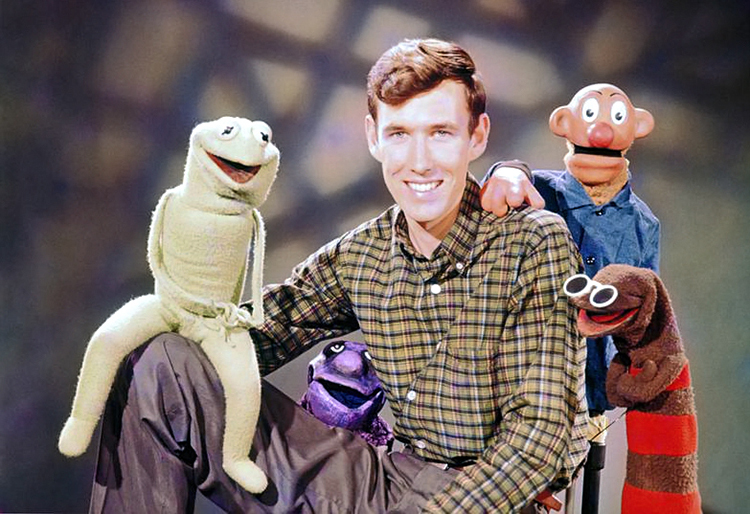
Young Jim Henson, moments before changing the world forever.

Saturday, May 5, 2012

¿Cómo se Dice "Sesame Street" en Español?

Before Dora the Explorer amassed a following of toddlers shouting Spanish words at their television screens, Sesame Street introduced it's own monster who would capitalize on the fact that Spanish is the second most spoken language in the U.S.  The show had already proved itself to be a worth advocate for multiculturalism, as the human characters came from a diverse ethnic background.  Luis and Maria were Mexican and Puerto-Rican respectively, and they would occasionally teach Big Bird and the others about their language and cultures.  But children needed a puppet character to call their own.  And so, Rosita, la Monstrua de las Cuevas, flew on to the scene. Literally.

 Tonight, we dahnce!

Introduced in 1991, Rosita was the first bilingual and winged monster. Supposedly, she was based off of a fruit bat, hence her wings and cave habitat. But eventually, she lost her wings (probably because they made for a very cumbersome puppet) and she became just like the other monsters.

This alteration was not as controversial as Snuffy's nasal reduction surgery.

While she lost her defining physical characteristic, she retained her exuberance for life. Like Elmo, Rosita was easily excitable and in her passion, she would often alternate between Spanish and English. Although she just started as a regular street character, she began to get her own sketches and songs where she explicitly taught the audience about her native Mexico and how to speak Spanish.


Her "Spanish Word of the Day" segments became a regular feature, but this did not deny her from having her own storylines and personality.  While all of the main puppets on the street came in a variety of colors, they all shared a culture, making it easy to put Rosita in the "different" category.  But Rosita's language did not define her and no one treated her any differently.  People she met were eager to learn her language and teach her English as well so that everyone could better understand each other.

This wasn't Sesame Street's first attempt at connecting with a Latin American audience.  Back in the early '70s, when the series was still brand new, the producers decided it would be best to bring the goodness of the Street to a wider audience, strengthening North and Central American relations in the process.

In 1972, Plaza Sésamo first aired.  Like most international versions of Sesame Street, the show was just a repackaged version of the original with a new language dubbed over the English dialogue and new street scenes containing a different human and puppet cast.  During these early years, the show was just Sesame Street with a coat of Spanish paint.  There were practically no allusions to the fact that this show was set in Mexico.  It wasn't until later reboots that Mexican culture was made a part of the setting and character histories.

The international Sesame Streets tend to only have a few unique puppets to add to the cast.  The two that Plaza Sésamo began with were a green parrot named Paco and a large orange crocodile named Abelardo, who served as the resident Oscar and Big Bird substitutes.

Also, everyone lived in a series of tubes.

After the first reboot in the '80s, the two characters seemed to have been combined into the new Abelardo, who looked more like Big Bird and was officially classified as Big Bird's cousin.  This Abelardo started off as dopey and gullible, as the new grouch in town Bodoque would constantly pull pranks on him.  After the second reboot in the '90s, Abelardo became more like the Big Bird we know today and he was joined by some kinder puppet friends.

 
Abelardo, Lola, Pancho Contreras and some visitors from the American cast.

In 1997, during a special Cinco de Mayo episode of Sesame Street, Abelardo was invited to the show in order to meet Big Bird face-to-face for the first time on American television.


As the language barrier proved difficult for Abelardo to get around Sesame Street, Spanish speaking children at home could relate to the situation.  Being placed in environments where everyone expects you to speak a non-native language is hard on anyone, let alone a child Abelardo's age.  Fortunately, after dealing with the setbacks of grouches and near-misses, Abelardo and Big Bird are able to reunite and share in experiences that do not require language to enjoy.

Together, like dos aves del mismo plumaje!

Sesame Street is known for it's universal appeal and it's devotion to the Latin American youth is just another attribute that helps give it credence. It's one thing to simply teach a language. It's another to focus on the confusion and loneliness that can be felt by a young child for whom English is a second language. Language is not just comprehension. It's interaction. It's connection. It's comunicación.

Thursday, May 3, 2012

Betty Lou Who?

Despite Sesame Street's devotion to equality, the male-female ratio of the puppets (like in most Muppet works) was heavily skewed towards the former.  Partially this was because the male puppeteers had more residency, and many female characters had to be played by men anyway.  But it took Sesame Street twenty years to address their serious feminine deficiency.  Prior to 1990, there were only two major female recurring characters.

And they were virtually identical.

Women:  Always picking apples off trees.

Prairie Dawn and Betty Lou were the girls and for a long time, they lacked individual characteristics.  Visually, their only clue was the hair.  Prairie's was fine and realistic while Betty Lou's was clearly yarn.  It was as if no effort went into the Betty Lou puppet.

Let's just grab one of Kermit's old Sam and Friends wigs.

Personality-wise, there were clearer differences.  In keeping with her appearance, Betty Lou had an affinity for "girly" things like dolls and tea parties and public transportation.

Woo!  The subway is awesome!

Prairie Dawn, however, was more mature and creative.  She was put in charge of the Sesame Street Pageants where her abilities as a leader shone brightly.  She was Lisa Simpson before Lisa Simpson was even thought of.  She was the girl to look up to.  Betty Lou just got stuck with being a stock character for sketches and songs where they just needed a "normal little girl" to appear, like the controversial "I Want a Monster to Be My Friend," which sounds like a creepy ode to stranger danger when taken out-of-context.


She didn't have a consistent voice performer until late in the series.  It was as if no one knew what to do with her.  Eventually, they tried to make Betty Lou more like her counterpart to be a better influence.  She promoted healthy habits like exercising...


and befriending people of different ethnicities.


This only strengthened the confusion the audience felt over the two girl characters.  Instead of highlighting their differences, the lesson being taught was that girls shouldn't all be alike, unless they are all like Prairie Dawn.

So put on some overalls and blend in!

Finally, in the '90s, with the surge of new characters, it was decided that the girls needed much needed support.  Characters like Zoe Monster and Rosita Monster joined the fray, each providing vastly different personality types and actually being...characters.  Betty Lou was given more emphasis, but, as you can see in this next clip, she was overshadowed by the dominant personalities of Prairie, Zoe, and Rosita.


Eventually, Prairie won in the "little pink, blond girl puppet" category, becoming one of the most recognizable characters on the show.  And with good reason.  A character can't depend solely on one defining characteristic.  They need a personality and, more importantly, distinction from the other characters.  This is why we never talk about Shermy from Peanuts anymore.  Bland characters void of substance do not make for thrilling entertainment.  While I'm sure there may be some Betty Lou fans out there somewhere, there is no denying that she was just redundant.

Cheer up.  At least you weren't a bizarre robot from space.

Wednesday, May 2, 2012

Sesame Street, But With Robots!

The funny thing about children's programming is that it is rarely made by children.  People who were once children are pretty skilled at tapping into what children enjoy, but unless they interact with them on a daily basis, there can be a large disconnect between the generations.

Sesame Street never seemed to fall into that trap, however.  The creators understood children, but they also didn't pander to them.  They just focused on making an educational show that could be watched with parents.  There was a universal appeal that didn't depend on an age range.  Even after all these years, watching Sesame Street characters recite the alphabet or count to 20 remains as captivating as ever.  But, every so often, there is a misstep.

Between the filming of each season of the show, the Sesame Street staff would brainstorm ideas for new recurring characters.  Other minor puppets may appear in the middle of a season and grow into larger stars, but these cases are rare.  Most recurring characters are planned and developed to be that way.  Today, this practice has decreased, since the cast has grown so large, producing only one new character every few years (the most recent being Abby Cadabby and Murray Monster).  But in the early years, nearly half a dozen characters would be added at a time.  These characters usually experienced very successful runs, and many still appear to this day.  Even if they started appearing on a less regular basis, a character would only be truly retired when their main puppeteer died or left the show.

The exception is S.A.M. the Robot.

How could something with complicated functions and sharp edges not be a huge hit with kids?

Sources differ, but Carroll Spinney, Jerry Nelson, and Jim Henson all claim to have had some input in the construction of this character.  In an obvious attempt to cash in on the science-fiction wave that was captivating the youth of the '70s, it was decided that a robot would be agreat addition to the cast.  But this puppet has going to be large and intricate, and it would constantly malfunction and possess a basic understanding of human functions and interactions.  This was sure to be a hit!

Early Henson sketches.  I'm kind of fond of the little spider-legged one on the first page.

So in 1972, in the first episode of Sesame Street's fourth season, children across America were introduced to this Super Automatic Machine, also known as Sam the Robot.  And, it seems as if they had used every joke they could think to make with this character right in his introductory scene.


In making this character, the creators seemed to have forgotten the appeal of robots to children: they are supposed to be cool.  Sam was not sleak and aero-dynamic.  He wouldn't hold up in a robot war.  He wasn't quiet and mysterious.  He could have been endearing if he weren't so self-righteous and unemotional.  Children want robots that can do things for them and be their friend.  Sam was cumbersome, unsympathetic, and unreliable.  Any basic kitchen appliance would have made a better robotic companion than Sam.

He doesn't even know the name of the street we live on!

Eventually, the writer's decided that they had to add some sort of personality to him, so they tried to teach him some emotions.  The Yip Yip Martians had far better results during their lesson.

Love.  Filthy robotic lust.  What's the difference?

Sam's stay on Sesame Street lasted only a few years, but that was just enough time for him to be immortalized in another hilarious attempt at appealing to children.  This time, in comic books!  Yes, Sam the Robot is the only Sesame Street character to officially pair up with Spider-Man.

I guess we should expect him to make a cameo in The Avengers, right?

As part of a crossover between Marvel Comics and the Children's Television Workshop, in an issue of Spidey Super Stories, the web-slinger teamed up with the cast of The Electric Company and Sam the Robot in a Star Wars parody that reminds me why I never read superhero comic books.  Sam was filling in for R2D2/C-3PO, except he came with a few new abilities.  Like karate-wheel-kicks-of-death!

If he fought more bad guys like this on the show, maybe he would have stuck around longer.

He did manage to inspire a spiritual successor in a late '00s direct-to-DVD Sesame Street adaptation of A Christmas Carol with Sam the Super Automatic Ghost of Christmas Future.

So that's worth something, I suppose.

Alas, Sam the Robot was not meant for this street. As with other needlessly complicated Muppet creations (like The Muppet Show's Vend-A-Face), the writers found themselves struggling to come up with justifiable material for the character. Children's television was just not ready for a malfunctioning, non-threatening, awkward-looking robot. It wouldn't be until a decade later when Conky from Peewee's Playhouse showed us how it was done. Puppeteer Jerry Nelson tried to fight for Sam's presence, saying that his belly screen could be used to show cartoons (again, preceeding the King of Cartoons from Peewee's Playhouse). But, unfortunately, the writer's decided, after three years, it was time to pull the plug.

The staff of Sesame Street created the most memorable characters of our childhood.  This time, however, they made a real clunker.

Note: Sam the Robot died on his way back to his home planet.

Tuesday, May 1, 2012

Struggling to Be Heard

Frazzle is a special monster.  Unlike the rest of his Sesame Street brethren, he is unable to communicate properly.  Others, like Cookie Monster, Elmo, and Grover, may have a poor grasp on grammar, but at least they can be understood by their peers.  Frazzle can only "speak" in growls, screams, and occasionally, simple words.  This isn't common to Frazzle's species, as his parents speak English eloquently.  Developmentally, he is far behind other monsters his age, and this can result in severe frustration.

Don't judge Frazzle by his cover.

There are many children who can identify with Frazzle.  Perhaps they have ongoing speech problems, or maybe they just aren't old enough to speak.  But these young children can recognize many of the issues that Frazzle faces, due to their lack of communicative skills.

Meeting someone new can be difficult for any shy youngster.  Having to strain to repeat yourself over and over can get embarrassing.  Eventually, many people will give up and just nod along to what you say.  There is a level of patience required that few are willing to give.


The difficulty of language can make young children stress out in unfamiliar situations.  Their anxiety level rises as they struggle to comprehend the changes in their daily structure.  A parent must be nurturing and reassuring, and, if possible, serve as an example of proper behavior.  The correct attitude can turn a frightening trip to the dentist into a comfortable experience that the child will be willing to repeat in the future.


It is better if you brief the dentist about your child's situation beforehand, however.

But a parent cannot always be present.  Eventually, the child will be placed in a situation with children his own age.  And, children are not the best at filtering proper responses in social situations.  Frazzle, like any child, yearns to be welcomed by his peers, not ignored and avoided.  This was best illustrated when he encountered a group of individuals who excluded him because he was different.  Frazzle found his strength, and refused to take no for an answer, and eventually the group allowed him to join in.  This may be one of the more important lessons he taught, because it showed young children how to accept all sorts of people.


Frazzle has faced many challenges, due to his disorder.  None of the other puppets featured on Sesame Street have had to deal with what Frazzle has.  Each Muppet can be linked to a type of personality commonly found in children, but only Frazzle represented that bundle of pure emotion that struggles to interact with the world when there are no means to do properly it.


Frazzle may be the best fictional role model for children who are like him.  Many critics lambast children's show characters who speak improperly (like the Teletubbies) because they fear it will teach the audience at home how to speak incorrectly.  But they are forgetting that for all children, communication is hard and it's even harder for those who physically can't learn to speak correctly.  Characters like Frazzle should be revered, not shunned.  It helps when you see someone else can go through the same issues as you and come out okay.

He may not speak English, but we can understand him just fine.