Showing posts with label monsters. Show all posts

Monday, November 12, 2012

Random Muppet #24: Azibo the Monster

On the Muppet Wiki, there is a "Random Muppet" button which sends you to the page of one of the thousands of Muppets in existence. I will press the button and discuss the importance of the Muppet that comes up, no matter how obscure. No skips. No redos. This is the Random Muppet Challenge.

Random Muppet #24: Azibo the Monster

A card-carrying monster.

Performer:  Kevin Clash

Muppet Universe of Origin:  Sesame Street (by way of Panwapa)

Most Significant Appearance:  Panwapa, October 10, 2007, Panwapa.com, "Hello Panwapa Island"

What a diverse bunch!

As a way to create a truly global Sesame Street experience, the Sesame Workshop and the Merrill Lynch Foundation created an interactive online video series known as Panwapa.  Originally Sesame World Wide Kids, Panwapa followed the exploits of a group of recycled Muppets who travel on a floating tropical island to various countries around the globe.  The show promoted cultural diversity and acceptance, proving that we are all humans and have much in common with one another.


Via the website, kids could create their own avatars and personality cards which allowed them to "explore" Panwapa Island and become a part of a larger community.

Learning is fun!

In the introduction episode, Azibo the Monster finds his way onto Panwapa Island.  The native animals are frightened at first, having never met a monster before.  Azibo is ready to call it quits when no one accepts him, but through the help of the wise owl Athena, he proves to the others that he is worth getting to know.

Why Is He the Most Important Muppet?

Society creates monsters.  That isn't to say that evils derive from a group mentality (although this is often the case).  But a society decides and defines what a "monster" is.  The more people who dislike a concept, the more monstrous that concept is.  And sometimes that concept is an individual.

The default reaction we have to the unknown is fear.  If we cannot control it or understand it, we avoid it.  The citizens of Panwapa Island were no different.  Despite being a culturally sensitive vessel, their first impulse is to run away from Azibo the Monster.  The burden is placed on Azibo's shoulders to convince the others that he is not a monster, at least, not in the way others view him.  He has done something to make others upset, and he must fix it.  And while the others learn a lesson about being more accepting, does it make their initial reaction any less valid?


He must be bad or else he wouldn't be a monster.

A scandal has recently rocked the Muppet community and all we can do is wait until we learn more.  Some may be quick to condemn, while others remain optimistic.  And then some are just devastated.  The world as they knew it has changed, and, for the time being, there is a possibility that someone we trust could actually be a monster.

We decide who to love and who to hate.  And when we our previous notions are shattered, we are at a loss for what to do.  Does this make our past a lie?  Have we been wrong this whole time?  Or are we wrong now?  Are we not giving it a fair chance?  There are no easy answers.

Sometimes we don't have all the facts.  We can only trust ourselves.  It is up to us to determine whether or not someone is truly a monster.  And it is up to them to prove us wrong.

Wednesday, October 24, 2012

The Most Dangerous Game

Muppet monsters eat.  That's all they are good for.  It's a simple notion, yet countless Muppet monsters have been created, all for the same purpose.  Consuming and destroying.

Muppets Tonight had to continue the tradition and a new Muppet monster joined the cloth.  And while he eventually appeared in the American episodes, he originated in the recurring U.K. Spot "Swift Wits."  This was a brand new game show, similar to Password or Pyramid, where the host would try to get the contestant to guess a secret word.  If the contestant failed, then a small, cute, innocent animal would be eaten by "Carl the Big Mean Bunny."

My, what big ears you have.

Big Mean Carl was the giant Muppet monster du jour.  What set him apart from the crowd was his various "personas" and his pleasant demeanor.  He wasn't a lumbering beast.  He thought rationally and was pleasant to converse with.  He just happened to eat without remorse.

Did I mention that he ate harmless, tiny mammals?  Victims like poor, little Buffy the puppy.

This is the cutest Muppet ever made.

Yes, each episode a different baby animal would be devoured all because the stupid humans would fail to say the correct word.  Each contestant was so self-absorbed that they would fail to recognize the carnage they would be responsible for.  They were moronic, big-headed, and oblivious.

Well, some of them were just scared.

It eventually got to the point that the host of "Swift Wits" Snookie Blyer would do all in his power to rig the game and keep the animals alive.  Sometimes he would purposely give the contestants the answer.  Other times he would play the game himself.  But no matter how hard he tried, the defenseless animals were always the ones to suffer.

Our noble hero...

But why does this game even exist in the first place?  Couldn't the animals just be put out of harm's way by...not putting them in harm's way?!  The simple solution would be yes, but, as 10,000 years of human development has proven, putting people into a competitive situation will eventually result in bloodshed. The animals are just innocent bystanders who have no say in the destruction and pain we are inflicting upon them.  Even when a few people try to help, there are dozens more standing in their way, causing more harm.

In these brief skits, we get a biting commentary on the human condition and its relationship to the natural world.  We created Big Mean Carl.  Now we have to live with the mess we made.  And so does the rest of the world.

Won't somebody please think of the beavers?!

Saturday, October 6, 2012

Random Muppet #19: Gorgon Heap

On the Muppet Wiki, there is a "Random Muppet" button which sends you to the page of one of the thousands of Muppets in existence. I will press the button and discuss the importance of the Muppet that comes up, no matter how obscure. No skips. No redos. This is the Random Muppet Challenge.

Random Muppet #19: Gorgon Heap

The monster that ate everybody.

Performer:  Frank Oz, Jerry Nelson, Dave Golez, and Richard Hunt at various points

Muppet Universe of Origin:  The Muppet Show

Most Significant Appearance:  The Muppet Show, January 29, 1977, "Episode 119: Vincent Price"

Gluttonous monsters are no strangers to the world of the Muppets.  So, when Vincent Price brings in his two guests for a panel discussion on gourmet eating, it is clear from the start how the event is going to go down.

One of these guys is going to be dinner.

As the world's greatest chef Pierre LaCousse argues with Price about the world's greatest dish, the world's greatest eater Gorgon Heap slowly devours everything insight.  His glass, his silverware, his dish, his fellow guest Pierre, and finally the host, Kermit the Frog.  As Kermit begs for help, Price reminds him that Mr. Heap has an excellent taste in cuisine and prepares to join him.

Why is He the Most Important Muppet?

Gorgon was not a person.  Gorgon was not a monster.  Gorgon was not a "Chaos Muppet".

He was a representation of The Muppet Show's nihilism.

He was also a chorus girl.

Nihilism is not merely the belief that the world is pointless and morality is null and void.  It is the acceptance that the universe exists in this fashion.  Gorgon Heap was not nihilistic. He was merely hungry.  But his role served to support the nihilism of others.

Take his very first starring role in "Sherlock Holmes and the Case of the Disappearing Clues."


As Sherlock Rowlf is called in to investigate a murder, all signs point to the butler Gorgon as the culprit.  He claims his innocence and when Rowlf uncovers piece after piece of damning evidence, Gorgon swallows them up.

Even Miss Piggy, the maid who saw the crime, is quickly disposed of.

Rowlf accepts Gorgon's illegal tampering of the evidence and decides to arrest his partner Watson for the crimes...until Watson disappears.  Then it is decided that no crime ever even existed and everyone can go home.

This forced ignorance to the obstruction of laws and morals follows Gorgon wherever he goes.  His appearance may change, but his rationale remains the same.  And nobody on the show minds.  He eats Pierre?  Okay, that's fine.  Wayne is gulped down?  Doesn't bother us.  Miss Piggy too?  Ehh, she could get annoying at times.  Our beloved host Kermit the Frog?  Well, everyone's gotta go at some point.

Gorgon is the mirror that we must holdup to society.  Our natural ability to turn a blind eye to the atrocities of the world while be our inevitable downfall.  If we aren't safe, all those we care about can disappear in an instant.  It is not the monster we should fear.  It is ourselves.

I mean, with Kermit the Frog gone, who are we going to turn to to lead us...Lenny the Lizard?

It's a never-ending cycle.

Saturday, August 11, 2012

Beware the Yuppies

During the 1980s, a new species emerged.  They could be easily spotted by their V-neck sweaters, their disenfranchised outlook on life, and their affluent wealth.  The baby boomer generation were no longer cute, numerous babies.  They were now thirtysomething.  They had grown into young, urban professionals.  They were the "yuppies."

And they were starting to multiply.

Raised by a generation of hippies, the yuppies sought structure and meaning in their lives.  Many of them found lives as lawyers, brokers, and professors, earning high-paying salaries and unsure of what to do with themselves.  To the non-yuppies, yuppies were self-absorbed and unsatisfied with their lives, despite the fact that they had found themselves in positions that many Americans would consider to be the ultimate dream.  A well-structured family living in a peaceful neighborhood would make almost anyone comfortable.  But the yuppies needed more.

The quintessential depiction of yuppie life in popular culture was the drama thirtysomething, emphasis on drama.  This allowed us a look into these creatures lives, allowing others to experience the problems that they encounter in their daily lives.  I would direct you to a specific episode, but honestly, all you need to understand their lifestyle is the opening theme, which I've dubbed "Suffering in Suburbia."


"MuppeTelevison" was not only an extension of The Muppet Show.  It set out to skewer current television trends.  So of course, they were going to comment on this growing culture, and they did so with the pitch-perfect parody "Hurtingsomething."

Prepare to be tortured.

The premise was simple: take thirtysomething and replace the cast with giant monsters.  In all forms of Muppet media, the monsters are used to represent some aspect of humanity.  In Sesame Street, monsters are children trying to get a handle on the world around them.  In The Muppet Show, monsters are our sins, pushed to the extreme.  In Fraggle Rock, monsters are those who abuse power.  And now, monsters are yuppies.

The monsters Anthony and Fern don't act like previous Muppet monsters.  They don't snarl or destroy or speak in mono-syllabic grunts.  They are intelligent and insightful and they just happen to snack on humans now and then.  In the first sketch, as Anthony and Fern prepare for bed, Fern shrieks when she discovers a tiny human that has crawled into the sink.

Anthony catches the tiny lawyer in a glass and proceeds to jokingly scare Fern with it before releasing it outside.  They then have a long conversation about how Anthony's immaturity trivialized Fern's fears, which only adds to the stress of her daily struggles as an independent woman.

It's time for our nightly in-depth conversation about our feelings.

In a later sketch, Anthony reveals that his therapist as instructed him to stop bottling up his feelings in "mason jars" and storing them away.  Fern provokes him into getting angry when she starts to cry before he has a chance to reveal the things she does that bothers her.  He can't stand that he has to walk on eggshells whenever he wants to propose a change in their behavior.

Oh, and they spend this whole conversation eating humans.

This is probably full of carbs, but I'm too angry to let that bother me at the moment.

This is exactly the issue most people have with yuppies.  They take their miniscule issues with their relationships or what have you and blow them into such big proportions that they forget about all the other people who have life much worse than them.  In a world of comfort, these monsters have to create their own problems.  That isn't to say their problems aren't real.  It's just that sometimes it helps to look at the bigger picture.

 Maybe you should spend more time worrying about the fact that your brain is exposed.

Most "MuppeTelevision" parodies were just brief, one-joke ideas based on puns.  But "Hurtingsomething" was inspired.  It showed us that as we evolve, your monsters evolve as well.  The new monsters were the ones who spent their days using complex metaphors to complain about their state of ennui.  Yuppie culture has changed over the years, but there are still elements of these monsters in today's age.  If you think you are or are becoming a yuppie yourself, just remember: at least you aren't currently being consumed by a giant monster.

Tuesday, May 1, 2012

Struggling to Be Heard

Frazzle is a special monster.  Unlike the rest of his Sesame Street brethren, he is unable to communicate properly.  Others, like Cookie Monster, Elmo, and Grover, may have a poor grasp on grammar, but at least they can be understood by their peers.  Frazzle can only "speak" in growls, screams, and occasionally, simple words.  This isn't common to Frazzle's species, as his parents speak English eloquently.  Developmentally, he is far behind other monsters his age, and this can result in severe frustration.

Don't judge Frazzle by his cover.

There are many children who can identify with Frazzle.  Perhaps they have ongoing speech problems, or maybe they just aren't old enough to speak.  But these young children can recognize many of the issues that Frazzle faces, due to their lack of communicative skills.

Meeting someone new can be difficult for any shy youngster.  Having to strain to repeat yourself over and over can get embarrassing.  Eventually, many people will give up and just nod along to what you say.  There is a level of patience required that few are willing to give.


The difficulty of language can make young children stress out in unfamiliar situations.  Their anxiety level rises as they struggle to comprehend the changes in their daily structure.  A parent must be nurturing and reassuring, and, if possible, serve as an example of proper behavior.  The correct attitude can turn a frightening trip to the dentist into a comfortable experience that the child will be willing to repeat in the future.


It is better if you brief the dentist about your child's situation beforehand, however.

But a parent cannot always be present.  Eventually, the child will be placed in a situation with children his own age.  And, children are not the best at filtering proper responses in social situations.  Frazzle, like any child, yearns to be welcomed by his peers, not ignored and avoided.  This was best illustrated when he encountered a group of individuals who excluded him because he was different.  Frazzle found his strength, and refused to take no for an answer, and eventually the group allowed him to join in.  This may be one of the more important lessons he taught, because it showed young children how to accept all sorts of people.


Frazzle has faced many challenges, due to his disorder.  None of the other puppets featured on Sesame Street have had to deal with what Frazzle has.  Each Muppet can be linked to a type of personality commonly found in children, but only Frazzle represented that bundle of pure emotion that struggles to interact with the world when there are no means to do properly it.


Frazzle may be the best fictional role model for children who are like him.  Many critics lambast children's show characters who speak improperly (like the Teletubbies) because they fear it will teach the audience at home how to speak incorrectly.  But they are forgetting that for all children, communication is hard and it's even harder for those who physically can't learn to speak correctly.  Characters like Frazzle should be revered, not shunned.  It helps when you see someone else can go through the same issues as you and come out okay.

He may not speak English, but we can understand him just fine.

Friday, October 28, 2011

Facing Your Monsters

As long as there have been humans, there have been monsters.  The original monsters were those misunderstood and dangerous beasts that could devour us if we drew near.  Bears, wolves, and lions were what early man feared.  These creatures, in addition to more fantastical interpretations such as dragons, wove their way into our tales, playing the villains.  As time went on, monsters began to develop human-like qualities.  Intelligence and cunning was far scarier than the wild chaotic bestial nature of the first monsters.

And so, monsters evolved into a physical representation of our fears.  And it is our fears that define who we are.  As the monsters grew to be more like us, harder to identify, it became evident what these creatures truly were.  They were our shadows.  The parts of ourselves we choose not to see.  The parts of ourselves we hate.  The parts of ourselves we are afraid of the most.

In every culture, myth, and story, it can be determined who the monsters truly are and which humans they belong to.  Take The Dark Knight for instance.  A great superhero story about the battle between good and evil.  Or was it?  It was more like order and chaos.  And who was to say which was better?  Batman feared the Joker not because he did harm, but because he reminded him of himself.  A masked loner who brought terror to the citizens of Gotham.

Jekyll and Hyde.  Frankenstein and his creation.  Captain Ahab and Moby Dick.  Luke Skywalker and Darth Vader.  Big Bird and Oscar the Grouch.  All of these pairings of heroes and villains are just opposite sides of the same coin.  They fear and need each other to continue living.

For children, their fears our based on more primal instincts, like early humans.  The monsters in their closet are big, furry creatures with sharp teeth and claws and horns.  They only exist to take them away from their families and eat them.  These unknown creatures are the biggest threat to children everywhere.

And Sesame Street is full of them.

Welcome to your nightmares, kids!

What is the meaning behind this?  Sesame Street is supposed to be a welcoming environment where children can learn and play!  Yet roaming beasts wander the sidewalks, free to reign terror upon the land.   Except, they don't.  They are all caught up dealing with their own flaws and problems.  They too are quite young.  While we may fear monsters for being too similar to us, Sesame Street is forcing children to look at their own negative personality traits, as depicted by these monsters:

Crankiness

Self-Consciousness

Obsession

Aphasia

Neurosis

Ticklishness

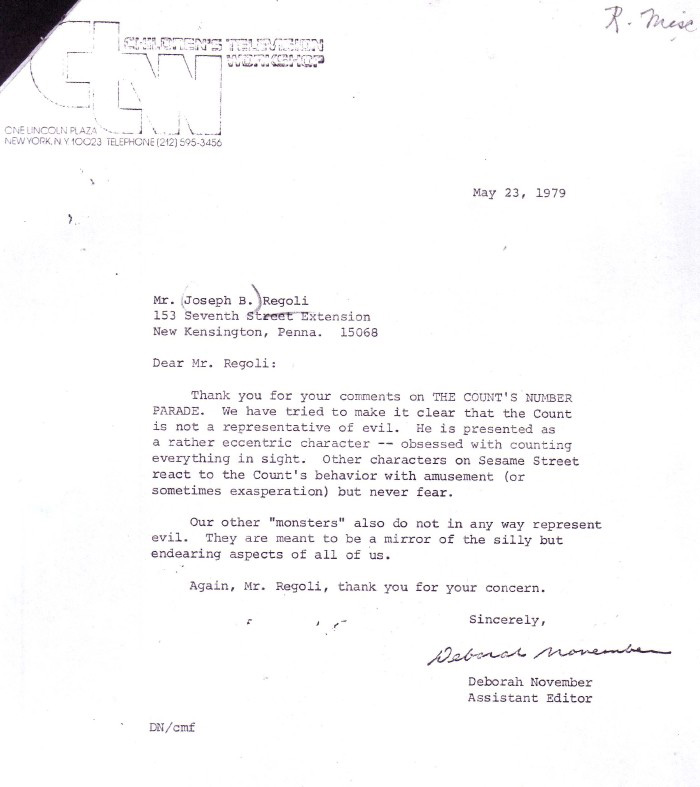
When the Count debuted on the show, many people were outraged at such a demonic creature being treated in such a positive, friendly light.  One letter in particular felt it was wrong to teach children to trust vampires and monsters, because they are beings of pure evil.  The staff produced a letter in response.


In this letter, it is noted that the monsters "are meant to be a mirror of the silly but endearing aspects of all of us."  And that's what children are being taught.  It is not to trust unfriendly beings.  It is to accept the monster within.  We all possess qualities that we sometimes wish we didn't have, but we must live with them.  If we can look them in the face and learn to appreciate our idiosyncrasies, we can conquer our fears and become better people in the process.

You may notice that one notable Sesame Street monster was missing from the above list.  That is our good old friend Grover who represents all of our insecurities.  He means well and wants to aid society, but his own failures get in his way and keep him from doing so.  He is the most insecure creature on the block.  But even he knows that sometimes, you have to brace yourself, look in the mirror, and welcome the monster you see staring back at you into your life.

  
If you don't wubba your monster, it won't wubba you.

Friday, October 7, 2011

The Monsters at the End

Beautiful Pandora was created by the gods to be the perfect woman, nay, the perfect human.  She was placed on Earth with a box (originally a jar) and given one instruction: do not open the box.  It's simple.  She could have lived a carefree, perfect life.  But, as a human, her curiosity got the better of her until she could stand it no longer and had to open the box.  By doing so, all of the world's evils were unleashed, dooming the rest of humanity.

Pandora (1896) - John William Waterhouse

POOR GROVER!  All week long, we have seen the noble dreams of this dear puppet crash to bits through multiple means.  He has suffered various atrocities when all he wants to do is relax and live a peaceful existence.  But once again, someone is standing in his way, and this time, IT IS YOU!

Happier times

Before we even open the book, the damage is done.  Both you and Grover know that there is a monster at the end of this book.  All you have to do is walk away and not open it and keep that monster locked away tightly.  But you've opened the book now.  Aren't you curious to see what comes next?  Fortunately, good old Grover is there to set you straight.


But you don't listen.  You don't take this sound advice.  Something deep within you is forcing you to see this monster.  Why?  What has Grover ever done to you?  Just walk away, there is still time!


Through ropes and boards and bricks, Grover pulls out all of the stops to save your soul.  But you are driven to keep on turning.  This unnatural urge from within is giving you strength and power to topple down walls.  Perhaps, the monster is not at the end of this book, but right here with you, drawing you closer and closer towards evil.


This is it.  Your final chance.  One turn and it is all over.  Humanity will crumble, thousands will perish, millions will suffer.  Why do we have this strong desire for closure?  Even if we know the end result will be a macabre mess of death and anguish, we cannot turn away.  This book is more than a book.  It is the entirety of the life experience bound in a dozen or so pages.  No other book draws the reader in as much as this one does.  You are the main character and, I am sorry to say, you are the villain.  Every page you turn has caused more and more destruction.  There is no redeeming you if you turn this last page.

And yet...

At the bottom of Pandora's box, after all of the evils had escaped, and after all of the horrors had caused their great ruckus, at the bottom of the box laid one tiny bird.  This bird was Hope.  It weakly stumbled to its feet and spread its wings and flew.

Out there, in the now chaotic and unpredictable world, Hope exists.  It may be hard to see, hard to find.  But it is there and it can show up just when you need it most.  So maybe all is not lost.  Maybe everything will work out just fine.  We do not know what the future has in store for us.  We should not fear it.  We must face it.  It could destroy us or it can make us better.  There is only one way to find out.

Let's turn the page....


(This post was inspired by the interaction one man had with his own monster at the end found here.)