Showing posts with label fran brill. Show all posts

Sunday, August 19, 2012

Random Muppet #14: Merlin's Assistant

On the Muppet Wiki, there is a "Random Muppet" button which sends you to the page of one of the thousands of Muppets in existence. I will press the button and discuss the importance of the Muppet that comes up, no matter how obscure. No skips. No redos. This is the Random Muppet Challenge.

Random Muppet #14: Merlin's Assistant

A sorcerer's apprentice who is only there to make her boss look good.

Performer:  Fran Brill

Muppet Universe of Origin:  MuppeTelevision

Most Significant Appearance:  The Jim Henson Hour, July 16, 1989, "Episode 107: Health and Fitness"

"MuppeTelevision" had many similarities to The Muppet Show, one of which was the batch of recurring segments called "Merlin the Magician, M.D."  This sketch was a spiritual successor to "Veterinarian's Hospital," with the setting changed to medieval times.  Instead of Dr. Bob, Rowlf now played Merlin and he would treat patients with a more spiritual (and outdated) method of cures.

Only Rowlf could make a beard look good on a dog.

Rowlf was not joined by his nurses Piggy and Janice this time around (probably because Frank Oz and Richard Hunt weren't part of the full cast for the show), so instead he was joined by a nameless assistant voiced by Fran Brill.  And, much like any magician's assistant, she only served to draw attention to Merlin's "tricks."  Except his tricks were more puns and punchlines, so she would emphasize each joke with a "Ta-da!"

In the couple times that this sketch appeared, Merlin's assistant would announce the patient and their ailment (which always seemed to involve something stuck in their head).

How does one even get a fish in the head?

During the second (and final) sketch, Merlin began to grow weary of his assistant's "Ta-das!" and tried to get her to cease this annoying habit.  Even she began to grow weary of her role, uttering her final "Ta-da!" completely out of breath.

Why Is She the Most Important Muppet?

Merlin's assistant combines two familiar sound cues to trigger a response from the audience.  "Ta-da!" is usually said right after something amazing or impressive has occurred while a joke is punctuated with a drum sting (sometimes called a rim shot).  In both of these cases, the sound lets the audience know that the goal of the performance has been achieved and it is time for them to react.

When it comes down to it, these sounds should be completely unnecessary.  If the preceding event is so great, shouldn't the audience respond naturally?  A sound cue just assumes that the audience isn't intelligent enough to pick up on the humor on their own, so it provides a familiar noise so that the audience can respond at the appropriate time.

Merlin's assistant's job is even more useless because, not only are the punchlines painfully obvious, but an actual musical sting underscores her "Ta-das," making her pointless task redundant as well.  Take that away, and she has nothing to do but stand there and look pretty while the magician does all the interesting stunts.

For my next trick, I shall pull a bloody sword out of a dying knight.

The role of a magician's assistant has undergone heavy scrutiny during the years since its inception, with many pointing out that the assistant is often put in situations of "peril," invoking the "damsel in distress" routine.  The assistant's presence only reinforces a notion that women are subservient to men and incapable of helping themselves.

While some assistants have gone on to receive top-billing in their magical acts by becoming more involved in the "magic" process, Merlin's assistant appears to have gone in the other direction.  She doesn't interact with the tricks in anyway, mostly keeping her distance.  And when she does come on screen, she just bothers Merlin.  The sketch and the patient would be just fine without her.

Merlin's assistant may be the most unnecessary Muppet created.  And, for that reason, she is important. It's not that we don't want her.  We want her life to be better.  We want to see her do something worthwhile.  We want to see her hone her skills.  Surely she can do more than just say "Ta-da!"  She is the assistant to a genuine wizard!  There is so much she can learn and so much she can offer.

Tragically, her days on television ended when the show was cancelled.  We never did get to see what she did after this.  We don't know if her life got better or worse.  We can only guess.

But there is one silver lining that came from all of this.  From this day forth, we can never hear the phrase "Ta-da" again without thinking of her.  She has a legacy now.

Saturday, June 23, 2012

Prairie Dawn: Why the Best Man for the Job is a Little Girl

A recent online article caused a big stir when it proposed the theory that each Muppet can be classified as either "Chaos" or "Order."  While I have a few issues with the simplistic view of these nuanced and complex characters, the most glaring flaw was the omission of the most "Orderly" Muppet in existence. You cannot talk about Order in the Muppet universe without mentioning Prairie Dawn.

So innocent and sweet.  And she can crush you like a bug.

Prairie Dawn (not to be confused with that other small pink Sesame Street Muppet) is a force to be reckoned with.  Kermit is often the go to example of an "Order Muppet," but even he lets loose, has fun, and, most alarmingly, employs a cast of characters who cause destruction as soon as they step on stage.  The loose, anything-can happen atmosphere of The Muppet Show would not fly under Prairie Dawn's watch.  If things are out of Order, she sees to it that they are fixed immediately.

Hell hath no fury like a little girl scorned.

The seeds of desire for power were planted very early on when Prairie Dawn was placed in charge of the "Sesame Street Pageants."  These 5 minute educational skits were directed by Prairie and performed by her fellow castmates.  While she stayed on stage playing the piano and narrating, her friends would appear to portray the necessary items in the play.  However, Prairie often found herself reprimanding the cast for missed cues, forgotten lines, and breaking character.  She would trudge ahead, but her fellow performers could never stick to the scripts.


For years, Prairie suffered through these pageants, and she found herself always being the responsible one.  Being 7, she was older than most of the "child" Muppets, and her maturity allowed her to take charge in many situations.  Eventually, she worked her way up to directing movies, and it's clear she had picked up some techniques for handling morons, namely "assertive force."


Her quest for order became her driving passion, so, for comedy's sake, she was often paired with Cookie Monster, the most "Chaotic" Muppet on Sesame Street.  They began with simple tasks in which  cookies were often used as props, and she would try her best to keep Cookie from rushing ahead and spoiling the lesson.


Eventually, the two would cohost the "Letter of the Day" segments, and the lack of cookies caused Cookie's behavior to become even more erratic, constantly keeping Prairie on the verge of a mental breakdown.


Fran Brill (Prairie's puppeteer) said she most enjoyed the segments in which Prairie would get frustrated.  She began her stint at Sesame Street playing background roles and right arms to two-person puppets, and one day she was handed the tiniest puppet in the shop.  She began playing Prairie as a sweet, innocent girl, but soon realized she had dreams of grandeur.  But, unlike the other Muppet dreamers, Prairie wanted control.  She wanted to direct and manage.  According to her, if Prairie were given enough time, she would run the television network.

And she would rule it with an iron fist!

When given the choice between Scooter and Prairie Dawn as a stage manager, Brill picked Prairie without hesitation, because she knew Prairie would get the job done.  There is a reason that Prairie has lasted as long as she had, becoming one of Brill's two signature characters.  Prairie has the gall and determination that all people long to have.  She knows what she wants, and she gets it, even if she has to deal with all of the other regular folk in the world.  She is a natural born leader.

Don't let her looks deceive you.  She can be scarier than the monsters.

One last thing: Prairie Dawn has "Days of the Week" underwear.

There is no more argument.  Compared to Prairie, everyone is a Chaos Muppet.

Tuesday, June 5, 2012

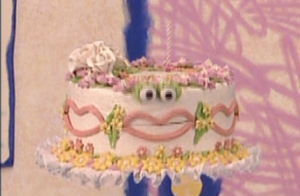
Random Muppet #2: The Birthday Cake

On the Muppet Wiki, there is a "Random Muppet" button which sends you to the page of one of the thousands of Muppets in existence.   I will press the button and discuss the importance of the Muppet that comes up, no matter how obscure.  No skips.  No redos.  This is the Random Muppet Challenge.

Random Muppet #2: The Birthday Cake

A sentient, sexually-ambiguous, floating cake with an unintentional death wish.

Performer:  Fran Brill/Joey Mazzarino

Muppet Universe of Origin:  Sesame Street

Most Significant Appearance:  Sesame Street, February 2, 2001, "Episode 3940"

In the recurring "Elmo's World" segments that began taking up a third of each Sesame Street episode in recent years, Elmo would choose a topic and ask questions about it without relenting for about 20 minutes.  He would interview various authorities on the subject, or present little clips that related to the subject in some way.  It was the television equivalent of a toddler tugging at your pant leg and asking "Why?" after every single thing you said.

One day, Elmo became really excited about birthdays, so he set out to explain the concept to all the viewers at home.  And while everyone in the world has the experience of being born, Elmo managed to book some abstract guests for his show, namely a birthday cake.  The cake only appears for two lines and then Elmo's short attention span causes him to get distracted by something else.


If you managed to make it to the birthday cake's appearance, you'll notice that it only had one noteworthy piece of wisdom when Elmo asks what its life is like:

Birthday Cake: "It's a piece of cake"

And that's it. The birthday cake floats on to spread advice and icing throughout the land.

Why Is He/She the Best Muppet?

Imagine the life of a birthday cake. Prepared with tender care, the birthday cake is treated very delicately, dressed up and decorated, quite possibly the prettiest of all foods. You are assigned a dangerous but revered task of carrying one or more burning torches, like an Olympian. When you are brought out to meet the public for the first time, the crowd erupts in a song of delight. Everyone focuses on you as you are presented to the guest of honor. They blow out your torches, you grant them a wish, and the ceremony is complete.

All sentient food in the land of the Muppets is aware of their imminent demise. They choose to accept or ignore their short lifespan and instead sing and be merry. But this birthday cake is actually treated with class and respect. It doesn't sing because it genuinely believes it will have a long rich life. The way everybody treats it, how could it not think that it is the center of the universe?

As soon as the knife is injected to make the first slice, realization hits and death is mere seconds away. But the cake has no reason to expect any harm. All other food is eaten along with other food. On the dinner plate, food helplessly watches as their brethren are eaten. In the fridge, food trembles in fear, awaiting the day they are either selected for consumption or met with expiration. The birthday cake lives it's entire life in solitude. It doesn't interact with other food, as it is often hidden from the birthday guest. The cake, for all intents and purposes, is untouchable.

The birthday cake appears again in a segment explaining the word "scrumptious." This time, it has a manlier voice, so it is unclear whether or not this is the same cake from Elmo's World. Either way, the cake has the perspective that all cakes have, unaware of the truth.

"Attractive celebrity" Jessica Alba presents various food items she finds scrumptious. Her final choice is the birthday cake, who in turn agrees that Alba is also "scrumptious."

They are both scrumptious, in very different ways.

This birthday cake clearly doesn't realize that scrumptious has two meanings. He/she believes Alba is complimenting his/her good looks and attractiveness. Alba laughs and plays along, but she knows that cake is not meant for this world very much longer.

Is it better or worse to be ignorant of ones mortality? The birthday cake lives its entire life in bliss. Is that necessarily a bad thing? Is there even an answer?

Life is not a piece of cake. Unless it is.

Monday, April 30, 2012

Small and Insignificant

If there is one Sesame Street character that got the short end of the straw, it would be the aptly-named Little Bird.

Remember me?  That's okay...so have the producers.

Those who remember this character will recall that he was supposed to be Big Bird's best friend and counterpart.  He has been with the show since the beginning, but, unlike his companions (Cookie Monster, Grover, Oscar, Bert, and Ernie), his presence on the show has decreased significantly.

The inclusion of a character such as this makes sense.  Big Bird was the lead character, so what better way to teach kids the difference between "big" and "little," than by explicitly using a character who is the opposite of Big Bird.  Even though Big Bird's point was that he was a giant version of a tiny creature, it didn't help to reinforce the difference.  Rather than make a new puppet, Henson reused a puppet that he voiced who was the mascot for a series of advertisments for the toy brand Kenner (makers of Easy Bake Ovens).


The bird didn't really have much of a personality, outside of his excitable frenzy over Knner-brand products.  But he was a small, yellow bird, and, therefore, perfect for the role on Sesame Street.

The children's show gig would be a lot safer.

Henson continued to voice the bird in his first appearance on the show.  This is where Big Bird and Little Bird would meet, in an origin story that would cement the two as an unforgettable fictional duo, like Holmes and Watson.  Since early Big Bird was depcited as very dopey, Little Bird would be smart.  Unfortunately, he came off as rude and sarcastic.  Nonetheless, Big Bird announced that the two would remain best friends forever.


Over time, Big Bird's personality developed into one that was more childlike and endearing.  Little Bird changed as well, becoming more supportive.  Ownership of the puppet transfered from Henson to Fran Brill, who gave the bird a sweeter voice, fitting to the new nature of the character.  But, outside of the initial "big/little" lesson, there wasn't much else for Little Bird to do.  So Little Bird began to appear in his own segments, interacting directly with the children at home.  Like an early Dora the Explorer, Little Bird was able to keep children engrossed in a conversation with their TV screens.  Little Bird's most famous lesson about imagination manages to get away with having children watch a silent, black screen for an extended period of time.  How amazingly progressive for a TV show.


As you can see by the end of the sktech, Little Bird's new shtick would involve scary run ins with larger monsters.  While most little Muppets would find themselves on Muppet monsters dinner plates, Little Bird only had to deal with personal bubble invasions.


Unfortunately, the show around Litttle Bird grew too fast for the bird to handle.  Big Bird's optimistic infantile attitude became better suited for interactions with the intelligent and pessimistic Oscar the Grouch.  The human adults would teach Big Bird his lessons.  And he would gain a new best friend by the name of Snuffleupagus.  Also, the monsters that once tormented Little Bird were established as genial creatures that wished him no harm, so there was no need for scary encounters.  Little Bird's role became reduced to minor appearances that required a bird to fly by, and eventually he only appeared in the merchandise.

Where the concept of size differences could reach a more literary audience.

Such is the fate of the tiny character.  He was brought in to be a permanent star, but he faded quickly.  The bird hasn't appeared on the show for over a decade now and there are no signs of his return.  Sesame Street has taught us many lessons, but the harshest one of all is that nothing, not even friendship, lasts forever.

Always remember the little people who helped you get to where you are today.