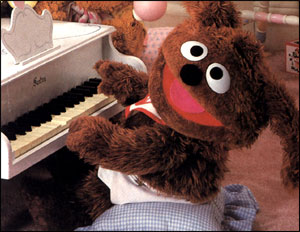
On the Muppet Wiki, there is a "Random Muppet" button which sends you to the page of one of the thousands of Muppets in existence. I will press the button and discuss the importance of the Muppet that comes up, no matter how obscure. No skips. No redos. This is the Random Muppet Challenge.
Random Muppet #14: Merlin's Assistant
A sorcerer's apprentice who is only there to make her boss look good.
Performer: Fran Brill
Muppet Universe of Origin: MuppeTelevision
Most Significant Appearance: The Jim Henson Hour, July 16, 1989, "Episode 107: Health and Fitness"
"MuppeTelevision" had many similarities to The Muppet Show, one of which was the batch of recurring segments called "Merlin the Magician, M.D." This sketch was a spiritual successor to "Veterinarian's Hospital," with the setting changed to medieval times. Instead of Dr. Bob, Rowlf now played Merlin and he would treat patients with a more spiritual (and outdated) method of cures.
Only Rowlf could make a beard look good on a dog.
Rowlf was not joined by his nurses Piggy and Janice this time around (probably because Frank Oz and Richard Hunt weren't part of the full cast for the show), so instead he was joined by a nameless assistant voiced by Fran Brill. And, much like any magician's assistant, she only served to draw attention to Merlin's "tricks." Except his tricks were more puns and punchlines, so she would emphasize each joke with a "Ta-da!"
In the couple times that this sketch appeared, Merlin's assistant would announce the patient and their ailment (which always seemed to involve something stuck in their head).
How does one even get a fish in the head?
During the second (and final) sketch, Merlin began to grow weary of his assistant's "Ta-das!" and tried to get her to cease this annoying habit. Even she began to grow weary of her role, uttering her final "Ta-da!" completely out of breath.
Why Is She the Most Important Muppet?
Merlin's assistant combines two familiar sound cues to trigger a response from the audience. "Ta-da!" is usually said right after something amazing or impressive has occurred while a joke is punctuated with a drum sting (sometimes called a rim shot). In both of these cases, the sound lets the audience know that the goal of the performance has been achieved and it is time for them to react.
When it comes down to it, these sounds should be completely unnecessary. If the preceding event is so great, shouldn't the audience respond naturally? A sound cue just assumes that the audience isn't intelligent enough to pick up on the humor on their own, so it provides a familiar noise so that the audience can respond at the appropriate time.
Merlin's assistant's job is even more useless because, not only are the punchlines painfully obvious, but an actual musical sting underscores her "Ta-das," making her pointless task redundant as well. Take that away, and she has nothing to do but stand there and look pretty while the magician does all the interesting stunts.
For my next trick, I shall pull a bloody sword out of a dying knight.
The role of a magician's assistant has undergone heavy scrutiny during the years since its inception, with many pointing out that the assistant is often put in situations of "peril," invoking the "damsel in distress" routine. The assistant's presence only reinforces a notion that women are subservient to men and incapable of helping themselves.
While some assistants have gone on to receive top-billing in their magical acts by becoming more involved in the "magic" process, Merlin's assistant appears to have gone in the other direction. She doesn't interact with the tricks in anyway, mostly keeping her distance. And when she does come on screen, she just bothers Merlin. The sketch and the patient would be just fine without her.
Merlin's assistant may be the most unnecessary Muppet created. And, for that reason, she is important. It's not that we don't want her. We want her life to be better. We want to see her do something worthwhile. We want to see her hone her skills. Surely she can do more than just say "Ta-da!" She is the assistant to a genuine wizard! There is so much she can learn and so much she can offer.
Tragically, her days on television ended when the show was cancelled. We never did get to see what she did after this. We don't know if her life got better or worse. We can only guess.
But there is one silver lining that came from all of this. From this day forth, we can never hear the phrase "Ta-da" again without thinking of her. She has a legacy now.
For this 100th post, I decided to do things a little differently. I have scoured through 100 episodes of The Muppet Show plus extra movies and specials to find the Top 10 Definitive Moments of Rowlf the Dog. While Kermit is Jim Henson's most well-known Muppet, Rowlf is the closest to his heart. More of Henson can be found in this character than in any of the other 150+ characters he has portrayed.
Little did he know that these sketches would be the basis for one of the world's most famous dogs.
1. The Spokesdog
Rowlf, like most early Muppet pitchmen, was part of a comedic duo. Joined by Baskerville the Hound, Rowlf would push Purina Dog Chow on the consumers. At this early stage, the modern Rowlf is nearly identical to the dog he would become. His physique suggests he would be a brute of a dog, but he rarely resorts to violence in the ads. He plays more of a stoic role to counteract the dim-witted Baskerville.
While Rowlf was destined for great things, Baskerville fell by the wayside. He would make occasional appearances in The Muppet Show (including a breif stint as Watson to Rowlf's Sherlock Holmes), but he did not possess the charisma required of a signature Muppet.
2. The Sidekick
Henson and the Muppet brand got their first opportunity at national recognition with a recurring segment on The Jimmy Dean Show. A portion of the show would be devoted to some playful interaction between the host Jimmy Dean and his new pal Rowlf. Although the jokes were all scripted by Dean's staff, Henson helped flesh out the character, imbibing the dog with his new personality. Dean played the straight man, and while his reactions to Rowlf's jokes may have been faked, the laughter he exhibits often seems genuine. Henson got the chance to show off some of his improvisational skills through Rowlf, making him the first fully developed Muppet.
Clips from the show are hard to come by, but the above video features some of Rowlf's best moments on the show, including one of the episodes in which Lassie was a guest star. Rowlf takes great pride in being a dog, and so he excels at the dog-related humor that comes his way. Interacting with Lassie is is first experience with a real dog and of course he falls in "puppy love." The usually confident Rowlf becomes weak in the knees, allowing us to see the depth in this puppet's soul.
This clip also neglects to showcase the emergence of Rowlf's musical career. He would end each skit with a duet with Dean. He hadn't quite yet found his true calling with the piano. Instead, the ukelele was his weapon of choice. However, I feel we could all agree that his true home is with the ivory keys.
3. The Star
Henson was no stranger to the world of advertising by the time he got the chance to advertise his own product. Rowlf, Kermit, and Snerf puppets would be the first official Muppet Merchandise (not including promotions that involved earlier mascots). In a bizarre-yet-effective ad, Rowlf promotes the various toys as they come to life and threaten to harm the consumer. Interestingly, the Kermit and Rowlf puppets have different voices than the characters they portrayed, recognizing that people will need to supply their own voices when playing with them. Although Snerf never made it big as a character in his own right (the design is cool, though), Rowlf and Kermit were ready for stardom and this was the first indication that they would last a while.
Rowlf would go on to appear in other shows after The Jimmy Dean Show, including Muppet pitch reels and his own hosting gig on the short lived Our Place. However, Rowlf was usually at his best bouncing off other people. He would later find a memorable solo act, but his witticisms needed other comedic partners in order to be effective.
4. The Reflective Singer
Once The Muppet Show started, Rowlf found himself in certain roles. Sometimes he would play narrator, other times he would act, but he was never very far from a piano. While Dr. Teeth was designed solely for his piano playing abilities, Rowlf's desire for the piano seemed to be born out of a natural interest in art. Because the world wasn't ready to seeing a puppet play the piano only, Rowlf would always sing cute novelty songs. His songs usually included a punchline or dealt with off-kilter subject matter. But in one of his most famous covers, he sings "Cottlestone Pie," originally sung by Winnie-the-Pooh in A.A. Milne's book. While Rowlf is more intelligent in Pooh, they both have similar personalities, refusing to let the world get them down. Rowlf is a thinker. And he is not afraid to fill the world in on his philosophies.
In the early episodes, there was a "recurring segment" called "A Poem by Rowlf." It only lasted two episodes because without the piano, Rowlf seems to drift aimlessly in his thoughts.
5. The Classical Pianist
Eventually, the writers of The Muppet Show became more comfortable allowing Rowlf to just be. He didn't have to talk all of the time. His piano could do the talking. Henson would still perform his head, but other puppeteers (usually Steve Whitmire) would play the fake piano, mimicking the recorded material prepared by on-site Muppet-musician Derek Scott. Rowlf played quite a few classical pieces but to make them unique, there would always be some inserted twist. For example, in the short rendition of "Moonlight Sonata," Rowlf gets distracted by the scenery, allowing the music to get carried away.
While comedic moments are always welcome, the above rendition of "Für Elise" is the purest "just music" spot that the show ever did. No funky visuals and no added jokes. Rowlf does occasionally miss a few notes for "humor," but if anything, it just shows that he is forever growing as a musician. The music is just allowed to be music, which is what Rowlf would have wanted.
You've come a long way, baby!
Like Schroeder from Peanuts, Beethoven was Rowlf's idol. He was often accompanied by a bust of his muse, who would often comment on his performances. While he sometimes had a negative reaction to the music, he would also join in the enjoyment. Another classic song "Eight Little Notes" (which was originally sung by Schroeder in the musical Snoopy!) has Rowlf pay homage to his hero.
6. The Best Friend
Rowlf was usually a loner, but he was always willing to lend a hand, providing backup for the other Muppet performers or guest stars. But in this clip, we see his bond grow with Fozzie Bear as he encourages Fozzie's previously unknown talent of playing the piano. Like an idiot savant, Fozzie finds the paino to be a natural fit for him, although he is not sure of where this musical magic is coming from. Whatever the case, having the two pianists work together makes an exciting and funny scene without stepping on the music itself.
Rowlf and Fozzie's relationship was not heavily focused on, but you could see that Rowlf kind of looked at him like a younger brother. Like Jim Henson and Frank Oz's relationship, the two characters respected each others craft, but they were not immune to some good-natured ribbing every so often.
7. The Continuing Story of a Quack Who's Gone to the Dogs
While the title and premise imply that it is a soap opera, Veterinarian's Hospital is just a vehicle for cranking out as many puns and gags as possible. Rowlf stars as head surgeon Dr. Bob, and he carries each sketch with his natural witty demeanor. The rapid-fire jokes don't quite suit a self-absorbed person like Piggy or a mellow musician like Janice. Rowlf was baasically born in the world of vaudeville comedy, so the zingers come naturally and his enjoyment doesn't feel forced. Rowlf would later host the television special Dog City where he would serve as the comedic narrator. His role as Dr. Bob prepared him for the longer routine, making him one of the best aspects of that tongue-in-cheek foray into silliness.
I chose the above VH sketch out of the 43 possible because it represents the familiar routine most accurately. During the first season, Piggy and Janice didn't yet have their signature personalities and voices, the Announcer didn't say the catchprases established by Jerry Nelson, and the jokes weren't as sharp. In later seasons, the patients always tied into an earlier part of the show. This sketch with Fozzie stands well on its own and features everything we have come to expect from VH. By being the most average, it is automatically the best.
8. The Musical Comedian
Many guest stars graced The Muppet Show stage, but one performer was a perfect fit for Rowlf. Danish comedian Victor Borge had built a name for himself through his musical and comedic chops. His usual routine consisted of classical music presented in a humorous fashion (such as playing familiar pieces backwards, flustering over the sheet music, or commenting on the less than stellar works of great composers). In one of his most famous bits, he plays "Hungarian Rhapsody No. 2" with a partner. But rather than have each person stick to one side of the piano, an acrobatic display of tangled limbs occurs in order to get through the piece. While it's difficult with a human partner, doing it with a puppet is a whole new ball game.
This is the only sketch in which the piano Rowlf plays is real (since Borge had to share it). If you look closely, you'll notice that Rowlf never actually hits the keys, he just lightly touches them. In any case, the two still have to move about to successfully play the song without stumbling. While Animal got to compete with famous drummers and Fozzie could go up against great comedians, this was Rowlf's only chance to share his instrument with one of the greatest.
9. The Frog and the Dog
The Muppet Movie featured many impressive technical feats as a way for Henson to show what his puppets were truly capable of. This resulted in such memorable scenes as Kermit riding a bike and Fozzie driving a car. But one moment that seems to go over people's heads is the duet between Kermit and Rowlf at the restaurant bar, "I Hope That Something Better Comes Along." On the surface, it's just another musical number. In terms of the story, it makes sense to introduce Rowlf as Billy Joel's "Piano Man," the type of fellow who would listen to the patrons drunken woes as they pass through. But there is something more at work here that makes this scene special.
Have you figured it out yet? Think to yourself, when on The Muppet Show have you ever seen Kermit and Rowlf interact? Kermit usually stays backstage and Rowlf performs onstage. They rarely have a conversation that lasts more than two lines. And why is that? It's because Kermit and Rowlf are both performed by Henson. Logically, he cannot perform both at the same time.
So here, not only do we get an extended scene between the two, they actually sing together at the same time! It's a once-in-a-lifetime duet, so I'd be remiss to leave it off this list.
10. The Appreciator
Rowlf may be the most complex member of The Muppet Show. While any of the characters can turn in a dramatic moment, they are usually played for sympathy. When someone like Fozzie or Gonzo gets serious, it is to invoke pity from the audience. But only Rowlf could sing Louis Armstrong's "What a Wonderful World" to an adorable sleeping puppy and not have it come off as cheesy. Rowlf, like Henson, enjoys the world he inhabits. When things get crazy around him, he can easily join in or sit back and watch. He never judges the craziness, but he doesn't feel the need to deliver comedy all the time. He wants the world to know that there is more to him than just being a funny, shaggy dog.
He makes us laugh and cry and ponder. He never belittles us or takes advantage of us. He respects and loves us all. He is loyal to the world.