Showing posts with label electric mayhem. Show all posts

Tuesday, December 4, 2012

The Non-Denver Christmas Album

The first original Muppet album to be released after the Disney acquisition didn't appear until 2006, over a decade since the last one.  A Muppet album was a thing of the past, but combining Disney, the Muppets and Christmas was sure to be a hit!  And although the Muppets collaborated with John Denver on a Christmas album before, this would be the first one that they had all to themselves.  So let's take a listen to A Green and Red Christmas.

So far, it's meeting all my expectations.

The lead song of the album, "'Zat You, Santa Claus?" doesn't make the best first impression.  This is one of three songs covered by the Electric Mayhem and right away, we understand why there hadn't been a Muppets album in such a long time.  We can only hear the Muppets, and despite everyone's best efforts, the Muppets just don't sound the same anymore (especially since only Dave Golez remains from the original five).  This has been a critique for many fans, and it never really bothered me.  I understood that it was necessary and it allowed others to play their favorite characters.  And for the most part, having new voices is fine.

But if any characters should have been retired, it's the Electric Mayhem.  Apart from Animal, the band only exists to cover songs nowadays.  But with all the voice changes, we lose that genuine aspect that the original Electric Mayhem had.  These are no longer five guys getting together and having fun with their fake band, these are a cheap imitation.  The other two songs on the album, "The Man With the Bag," and "Run, Run Rudolph," don't fare any better.  The band has lost their mojo.  Judge for yourself in their 2009 live appearance at Rockefeller Center.


The second song on the album is also the first original number, "A Red and Green Christmas."  Despite the fact that the title contradicts the title of the album, this is actually a pretty good song.  Kermit and Miss Piggy argue over which color is the definitive Christmas hue, with each one listing holiday elements associated with their choice.  Of course, by the end, they decide that both are acceptable.  It's sweet and inspired.  It's what the Muppets should be.


The other original songs on the album are hit or miss.  Rowlf's "The Christmas Party Sing-Along" does not warrant Rowlf's resurrection and Fozzie's "North Pole Comedy Club" is unbearable.  Good comedy albums get stale after repeated listenings, so who in their right mind would want to listen to bad comedy more than once?  More successful are Piggy's "The Christmas Queen," where Piggy must deal with her insulting back-up singers (and probably would have been really funny with an official music video rather than just a well-intentioned fan-video).  And "Christmas Smorgasbord" is a nice parlay into the world of the Swedish Chef, even if the song is musically bland.


Things are more consistent with the rest of the covers.  Miss Piggy sings "Santa Baby," as she should.  Kermit's "Have Yourself a Merry Little Christmas," while not as memorable as Rowlf's version (or the Muppet Family Christmas version) is still endearing, and Gonzo and Rizzo have a fun rendition of "The Most Wonderful Time of the Year," as seen in the Rockefeller Center clip.

Although the other Muppets aren't featured on the album version, it still does the trick.

As it stands, the album isn't essential, but it has enough going for it that it's worth adding a couple of tracks to your holiday playlist.  But if you were to purchase it, make sure you get the 2011 re-release that was made to promote The Muppets.

Even if you have to settle for the less charming cover artwork.

There are two additional songs on this version, each rmade after 2006.  First up is Gonzo and Fozzie's "I Wish I Could Be Santa Claus" from the 2008 special Letters to Santa (which I be discussing later this month).  The money-maker, however is the Muppets and Andrea Bocelli's "Jingle Bells."  This song was also featured on Bocelli's 2009 album My Christmas and, as seen in the promotional television special, it is a charming, clever, and funny affair.


This one song is the reason we need a Muppet Christmas album.  It brings our favorite characters together in a way that retains their personalities without giving up musical quality and integrity.  Bocelli adds a legitimacy to the album that is lacking from a majority of the previous songs.  Although celebrity cameos can be hokey, when they work, they work.  So, once you're sick of hearing all the other holiday songs this season, give this album a listen.

Or give Andrea Bocelli's album a listen.

Wednesday, May 30, 2012

The Muppets Take Manhattan, Part 3: Anything Goes

There is something weird that happens when reviewing a movie like The Muppets Take Manhattan one fifth at a time.  It really shows you how disjointed the plot is.  I have seen this movie a few times before, and if I were to summarize it in a paragraph, absolutely none of the following scenes would be mentioned.  It's not that they aren't entertaining.  It's just that the things that are important to the story have been pushed to the beginning and ending edges.  While watching this film, one gets the feeling that the Muppet staff had a book full of ideas that they wanted to see the Muppets do, and now that there was no longer a show, those ideas would have to go into the movie.

So here are some hypothetical excerpts from this fictional Muppets Take Manhattan Idea Journal:

Idea #276:  3-D movies are all the rage now.  (Possible Lew Zealand Cameo?)

Kermit's first letter is from Scooter, who has found a job at a movie theater as an usher.  First we get to see Swedish Chef working the concession stand, which goes exactly as you expect it would.


Then we have an appearance by Lew Zealand, a one-note character whose whole schtick is that he only has one joke: boomerang fish.  So, of course, he loves the 3-D movie about killer fish because it allows him to "interact" with the movie.  Yeah, it's a lame set up for an even lamer joke, but that's who Lew Zealand is.

Apparently, this scene is so iconic that you can get your very own "Usher Scooter" action figure!

"My favorite Muppet action figure is Usher Scooter."

Idea #328:  What if Fozzie met a real bear?

In Fozzie's letter, Fozzie, unable to find work, decides to give hibernating a try.  He finds himself in a den filled with realistic-looking Muppet bears, which presents a very odd contrast with the cartoonish Fozzie.  Unfortunately, Fozzie can't sleep.  Womp, womp.

 That's not a bear.  Bears wear hats.

Idea #12: What if the Electric Mayhem had to play polka music?

 
I miss the Happiness Hotel.

Idea #56: Okay, so Kermit has to pretend to be a big shot producer in order to start some buzz about his Broadway play. And, like, he goes into a fancy restaurant in disguise. It's one of those restaurants where they have pictures of all the famous people who've ever eaten there on the wall. And Kermit replaces his picture with another celebrity (TBD, check our Muppet Show guest roster). And then that celebrity actually shows up and Kermit gets kicked out! Also, rats.

At least this disguise is more tolerable than his "boffo" agent.

So yeah, Kermit decides to start a "whispering campaign" having all the rats hide under the tables of patrons in order to subliminal work Kermit's play into their conversations. And the rats reveal themselves and everyone gets kicked out, making for another funny, yet pointless scene.

  
Oh, and they chose Liza Minnelli.

Idea #1237:  In our last movie, we had Miss Piggy ride a motorcycle.  How can we top that?

In yet another day of spying on Kermit and Jenny, Piggy's purse gets stolen and since her little puppet legs can only take her so far, she has to borrow some roller skates.  Time for an action sequence!


The skating scene I could do without, but the confrontation at the end between Kermit and Piggy with Gregory Hines acting as the supportive mediator is probably the funniest scene in the whole film.

"You didn't say there were huggies!"

Idea #1:  What if the Muppets were BABIES?!

Okay, so this song/scene has no bearing on the movie whatsoever, but it is so iconic and important to the franchise that it's worth making a whole movie just for this moment.  Basically, Piggy imagines the premise of Muppet Babies and it is adorable.

  
The fantastic song that spawned a regrettable genre: famous characters as babies.

We already know why this song is great, so instead check out this weird promotional music video version of the song that aired on The Merv Griffin Show.  It features homages to 2001: A Space Odyssey, Flashdance, and Michael Jackson's "Billie Jean" music video, with a live action pig and frog to boot.  And Jim Henson also has a cameo as...I don't even know.


I don't know what all that extra stuff has to do with babies or love.  Seeing the pig and frog was interesting, but it kind of stepped on the whole premise of the scene, especially since the scene does just fine on it's own.  Maybe that was another idea from the big journal of ideas and they couldn't fit it into the film. (Idea #15,029: The Muppets as actual live-action animals!!!!).  In any case, the actual moment in the movie is great.  And it's the last "random" thing to occur in the film.
Yayayayay!  Bye babies, see you on CBS!

Tomorrow, we finally get back to the story, as Kermit makes significant leaps forward and loses his mind.

Tuesday, February 21, 2012

The Muppet Movie, Part 2: Muppets Assemble!

Now that the plot is set up, we enter the portion of the movie that I refer to as "Collecting the Cast."  While the duo of Kermit and Fozzie is wonderful and "Movin' Right Along" is one of the best songs in the movie, the movie is about the whole group, not just two individuals.  Because the the next few scenes are just a cattle call of character introductions, let us examine them one at a time.

After we take a moment to enjoy the scenic drive.

Big Bird

The third Muppet introduced in the movie proper is not from The Muppet Show.  Stopping in to make a quick cameo, Big Bird informs Kermit and the cast that he is headed for New York City to achieve stardom through public television.  Although his appearance is just for a joke, this segment reminds us that, before The Muppet Show, Henson was best known for Sesame Street.  And, if we are chronicling the symbolism of Kermit's journey as equal to Henson's, this moment implies not only that Big Bird/Sesame Street will achieve fame and recognition before The Muppet Show, but that he is also traveling in a direction opposite to the way Henson wanted to go.  Because Henson wanted to break away from the kid stuff, this was his nod to the previous enterprise, acknowledging that it was important and helpful, but it wasn't his true calling.  (Of course, if it weren't for the revenue that Sesame Street merchandise made for the Henson company, many of his projects would never have gotten of the ground.)

Giving credit where credit's due.

What follows is another interaction with Doc Hopper and his toadie Max (like the Grinch!).  This roughly repeats the same information as the earlier scene, with the added implication that Hopper will stop at nothing until he employs Kermit.  This isn't particularly necessary, but it allows Max to display his first sign of humanity.  Apparently, the actor who played Max wanted a bigger role than just "driver/henchmen" so director James Frawley added more lines to give his character an "arc."

Doc Hopper: "So, you're going to end up betraying me by helping the protagonists, aren't you?"

Max: "Yes, and whenever people think of The Muppet Movie, they'll remember that Max saved the day!"

...Moving right along...

The Electric Mayhem

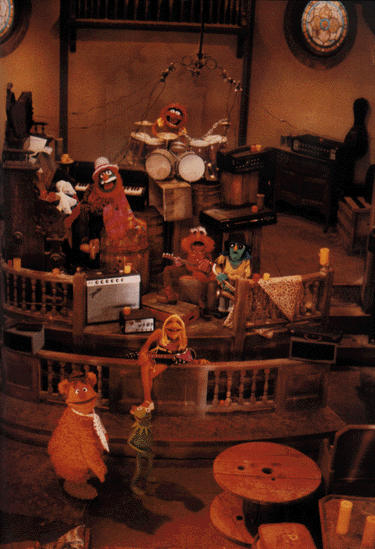
Kermit and Fozzie take a rest at an abandoned church which is in the process of being converted into a coffeehouse by a group of freeloading hipsters.  I mean, rock gods.

Also, this is the third instance of a recurring gag that I never noticed when I was younger.

Each member of the band is introduced succinctly, which is helpful for an audience who is aware of the Muppets, but not too familiar with them.  Since the Electric Mayhem was the first recurring fixture that Henson envisioned for The Muppet Show, they are introduced before the rest of the main cast.  While they won't be joining the road trip just yet, they will have their time to shine eventually.  Since they were always in the back of Henson's mind, he is suggesting that he keep them in the back of our mind for now.  Unfortunately, there is one character who for some reason gets lumped in with the band in this scene, which doesn't do his character justice:

He has to stay isolated up in the nosebleeds, too.

Scooter

Instead of using the backstory created for him in The Muppet Show, Scooter is reintroduced as the band's road manager (as opposed to the nephew of the owner of the Muppet Theater).  I would understand the need to change Scooter's past if he were going to join them on the trip to Hollywood (because he could very clearly pull a lot of strings and eliminate all of the conflict) but the script keeps him saddled to the Electric Mayhem the whole movie!  I feel as if this is unfair to Richard Hunt.  Scooter was his main character, and it just feels odd not to have him travel with the rest of the crew.  At least Jerry Nelson gets to come along as Camilla the Chicken, even if he has little to do.

Also, you can clearly see Hunt's arm in this shot.  Scooter don't get no respect.

Anyway, rather than join the frog and bear on their trip to Hollywood right away, the band and Scooter decide to camouflage their car to help them elude the villains of the movie.  Sure, they use bright, gaudy colors, but at least we get an original Mayhem song to accompany the painting sequence.


And sure enough, the new paint job helps our heroes escape the clutches of Hopper and Max!

That's pretty clever.

The victory is short-lived, because it suddenly seems as if the screenwriter realized the movie was running over time, so the next introduction comes crashing headfirst into the story.

And his vehicle's ornament looks very familiar.

Gonzo and Camilla

Like Scooter, Gonzo gets gypped for his introduction.  With little warning, he is literally thrown into the movie by way of a random collision.  Driving his plumbing van, Gonzo ends up joining the bear and the frog without any hesitation (except Gonzo was actually headed for Bollywood).  While this fast-paced scene is amusing, it would have been nice to hear more of Gonzo's backstory before he joined the caravan, since this is representative of Dave Golez's addition to the group.  He's a plumber?  Where did that come from?  Fortunately, he becomes a permanent traveling partner and his allowed a few moments to shine later on in the film.

This portion of the movie moves so fast that we barely get to enjoy the rainbow Studebaker.

The trio avec poultry decide to trade in their insurance nightmare for a more reliable vehicle (during an ADR'd moment, implying there was probably more to this scene that was cut).  Milton Berle is on hand to play the sleazy used-car salesman, since we haven't had a celebrity cameo in a while.  He calls out his assistant who is another Muppet favorite:

Sweetums

Aww, he's the best.  This is probably why Scooter couldn't join the trip (Hunt plays both characters).

Actually, this is probably Sweetums' best known role for people unfamiliar with The Muppet Show, for reasons that will become clear later on in the film.  For now, he unintentionally aids our heroes by decreasing the price of a car into Kermit's budget (under $12).  This mimics his original role in the Muppet television special The Frog Prince where he played a villain's sidekick-turned-big-ol'-softy.  Kermit extends his offer to give him a lift to Hollywood, and the brute runs off, missing his chance.

"Wait for me!  I want to go to Hollywood!" - Every dreamer's nightmare.

Tomorrow:  The gang meets the most beautiful pig in all of Bogen County.

Friday, September 16, 2011

ANIMAL EAT DRUMS

Early Animal, as designed by Henson

If the rest of the Electric Mayhem seem to lack energy, that is because their drummer more than compensates in that department.  Unlike the other four who were inspired by specific musicians, Animal is just the basic concept of the wild drummer.  He is the unbridled id who only exists to make noise.  His puppeteer Frank Oz described Animal as consisting of five basic ideas: "Sex, sleep, food, drums, and pain."  And more often than not, food and drums are combined.

Down! Back! Sit!

His spastic nature has made him the most popular member of the Electric Mayhem.  And they certainly need him on their team.  He makes sure they never stop rocking.


Even when forced to perform classical music, Animal refuses to be tamed.

Animal's not gonna make it, man...

Like his name suggests, Animal only functions on basic primal urges.  He is not very complex, which may contribute to his popularity.  Everyone can recognize what Animal is all about.  He does not hide his true nature and, in some ways, is like the Muppet Theater's resident pet.  He is kept chained up in the basement, only allowed out to perform his art.  And despite his unhinged persona, he is quite the talented drummer.  Like Zoot, Animal had his own personal musician who supplied the music, and the puppeteers had to be careful to match his flailing drumsticks to the actual beat.

Ronnie Verrell, the man behind the Animal

Animal will appear many more times throughout the Muppet canon, sometimes playing crucial roles, but more often trotted out to provide comic relief.  It is simple humor to have this monstrous puppet devour and destroy, and that was the humor Henson liked best.  However, Animal's talent allowed him to break away from the repetitive nature of other famous Muppet monsters.  In the final clip, Animal's skills are pushed to the test as he must focus his energy and beat legendary drummer Buddy Rich in a drum battle.


In classic Celtic mythology, there exists the stock character of "the wild man," a shaggy individual who lives outside of society, both physically and mentally.  He behaves like a creature of the forest and attacks humans, unable to control his urges.  He is not welcomed in civilization and is treated as being below humanity.  His language is basic, often resorting to primal yells and grunts.  His skin is tanned and his teeth are sharp.  He is identified by his bright red hair.  Sound like anyone we know?

Don't worry, he's just upset about missing the Renoir exhibit at the National Gallery.

Thursday, September 15, 2011

Uh Oh... Zoot Skipped a Groove Again.

"Zoot is just a fifty-year-old burnt out musician." - Dave Golez, Zoot's puppeteer

The sax man.

I am tempted just to leave the entire post at that.  It would be fitting to Zoot's character.  He is a man of few words, letting his saxophone do the talking.  Because he plays the saxophone more than he speaks, it would be more fitting to describe his "vocal" performer as saxophonist Frank Reedy, who was one of the musicians behind the scenes The Muppet Show.

Frank Reedy recording Zoot's lines

Zoot's silent nature was not intentional.  While he was supposed to be a very laid-back jazz musician (and named after the common jazz apparel, the zoot suit), he originally was a very outspoken character.  Like Floyd, he often respected the integrity of the music, and would half-heartedly rebel as much as he could muster.  There was a sense that he was once a trend-setter in his youth, but a life of drugs and excitement took a toll on his soul, causing him to all but give up.

This behavior is evident in the first season, where he had more speaking and solo parts.  In "Sax and Violence," he rejects a piece for it's minimal saxophone parts, yet decides it's ultimately better to keep his gig.  As he deals with the musical (and physical) abuse the song brings him, he turns his weapon of choice into an actual weapon.


Zoot was supposed to be Dave Golez's main character (before Gonzo became an unexpected breakout star).  However, Golez often found difficulty finding motivation for Zoot to speak.  He would often pawn lines and jokes onto the other members of the Electric Mayhem, rather than find the way Zoot would deliver them.  Due to this behavior, Zoot became the butt of many jokes at the expense of his drug-addled brain.  He was sleepy, slow to react, and apparently homeless.  Not exactly the fun, glamorous, exciting world of rock and roll the Electric Mayhem set out to depict.  But it was accurate.  For the little that he did, Zoot grounded the group in reality.

I am sure there is a perfectly PC explanation for this picture.

One final oddity about Zoot is that in the five-year run of The Muppet Show, he underwent seven very different design changes.  The rest of the Muppets went through a few changes on average to produce better quality puppets.  But they mostly stuck to their original design and colors and significant changes were only added to increase facial expressions (movable eyebrows and eyelids, for example).  Zoot is a very unexpressive character, yet he was constantly updated with different skin tones and nose colors.


Is he blue, gray, or green?  Is his nose yellow or not?  Is this the result of drug abuse and malnutrition?

Whatever the truth is, Zoot ain't talking.

Wednesday, September 14, 2011

Like, Totally!

Janice, the lead guitarist for the Electric Mayhem, underwent a unique path in character development.  In the original plan for the band, there was no female member.  There was, however, a guitarist heavily influenced by rocker Mick Jagger's appearance and build.  His big lips and skinny frame lead to the design of the proto-Janice.

One of the features includes an exaggerated Adam's Apple.  Definitely a guy.

The long, bright white hair was supposed to invoke the hairstyles of male punk rockers at the time, but somewhere along the way, it was decided that the Electric Mayhem required a feminine aspect.  So this already girly looking character became Janice, based on female musicians like Janis Joplin.

During the first season of The Muppet Show, Janice was voiced by Eren Ozker, taking over from Fran Brill who voiced her in the pilot.  Brill, known for characters like Prairie Dawn, had given Janice a high-pitched voice, unsuited to her rock and roll atmosphere.  Ozker, however, gave her a sexy, husky voice that invoked Joplin's signature style.  However, Janice's singing voice was never featured during Electric Mayhem's songs.  The only chance to hear her sultry voice was during her role as Nurse Janice during the Veterinarian's Hospital sketches.


Ozker left after the first season, allowing Richard Hunt to step in as Janice's performer.  He created the Janice we are familiar with today, with a valley-girl attitude and vocabulary that was previously not present.  Still, Janice was not offered many solo singing roles, due to her voice no longer fitting the intended persona for the lead guitarist.  She became Floyd's love interest and would be found singing love-themed duets with him.


Her biggest solo number, fittingly, was "With a Little Help from My Friends."

What would you do if I sang out of tune?

Personally, I was a fan of the original Janice.  The voice and personality seemed more appropriate to the Electric Mayhem's nature and the "valley-girl" speak feels a little forced and unnecessary at times.  She does not act like a spoiled brat, nor does she appear ditzy.  But the "fer sures" and "rullys" have replaced most of her character traits.

Like, oh my gosh, ya know?

However, Richard Hunt realized the potential that this one-dimensional character had.  Because the other Muppets were so well defined, he could add anything he wanted to Janice's character and make it part of her personality.  These ad-libs became apparent in the Muppet films, in which Janice would find herself in the embarrassing situation of talking during conversational lulls.


Those small, random moments make Janice one of the most unconventionally funny Muppets of the main gang.  Her random thoughts take on a more risque nature than the Muppets are usually associated with.  In public appearances, the puppeteers have fun exploring the sexuality of the token "hot girl" Muppet.  At Muppetfest in 2001, some the puppeteers and their Muppets took turns answering questions from fans.  This resulted in the following exchange:

Question:  (to Floyd Pepper) "Are you still tight with Janice?"

Floyd: "Well, Janice ain't so tight anymore."

(The audience laughs, shocked.)

Elmo:  "Elmo doesn't understand the question.  Could you explain the question, Mr. Floyd?  'Cause Elmo learned on Sesame Street - if you don't understand something, always ask!"

Janice:  Reminding us that the Muppets aren't always for kids since 1975.

Tuesday, September 13, 2011

Mr. Bassman

Original Floyd concept art

Performed by Jerry Nelson, Sgt. Floyd Pepper was often used as the voice of the Electric Mayhem.  He took lead vocals on most songs and would voice any complaints and requests the band would have.  Although is name and appearance drew inspiration from the Beatles' "Sgt. Pepper's Lonely Hearts Club Band" and Pink Floyd, his attitude and voice had mellow, urban American feel as opposed to his British influence.  Nelson described the background of his character as having started as a beatnik who segued into jazz and then rock (and stopping right before punk), much like himself.

"I am he and he is me and we are all together." - Jerry Nelson

Because of his role as band spokesman, Floyd embodied the soul of music itself.  His morals and values revolved around the integrity of the musical craft and would speak out if his creative freedom was compromised.  He stuck to the stereotypical attributes of the bassist, embodying coolness and maintaining 100% of his focus on his instrument.  He did not perform to show off.  He performed because it was right.


The bassman exists to carry the rhythm of the song and rarely gets solos.  Floyd, however, did get to break from the norm and perform songs by himself, resulting in some classic Muppet Show moments.  The following clip harkens back to the puppet's roots with "While My Guitar Gently Weeps," a song originally by George Harrison.


And his soft, rapsy voice seems to have been made for "Blackbird."


Because of his relationship with music, Floyd Pepper became one of the few Muppets who got to perform at the Grammy Awards.

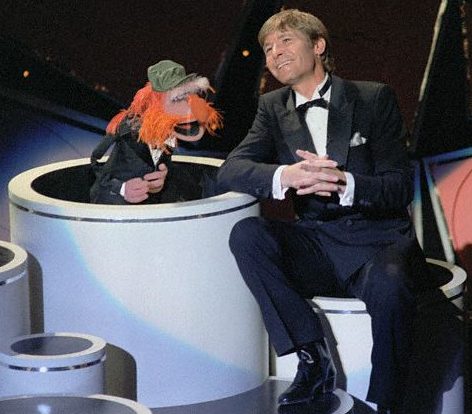
All dressed up with John Denver

In 1982, John Denver had a televised special Rocky Mountain Holiday with John Denver and the Muppets which also had an album released in conjunction.  The album was nominated for a Grammy, and Floyd was invited to sing "Gone Fishin'" at the awards show with him.


While puppeteer Jerry Nelson didn't get a character as popular as Kermit, Fozzie, Miss Piggy, Animal, Gonzo, or Scooter, his signature character was a very respectable member of the Muppet crew and possibly one of the coolest cats ever to grace the Muppet Theater stage.

Everything is everything!

Monday, September 12, 2011

Golden Teeth and Golden Tones

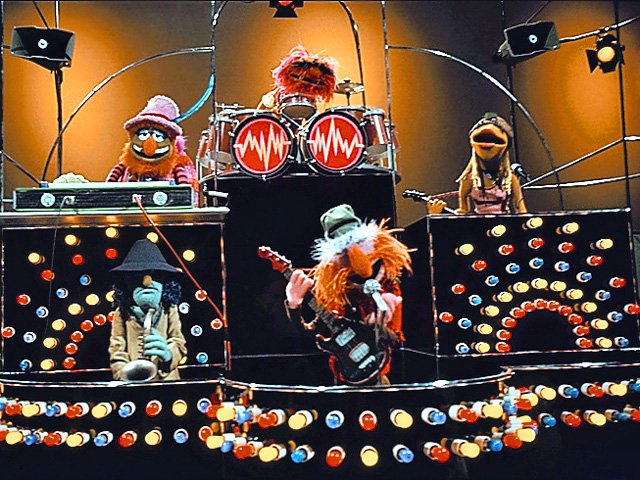
Ladies and gentlemen, Dr. Teeth and the Electric Mayhem

Henson had a fondness for the rebellious nature of rock and roll music.  In creating The Muppet Show, he made sure to include the most outlandish rock and roll group he could think of.  The Electric Mayhem was created as a hodge-podge of different rock musicians and styles, creating a unique looking bunch that could only exist in a fictional form.  Each of the five main performers on the show were given their own character to perform.  This week, we shall look at the parts of the whole that contributed to the Electric Mayhem's sound.

First up is Jim Henson's proxy and the leader of the band, Dr. Teeth.

Henson's original character concept art

As you can see from the first sketch, Dr. Teeth was originally known as "Leon 'Doctor' Eltonjohn Dontshoot," drawing his inspiration from piano players such as Leon Russell and Elton John.  But the biggest influence on the character design was jazz and zydeco enthusiast Dr. John.  The following clip shows the original musician in his prime, and it is easy to see where Teeth's movements, voice, and language patterns came from.


Dr. John represented the fringe nature of rock music and it was that break from the norm that Henson wanted to encapsulate.  Dr. Teeth's band would perform the music that your parents thought was too loud and sounded like garbage.  Even when given the task of performing classical pieces or sweet love ballads, the Electric Mayhem's rock nature always crept through.


Although the band usually performed covers or backup music, original pieces were created, such as "Don't Blame the Dynamite," which neatly sums up the message of Mayhem.


In this piece, Dr. Teeth encourages the listener to embrace the music and bring back the fun in their boring life.  It seems directed at all of the old fogies who have forgotten what it is like to be young and are wondering where that spark of life has gone to.  Teeth reminds them that the passion is still there and it is up to you to unearth it.

Like the Swedish Chef, Dr. Teeth is another unique version of the two-person Live-Hand Puppet.  In order to capture Dr. John's signature piano-playing hunch, long, extendable arms are attached to the body that droop when Teeth is close to the piano.  To highlight this unique quality, Henson would enjoy walking as far away from the piano as possible to show the connection Dr. Teeth has with his instrument.  A second puppeteer would be playing the piano with the two hands, but unlike the other puppets which have large bodies to hide the second puppeteer, the two hands seem magically disembodied.  Watch Dr. Teeth's arms as he performs in this next clip.


This stylistic choice results in one of the most interesting looking puppets on the show.  Henson once said that he sees the Muppets as representing abstract concepts rather than actual creatures.  That is certainly true with Dr. Teeth, who is piano playing incarnate.

Welcome to my presence.