Tuesday, July 10, 2012

Random Muppet #7: Socks the Cat

On the Muppet Wiki, there is a "Random Muppet" button which sends you to the page of one of the thousands of Muppets in existence. I will press the button and discuss the importance of the Muppet that comes up, no matter how obscure. No skips. No redos. This is the Random Muppet Challenge.

Random Muppet #7: Socks the Cat

A presidential kitty.

Performer:  Dave Golez

Muppet Universe of Origin:  General "Muppets"

Most Significant Appearance: Larry King Live, April 1, 1994

On April Fools Day, 1994, Kermit the Frog stepped in as guest host of Larry King Live. He interviewed a normal array of guests, including news anchor Ted Koppel, wrestler Hulk Hogan, actress Carol Alt, and presidential advisor David Gergen.  The show was peppered with appearances from other Muppets, both visually and calling in, but it wasn't until the very end that a non-human was interviewed.

That "person" was Socks the Cat, First Cat of the United States, owned by the then-current President Clinton.  Presidential pets are basically living PR campaigns.  They humanize the elected official and allow for the general public to feel closer to the White House.  They have a cute puppy or kitty just like us!  That makes us like them more!

But Kermit wasn't going to stick with cutesy stuff.  He was there to ask the hard hitting questions.  In a spoof of presidential "scandals," Kermit analyzes the first missteps of Socks the Cat's term in office.


Socks must explain his uncalled for behavior as the cameras capture his attacks on other cats.  Kermit  amusingly is shocked and appalled by what he sees and the Cat must come up with valid talking points to remain in the audiences good graces.  He eventually works himself into a hairball-hacking frenzy as he is escorted offstage by his advisor.

Why Is He the Best Muppet?

The nature of celebrity is fundamentally absurd.  There are three basic types of people who become famous: those in politics, those in the entertainment industry, and those who change the world through science and humanitarian efforts.  Yet, despite their roles and validity as human beings, we treat them all the same as the collective "celebrity."

We analyze how they dress, what they eat, who they interact with, where they go, what they do, how they look in a bikini, what they accidentally said to their mistress, how they sneezed, etc.  If a non-celebrity meets a celebrity, they get excited because they have interacted with a person they recognize who has no idea who they are.  We are in awe of these people.  We treat them like royalty.

And we treat them like dirt.  Because there is nothing more interesting than a good piece of gossip.

In the high school of life, celebrities are the popular kids that outshine the rest of us.  And we love to see them fall.  In politics especially, minor gaffes and scandals can be blown out of proportion as evidence to discredit these people's characters.  Some scandals are worthy of discussion and important to follow up on, but others are completely ridiculous.  If you watch any major news channel, you can tell by the extreme severity of their graphics that we have trouble distinguishing what is actually crucial knowledge in the world of political snafus.

Socks exists to highlight our insatiable need to scrutinize our celebrities.  This interview came out before Clinton's career defining scandal, but if anything, that only increases the relevance.  Kermit pulls out a piece of damning evidence, trying to put Socks on the spot to explain his actions.  He is behaving like a normal cat.  He may be misbehaving, but a lot of cats misbehave.  He just had the misfortune of being a cat that people looked up to and constantly observed.  He has no privacy.  Every misstep is added to his permanent record and it tarnishes his reputation and actual service to the country.

Socks is just a cat trying the best he can.  Perfection is a terrible burden to place on a little kitty.

Monday, July 9, 2012

Random Muppet #6: Treelo the Lemur

On the Muppet Wiki, there is a "Random Muppet" button which sends you to the page of one of the thousands of Muppets in existence. I will press the button and discuss the importance of the Muppet that comes up, no matter how obscure. No skips. No redos. This is the Random Muppet Challenge.

Random Muppet #6: Treelo the Lemur

A bundle of energy.

Performer:  Tyler Bunch

Muppet Universe of Origin:  Bear in the Big Blue House

Most Significant Appearance:  Bear in the Big Blue House, 1998, "Episode 221: Dance Fever!"

It's a quiet day in the Big Blue House, and everyone is content to do their own thing.  Some draw, some swing and some nap.  But Treelo can't stop moving and he wants everyone to dance!  He drags his music around imploring his friends to get up and move, and after some initial reluctance, everyone comes down with a case of "dance fever."

It's spreading!

Eventually, all of the dancing gets Treelo tuckered out.  Finally, he decides it's time to rest, but no, the others say that he has to keep dancing.  My, how the tables have turned!

Why Is He the Best Muppet?

Bear in the Big Blue House was yet another Henson children's production at it separated itself from the rest by targeting a different age demographic.  Sesame Street was ideal for 3-to-7-year-olds, Fraggle Rock was for slightly older 5-to-9-year-olds, and the Disney Channel's Bear in the Big Blue House was best for 1-to-4-year-olds.  Because the audience was so much younger, there was a lot more order and simplicity to the events of the house.

Each episode began with the caretaker Bear greeting the viewer and smelling them.  Then, the topic of the day would be introduced.  Rather than learn a preschool curriculum, the topics dealt with daily discoveries in a toddler's life.  The characters would learn about things like bathtime, going to the potty, visiting the doctor, and playing outside.  The episodes would then end with Bear reflecting on his day with the moon Luna.

Like Blues Clues, the show featured a lot of talking directly to the viewer and repetitive songs that would signify each recurring segment.  Bear was the only "adult" in the show, and the other Muppets provided the mindset of children, much like the Sesame Street Muppets.

The youngest was Treelo, who seemed to be about two years old.  Unlike the other characters, he never had much to add in the way of teaching.  He just observed and participated and learned.  And, he ran around and climbed on walls because he was an unstoppable toddler.  And a lemur.

Treelo!  Get off of that bathroom vine!

Like a mix between Elmo and Baby Natasha from Sesame Street, Treelo spoke with a limited vocabulary and would often delve into incomprehensible baby babbles known officially as "Treeloese."  He was capable of having a conversation, but it was clear that he was still in the process of learning how to speak.

Despite his vocal limitations, he did not hold back in communicating his needs and wants.  Like all 2-year-olds, the world revolved around him.  If he wanted to dance, it was time to dance.  If he wanted to play, it was time to play.  He wouldn't throw tantrums, but he just lacked the ability to process that other people don't see life the way he does.  In the following clip, he tries to get the mouse Tutter to play a game of pretend with him.  Tutter, behaving like a 4-year-old who has just figured out logic and rationality, refuses to play the part of the Snow Bear because he is a blue mouse, not a white bear.


Tutter throws a fit trying to explain that a mouse can't be a bear, but none of this registers with Treelo.  He calmly repeats his request, since he enjoys playing Snow Bear.  He asks Tutter to pretend, and Tutter finally understands that he will have to play make-believe.  But for Treelo, "pretend" is just a word that people use when they are playing and it makes people more willing to do what he wants.  Tutter still remains upset that Treelo sees him as just another plaything, but Treelo can't help but view him in that fashion.

The reason Treelo barely had any signature episodes was because a 2-year-old operates on his own level, and only he would understand his true intentions.  In a show as orderly as Big Blue House, Treelo had nothing holding him back.  Putting him in charge would be sheer chaos.  "Dance Fever" is his greatest showcase, because he can present his case clearly, and everyone ultimately gives in and lets their inner child come out to play.  No worries, no responsibilities, no thoughts.  Just living in the moment.

Treelo exists in all of us.  Some are more in tune with him than others.  Life is a balance, carefully choosing the right moments to let Treelo out.  But sometimes, we need not think so hard.

Sometimes, we just gotta dance.

"We are fools whether we dance or not, so we might as well dance."

Sunday, July 8, 2012

Rocky Monotonous Holiday

Why do people go camping?  Some do it to be closer connected with nature, far from civilization and pollution.  There is an element of the wilderness being pristine and untouched, waiting to be enjoyed like a hidden treasure.  Others camp to challenge themselves.  Finding new ways to prepare food and shelter, while also trying activities like hiking, rock-climbing, and swimming.  It's that sense of adventure that attracts people from the comfort of their homes.  Still, others enjoy the camaraderie that develops.  You never really know someone until you go camping with them.  And then there are those that enjoy the peace and solitude.

All of these aspects make camping a wonderful choice for a vacation.  John Denver is obsessed with camping and he wanted to produce another special with the Muppets exploring the joys of the Rocky Mountains.  And what's John Denver's favorite thing about camping?

Apparently it's singing a never ending slew of cheesy songs.

Alright, now for my 35th song...

Rocky Mountain Holiday follows a similar format to A Christmas Together in that a loose storyline of Denver hanging out with the Muppets is broken up by traditional and original songs associated with the holiday.  But while a Christmas special can get away with a certain level of corniness, a summer holiday special seems to be forcefully dull.

For one thing, camping songs aren't as prevalent in the modern culture as Christmas songs are.  Because the airwaves get over-saturated with holiday cheer in the winter, we become numb to the actual content of the song and appreciate it when it rolls around.  If you aren't an avid camper, the camping songs aren't as memorable, but just as insipid.

Jimmy Crack Corn and I Don't Care.

John Denver prides himself on wholesome entertainment, but seems to have forgotten that entertainment involves something entertaining by definition.  Denver, once again, seems to live in his own little world, singing songs to himself while the Muppets (being just shells of themselves) egg him on.  Like A Christmas Together, the unity between Denver and the Muppets is lacking, but at least at Christmas, the Muppets were able to do their own thing.  Here, it feels like Denver dragged all the puppets out to be his captive audience.

Give us the keys, Denver!

The Muppets constantly reminisce about past vacations they spent with Denver, but these moments feel hollow.  When they aren't stroking Denver's ego, they are going through run-of-the-mill camping jokes that were clever in the 1950s.  Animal pitches his tent...into a lake!  Rowlf is wondering where he can set up...his television set!  The Muppets aren't behaving like themselves.  They are just joke dispensers.

The gang's all here, but they aren't really "all there."

But the truly aggravating moments are the campfire sing-alongs that take up the second half of the episode.  The Muppets barely talk about anything other than what song is going to be played next.  Oh, there is a "hilarious" ghost story about a Man-Eating Chicken.  But other than that, it's just song after song after song.

Even when the chicken does show up, it can't end the horror.

As I was watching this, I began asking myself, "Is this really it?  Is this what so many people love about camping?  Singing bland songs at each other all night?"  And then I remembered my own camping experiences with friends.  Yes, we sat around a campfire, but we didn't avoid conversation.  We delved into our inner most psyches.  We got to know each other in ways we never had before.  We played games and told jokes and had fun.  This is the camping special I would have wanted to see out of the Muppets.

Imagine Jim and Frank and Dave and Richard and Jerry, alone, as their characters, just improvising conversations about life.  That would have been a captivating special!


This is what the Muppets are capable of.  Let them live!  Don't keep them constrained to silly jokes and songs.  The Muppet moment I kept thinking back to as I watched this special was the camping scene from The Muppet Movie.  There, we have the exact same set up, but, due to the added drama of the movie, there is a somber, yet interesting tone to the scene.  They start singing and it is a genuine moment.  Kermit has a self-reflective monologue.  All because they are out in the middle of nowhere, trapped under the stars.  This is what Muppets are like when they go camping.

Wow, profundity.

Rocky Mountain Holiday does contain some drama in that Robin feels as if he is too small to help out. But Robin is always feeling too small. All Denver does is sing some loosely-related song to him and it cheers him up.

CRISIS AVERTED!!!

I went into this special with high hopes, but this sterile complication of musical numbers left me high and dry. There also exists an album version of this special, like with A Christmas Together, but since the point of camping is the experience of being outdoors in nature, we lose a lot of the beauty in the transfer to audio.

These pictures look so great.  Maybe if I watched the special on "Mute," I would have enjoyed it.

If you have fond memories of this special, I don't want to take that away from you. The special is quaint. And it's charming. But it lacks any sort of depth.

At least this special makes me want to go camping... far from any television sets.

Saturday, July 7, 2012

War, What Is It Good For?

Fraggles live a good life.  Their society, for all it's flaws, is quite utopian.  Their problems can always be easily fixed and while their simple minds may take them a long moment to figure out proper solutions, they always live to see another day of fun and laughter.  They are a peaceful, non-violent society, and nothing could ever change that, right?

Well, it's time to look at "Episode 217: Fraggle Wars."

Red and Mokey go camping as far away from Fraggle Rock as possible (because Gobo also went camping far away, and Red has to beat him).  Mokey muses that despite their differences, all Fraggles are the same, deep down.  Her explanation of the episode's moral is cut short however, when they discover that they have wandered on to the land of another group of Fraggles.  These Fraggles of "Fraggle Cave" are the exact opposite of the Fraggles we know an love.  Orderly and humorless, the Cave Fraggles are not keen on excitement of any kind.

"We are happy here."

Recognizing Mokey and Red as enemy Fraggles, the Cave Fraggles capture Mokey and lock her in a cage.  Red manages to elude them and returns to Fraggle Rock to warn the others.  The World's Oldest Fraggle steps in and reveals that the Cave Fraggles are the sworn enemies of the Rock Fraggles and since they have captured Mokey, there is no choice but to go to war.

Listen to him! He has a beard!

The peaceful Fraggles are hesitant and confused about going to war, but Red exaggerates about Mokey's predicament, claiming all sorts of torture that the Cave Fraggles are putting her through.

I feel like there might be a metaphor in all of this.

Back at Fraggle Cave, Mokey tries to reason with her captor, Beige Fraggle, who sympathizes with her, yet feels that rules are rules and Mokey should be punished.  The Cave's own Oldest Fraggle also decides that a war is in order, and Beige blindly follows along.  Mokey tries to get Beige to experience the joys of laughter and song, and it is revealed that Cave Fraggles have their own form of humor: telling jokes without punchlines or wit and then laughing in rhythmic unison.

No video here, but I assure you, it's creepy.

Mokey tries to convince the Cave Fraggles to listen to their inner voices rather than their oppressive rules.  But the Cave Fraggles don't understand her and instead leave her as they head off to war.  Mokey sings a wistful tune as the two sides prepare to kill each other, reflecting on the beauty of life that is about to be demolished.

I know why the caged Fraggle sings.

But alas, all of Mokey's efforts are futile.  The Cave Fraggles ready their weapons.


And the Rock Fraggles brandish the first weapon they've ever used in decades.

 This is serious.

Red, who only wants to save Mokey, asks the World's Oldest Fraggle why the two groups hate each other so much and it is revealed that because of their different senses of humor.  The Rock Fraggles believed only their jokes were funny while the Cave Fraggles believed only their jokes were funny.  Realizing that Fraggles could die over this inane reasoning, Red teams up with Beige, and together, they pie their respective leaders in the face.

Just like the alternate ending to Dr. Strangelove!

Both groups of Fraggles start laughing and the war is averted, now that each side finds something that they have in common with the other: pie-to-the-face comedy gold.

This anti-war episode of Fraggle Rock deals with the atrocities of war as best as a children's show can. There are euphemisms for everything, including the reasoning behind barbaric practices.  Mokey's torture, the Cave Fraggles blindly following orders, the "wise" elders leading the charge based on tradition, the doomsday weapons.  Each of these are treated with simplicity, yet speak to larger issues.  But the fact that even the peaceful Fraggles can be brought to a state of war is alarming.  That the cause of war is over a source of joy makes the absurdity all the stronger.  The episode serves to remind us that no matter our beliefs or affiliations, we are all sharing the same Rock.

Friday, July 6, 2012

This One Time at Summer Camp...


In 1982, Big Bird spent a week at summer camp.  It was is first time away from home.  And to a kid, this was a life changer.  This was scarier than going on vacation and scarier than going to school.  This was complete isolation from the family you've spent your whole life with.  Sure, at first, Big Bird is excited about all of the fun things he'll get to experience at camp.

In fact, everyone is a little too excited.

But then, reality sets in as Big Bird realizes he'll be leaving all his friends behind and he won't be able to see them at the end of the day.  He is both happy and sad at the same time, and these mixed emotions confuse and overwhelm the bird.  Even Gordon starts crying because he knows Big Bird is growing up.

Crybaby.

Big Bird has no idea what he is in for, and how could he?  Summer camp is unlike anything else in a child's world.  It is a solid week of outdoor fun and games, yet there are also rules and regulations, not to mention the abundance of new faces who have no idea what is going on.  Big Bird meets his first new "friend" on the bus to camp, and this kid is a pain!

He's the only other Muppet on the bus.  I guess I'd better sit with him.

His name is Rusty and his main character trait is that he is completely unwilling to try new things until people coax him into it (or ignore him) and then he ends up doing the new thing anyway as if he had planned on it all along.  He's insufferable.  After everyone gets situated in their cabin and spends the first night, Rusty refuses to get up in the morning and holds everyone up, demanding they bring him breakfast in bed.  This kid quickly learns that the world of summer camp isn't going to cater to his every whim and he'll actually have to be productive.

This kid's begging to be short-sheeted!

Big Bird runs into similar troubles, as he insists on carrying his teddy bear with him to every activity.  He quickly learns that he'll have to leave the bear behind if he wants to participate.  He worries when he is called up to play baseball, since he has never played before.  But, through practice, he succeeds in getting a home run! Trying new things is good!

And he managed to do it with only one arm!

After an exciting day, Big Bird settles into bed, and then gets very homesick.  That morning when he woke up, the new surroundings confused him at first, but he learned to enjoy the camp.  But now that he has time to rest and reflect, he can't help but be sad.  Rusty also feels homesick (though he won't admit it, the punk) and together, the two share a good cry.

It isn't a good day at summer camp unless it ends in tears.

The next day, Big Bird tries many new things, with his biggest accomplishment being swimming!  I don't even want to think about how they dealt with the aftermath of the Big Bird puppet being dunked in a lake.  Poor Carroll Spinney.

Sure, Big Bird looks happy, but inside is a man gasping for air.

The following day is a hike, and Big Bird and Rusty spend their first night out in the wilderness.  The group gathers around the campfire for songs and stories.  And tacky rock and roll numbers.

Can't we just appreciate the peace?

Big Bird and Rusty share a tent and the two argue about space issues.  Eventually, they manage to settle into a configuration that makes both of their puppeteers happy.

Rusty's just upset that he can never take off his baseball cap.

Finally, after a weeks worth of new adventures, the campers get ready to head home.  Everyone wins obligatory camp awards.  Is this a summer camp tradition?  Everyone gets an award on the last day?  I never heard of it before.  Anyway, after the nameless extras win "Tidiest Bunk" and "Least Acorns Shoved Up Nostril," Big Bird wins "Best Swimmer" and Rusty wins "Most Willing to Try New Things Even If He Thought He Wouldn't Like Them."  And, true to his nature, Rusty doesn't care if he got an award, but he accepts it anyway if it'll make everyone happy.  What a little Pete Campbell.

Seriously, that kid is the worst.

Eventually, Big Bird says goodbye to camp and returns home.  He learns that Rusty lives just around the corner from him and he promises to visit him all the time now that camp is over.

And we never saw Rusty again.  Seriously.  Good riddance.

Summer camp is not an event.  It is a state of mind.  For Big Bird, it was a time to face fears and try knew things.  He learned a lot about himself, now that he was away from everything that was familiar to him.  Summer camp allows for introspection, and upon returning to the real world, you are faced with a new outlook on life.  Anything can happen in this world, and you've got to be ready to face it.

Otherwise you'll end up just like Rusty.  And that kid's a tool.

Don't be a rusty tool.  Be a happy camper.

Thursday, July 5, 2012

Be Prepared in Mind, Body, and Webbed-Feet

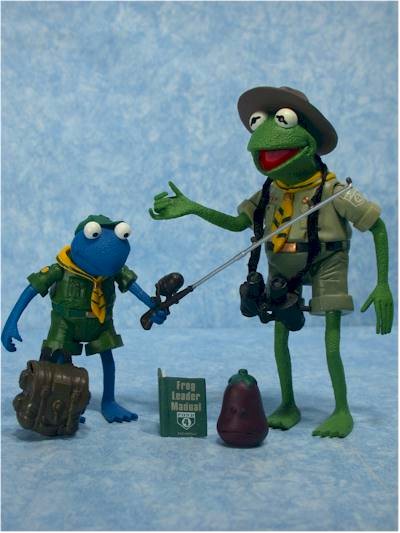
Boys have Boy Scouts.  Girls have Girl Scouts.  Frogs have Frog Scouts.

Trustworthy, Courteous, Amphibian

Scouting culture originated in Europe, but the American Boy and Girl Scout organizations have become synonymous with "Americana."  Thanks to pop culture and Norman Rockwell, the images of groups of children learning wilderness survival and cooperative skills are filled with nostalgia for a great American childhood.  By studying different techniques to become better citizens, the Scouts represent the best of what America has to offer.  Kermit the Frog's virtues makes him the ideal candidate for a Scout Leader, and, by default, the Frog Scouts were born.

Rule #1: No shoes allowed!

Scout Leader Ms. Appleby and the Okefenokee Pack 12 of the Frog Scouts.

They first appeared as a group in an episode of The Muppet Show in which Robin invites his troop backstage for a chance to meet that week's guest star, Debbie Harry of Blondie.  This storyline would have worked with any guest star, so, due to random chance, we are treated to a group that is obsessed with Debbie Harry and hopes to earn their "punk" merit badges.

Just like when you were a kid!

The episode mostly features the young frogs getting in the way and being starstruck, but they manage to find time to be useful.  They are able to fill in for Gonzo's cancelled act and they even stitch up Link after a particularly brutal "Pigs in Space" sketch.

If you couldn't tell, he had a broken nose.

The jokes never go beyond the surface level of funny merit badges or the troop's overeagerness, but this wouldn't be the last we saw of the Frog Scouts.  They would continue to appear in other publications, continuing their display of silly badges, because that's all there is to say about Scouts, right?  All those crazy badges, you know?!

A young Alfonso Ribeiro (a.k.a. Carlton Banks from The Fresh Prince of Bel Air) receives the "Boogie Badge."

In picture books, the Frog Scouts would undergo a familiar routine where the adults, in trying to teach them survival skills, always ended up needing to be rescued by the young Scouts.

Even Kermit suffers from this fate.

But the Frog Scouts' greatest moments occurred during Nickelodeon's "Muppet Time" segments that aired during reruns of The Muppet Show.  Here, we got to see the Scouts all on their own, out in the element, using their wits and teamwork to survive tough situations.

Like constant bear attacks.

Except for Robin, we never learned the names of these frogs, but they each had a distinctive personality  from which comedy (and life lessons) could ensue.  For example, never underestimate string.


If you watched that clip, you may have noticed that one of the Frog Scouts is a girl.  It seems that the Frogs Scouts is an equal-opportunity organization, which creates a stark contrast with the Scouting organizations it's based on.  Much controversy has arisen over the Boy and Girl Scouts approach to creating better citizens by explicitly excluding certain individuals from joining.  Apparently, intolerance is a virtue.

But the Frog Scouts are not like that.  Watch the next clip as a new member tries to join their group.


The group initially hesitates for taking in the new member.  It isn't because of her gender or her beliefs. It is because her talent doesn't seem very crucial to wilderness survival.  But, once she shows that she can benefit the group with her talent, they realize they were quick to judge and allow her in.

Going back to the original Frog Scouts episode, we can see that this has always been a part of their practice.  Why, at the end of the episode, they make Debbie Harry an Honorary Frog Scout!  She isn't even of the same species, yet they accept her all the same!  For comparison, Honorary Boy Scouts have all been Christian males, just like regular Boy Scouts.  

Even in this simple episode, the Muppets were being startlingly progressive.

As a safe haven for children to explore the wilderness, learn about life, and form friendships, the Scouts offer great lessons and valuable services.  But, if given the option, I would choose Frog Scouts over any of the other organizations.

Boys have Boy Scouts.  Girls have Girl Scouts.  Anyone and everyone has Frog Scouts.

You are welcome.

Wednesday, July 4, 2012

An All-American Avian Ace

Sam the Eagle represents American patriotism at its worst and best.  He is extremely loyal to his country (or at least his idea of his country) but completely oblivious to what his country is all about.  Created to parody right-wing conservatives, Sam behaves like a buffoon, more so than the clowns he associates with.

He's a birdbrain...with standards.

Acting as The Muppet Show censor, Sam hoped to bring quality entertainment to the American public, removing any sense of indecency.  Compared to other forms of entertainment, the Muppets are quite wholesome.  They were quirky and weird, but they never aimed to offend.  So, adding a censor to their midst required that person to be the stuffiest individual imaginable.  Sam was always quick to naysay, but he never seemed to know what he wanted.  In one famous speech, he starts condemning every creature in the world for being naked under their clothes, fur, and feathers.


Kermit, as we know, was a very orderly host.  He was usually the straight man for bizarre shenanigans.  When you're trying to argue that he isn't wholesome enough, then you know you have issues.


When pressed to explain what exactly he wants out of The Muppet Show, Sam commonly calls for  "culture."  Yet, when he must prove his knowledge of "cultured" art, he often comes up short, mistaking opera for ballet or failing to recognize great artists when he is talking to them.

Of course, Liberace was going to be a tough sell on this eagle no matter what.

Because of his ignorance about art, the other Muppets would usually prank Sam into performing items that featured "crassness" in subtle ways.


He was definitely a punching bag for the liberal minded Muppeteers, yet, he was painted in such a way that even those he was mocking could appreciate him.  Stephen Colbert is a great example of a fake conservative who uses his character for satire, yet he stays so true to character that some can't tell the difference between him and an actual conservative.  Those conservatives who are aware that is an act are generally not fans, although many have a good sense of humor and are willing to engage with him.  Sam probably wouldn't offend as many conservatives as Colbert, though.  Because he is often the victim of his own hubris, audiences can sympathize with him, no matter their political affiliation.  He just tries so hard to be right that he can't help but stumble.  In one surprisingly serious moment, Sam reveals the nature of his family, having a wife who left him and two college-aged children who don't write to him.


He is so hard pressed to promote American family values that he is unable to value his own family.  That's tragically and comedically poetic.

No time for family.  He's got a country to protect.

No matter how absurd Sam's demands can get, he is still viewed as being a great American.  Being an American eagle, he has to do no more than just exist in order for an American citizen to feel pride.  Even if he stands against everything you believe, he loves his country and is willing to do whatever he can to defend it.

The best thing to come out of the Disney-Marvel merger.

Though his feathers get ruffled over any form of weirdness, he must remember that the greatest value of the American Way is exercising one's rights to freedom.  No matter how flustered his companions make him, they are being American by being themselves.  His is a difficult life, being the only Muppet who represses his own Muppet heritage.  But, he takes himself so seriously and to such an extreme that he can't help but belong with the other crazy Muppets.


They are all weirdos, and he is the weirdest of them all.

*      *      *

As a 4th of July bonus, here are Don Music and Grover reenacting the signing of the Declaration of Independence.


Happy Independence Day!