Tuesday, May 22, 2012

The Fragglian Shadow

"Everyone carries a shadow.
The less it is embodied in the individual's conscious life, 
the blacker and denser it is." 
Carl Jung, "Psychology and Religion" (1938). In CW 11: Psychology and Religion: West and East. P.131

Fraggles, like children, run on pure id.  While Doozers work, the Fraggles frolic and play all day.  It is part of a Fraggle's nature.  It's in their blood.  So it comes as a shock to many Fraggles when they meet Boober, the Fraggle who hates fun, surprise, and any sort of danger.  His concern for safety has branded him as a worrywart, but he is content to be so.  As long as people leave him alone, he gets along just fine.

But Boober's repressed Fraggleness wasn't going to stay hidden for long.  Sooner or later, Boober's psyche was going to burst, and the side of him he had kept down in the bottom of his mind was going to take over.  Thus, Sidebottom was born.

The Hyde to Boober's Jekyll

In Jungian psychology, there are three steps people take when interacting with their shadow and Boober takes this journey over the course of three episodes, each chronicling a different step.

1. The Encounter with the Shadow (Episode 206: "Boober's Dream")

The shadow usually reveals themselves in dreams or visions and this is exactly how Boober first meets Sidebottom. In a series of nightmares, Boober finds himself having fun as the life of the party. He turns to his friend Wembley for help and, through the Fraggle process of shared dreaming, Wembley is introduced to Sidebottom, the fun side of Boober.

He's got a silly hat and everything!

During this stage, the shadow reveals himself to showcase all aspects of the hero that refuse to be acknowledged. Sidebottom is energetic, funny, and playful. He tells great jokes and makes sure everybody has a good time. He makes Boober sick, but Wembley thinks he's a blast! Sidebottom instructs Wembley to bring all of Boober's friends into the dream so he can finally play with them. Wembley obliges, and that night, all Fraggles join in Boober's dream.

Make your own Inception reference here.

All Fraggles have a great time playing with this new side of Boober, but, with the Encounter comes the suggestion that the hero will eventually fall victim to the shadow. Sidebottom begins to hold the rest of the Fraggles hostage, agreeing to only let them escape from the dream if Boober agrees that he'll let Sidebottom come out to play in the real world. In order to save his friends, Boober agrees that he must embrace his fun side from time to time. In the context of the episode, this is treated as a success, for in this case, Boober's shadow is actually the more pleasant of the two. But Sidebottom's sinister tactics should not be ignored.

Sure, everybody's singing in harmony now...

2. The Merger with the Shadow (Episode 223: "Boober's Quiet Day")

Boober didn't stay true to his promise, however. So, on a quiet day, when Boober's mind has been cleared, he drifts back into the dark recesses of his mind, where he runs into Sidebottom once again.


This time Sidebottom "accompanies" Boober as we awakes, affecting the decisions he makes throughout his day.  During the Merger, the hero must learn how to integrate the shadow into his life, lest the shadow take complete control and turn the hero into his slave.  Here, Sidebottom asserts his power over Boober subtly.  As Boober keeps encountering distractions on his quiet day off, Sidebottom feeds him little white lies to keep everyone out of his business.  Eventually, all of the lies add up and Boober must rely on Sidebottom to get him out of his increasing problems.

Of course, Boober has to end up pretending he is an old gypsy woman.

Despite the added stress and ridiculous set-up he has to maintain, Boober finds himself enjoying the absurdity of his no-longer-quiet day. Sidebottom is no longer his enemy. He is his ally.


Regular Boober would never have gotten himself into this situation.

Boober now realizes how much fun fun is. And he sees no reason to stop listening to his shadow.

3. The Assimilation of the Shadow (Episode 403: "Sidebottom Blues")

Eventually, the hero will ascent away from his merger with his shadow. Boober will eventually get to this point, but first he must descend to the absolute bottom of his journey. When over hearing his friends talk about a "big goof" who is standing in the way of their fun in the Gorg's garden, Boober assumes it is him they are refering to. He has tried to be more fun but he realizes that it's not enough for his friends. In a desparate moment of weakness, he allows Sidebottom to completely take over his body for the first time ever.

Boober/Sidebottom rounds up all of the Fraggles and proves that he can be the coolest Fraggle in the rock by leading them out to the Gorg garden to play games. However, the Fraggles are worried they'll be captured by Junior Gorg (the "big goof" they were referring to before). Without thinking about any consequences Boober/Sidebottom dubs himself "Dr. Fun" and heads straight into dangerous territory.

Looking danger in the mouth.

There, Boober's newfound courage allows him to convince the Gorg that he is actually a Fraggle and the Gorg becomes a harmless plaything. The other Fraggles remain weary, especially Wembley, whose bonkberry allergies begin acting up due to the recent bonkberry bloom. Boober/Sidebottom throws all caution to the wind, however, and forces the Gorg to make a bonkberry stew. When the hot stew touches the Gorg's lips, the Gorg flips out into a rage and the bonkberries fall on Wembley, rendering him unconscious. Only Boober knows the remedy for Wembley's reaction, but Sidebottom is still in charge. Sidebottom then must turn to his own inner self, Boober and allow him to come back so that Wembley's life can be saved.

It is here that Boober's shadow is assimilated into his whole persona. He learns that there must be a balance between his cautious, rational side and his thrill-seeking, irrational side. This was the last we ever saw of Sidebottom as a separate entity, but his effect on Boober's life was strong.

Boober faced his shadow and is better Fraggle for it.

Sidebottom  has finally been accepted.  Boober ventured into the darkness and emerged victorious.

Monday, May 21, 2012

Where's Waldo?

Henson, always one to explore the world of puppetry, discovered in 1986 that the animatronic technologies he used to create characters like the Doozers could be used as the base for digitally animated puppets.  He spent the next couple of years working with Disney Imagineer Kirk Thatcher and in 1988 they had created the first digital Muppet, known as Waldo C. Graphic.

Starting with this...

...adding some nonsense...

...and ending up with everyone's favorite clown...fish...Cat-in-the-Hat thing.

Named after the "waldo" robotic device used to manipulate the puppet (which in turn was named after a 1942 short sci-fi story about a man who built robotic devices), Waldo was supposed to revolutionize the field of puppetry.  The difference between Waldo and other digitally animated characters being developed around the same time was that the puppeteer could animate the Waldo character in real time. By manipulating the waldo device, the character would appear on the television screen, responding to every movement.  The "puppet" itself looked nothing like the end result.


KILL IT WITH FIRE!

A simple explanation of how the puppet works

Waldo would go on to become a recurring character in The Jim Henson Hour, which was a great opportunity to test out new forms of puppetry.  Waldo was regulated to a few random appearances, and he had the personality of a clownish shapeshifter, not unlike the Genie from Aladdin.  In one of the last episodes filmed, "The Secrets of the Muppets," Henson explains to a dog named Jojo how Waldo works.  Note that the actual "live" capture of Waldo is very primitive and that additional animation and care is required to make the character actually look good during this era.


Waldo was also the perfect puppet to make the transition to 3-D.  He is now immortalized in the Disney Park attraction Muppet*Vision 3D in case you were wondering why he looks so familiar.

He tended to disguise himself, though.

But then, after Henson's death, Waldo just seemed to disappear.  We was supposed to take puppetry and the Muppets into the 21st century.  So why haven't we ever seen him again?  And why aren't digital puppets more of a presence in our entertainment and culture.  He was made almost 25 years ago.  Surely, we should have digital puppets all over the place.

Well, actually, we kind of do.

At the Disney Parks, for instance, several attractions use this kind of puppetry to create an interactive experience with Disney and Pixar's cartoon characters.  The "Turtle Talk with Crush" attraction, based on Finding Nemo still operates today and is quite popular.  The puppeteer stands behind the screen, watching the interaction through a monitor has he manipulates the puppet to talk with kids in real time.  Improvisation and puppetry skills are key, as is the case with any Muppeteer interacting with a child.

It's like I'm in the movie!

Starting in the 2000s, the Jim Henson Creature Shop began using the Henson Digital Performance System to create puppets for a variety of productions, such as The Skrumps, Sid the Science Kid, and Wilson and Ditch: Digging America.  You know, all your favorites!  Well...I'm sure the kids love them.

The cast of Sid the Science Kid seems to have stumbled upon the uncanny valley for Muppets.

The Muppets' official website even used to use digital puppet versions of our favorite characters to welcome guests to the site.

Even this somehow manages to be unsettling.

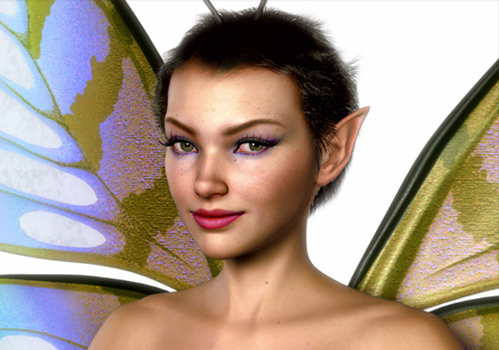
One of the most impressive uses was for a demonstration in 2004 to create a human-looking digital puppet capable of displaying complex emotions.  Dawn the Fairy and Nalu the Mermaid were the chosen demo models and these results were far better.  Check out Dawn's range of emotions here.

It always comes back to sexy fairy ladies.

If the uses on human characters seems familiar that's because modern video games and movies are using more and more motion capture technology to create realistic characters that respond in real-time.   We are seeing the effects of Waldo more often that you'd expect.

This isn't to say that Henson invented the idea of motion capture.  We'd probably still have Andy Serkis's characters and Robert Zemeckis's films without Waldo.  Waldo himself was less of a character and more of an expensive toy.  But Waldo paved the way and Henson was right there at the forefront.  He helped create a form of puppetry so unique that we no longer consider it to be puppetry.  He created the future, and the rest of the industry just needed to catch up.

Wednesday, May 16, 2012

Just One Person

On May 4th, 1990, Jim Henson made an appearance on The Arsenio Hall Show to promote The Muppets at Walt Disney World.  After the taping, he began to feel a little unwell.

On May 16th, 1990, Jim Henson died after having checked himself into the hospital the previous day.  The news came as a shock to everyone.  This man, so full of life, had provided the world with so much and he was not yet finished.  The world of the Muppets was shaken, yet Henson, in an odd way, seemed prepared for this untimely end.  He had already drawn up messages to his children and instructions for his memorial a few years prior.  So, on May 21st, Henson's family and friends were able to give him the send-off he desired and deserved.

Henson loved a lot in this world, but most of all, he loved the music.  Fittingly, the memorial played out like a soundtrack to Henson's life, playing all of his requests.  He did not want the occasion to be somber and he stated that he did not want everyone to be dressed in black.  In New York's St. John's Cathedral, it felt more like a concert than a funeral.  People shared their words, but the music took center stage.

To open the event, an organ played the Sesame Street theme and "The Rainbow Connection." Later, Harry Belafonte appeared to sing "Turn the World Around" on more time for Henson.


And there may be no moment quite like when Big Bird sang "Bein' Green."

Only in the context of Henson's life would a man in a giant bird costume be apt for a memorial.

But the show-stopping moment was when Richard Hunt introduced a medley of Henson's favorite Muppet related songs.  Each of the main puppeteers came to the stage and sang in the voices of their most iconic characters.  And it all led up to the most heart-warming song of them all.


"Just One Person" originated as a Muppet classic back when little Robin the Frog needed to be uplifted.  With each puppeteer pulling out their signature puppets, the song becomes so much more.  Starting with Scooter, the song begins simply and suddenly we see Fraggles and Sesame Street Monsters join in until Fozzie and Gonzo and all of our old friends swarm the stage.  Other than Big Bird's solo, this is the only time we see Henson's puppets take the stage and it's indescribable.

By seeing the puppets with their puppeteers, we are left with the feeling that Henson didn't just touch the lives of those he interacted with, he created these lives.  Without Henson, none of these characters would be a part of our collective conscience.

Everyone, together, for Jim.

That year, no new Muppet productions were created until November.  This new special was called The Muppets Celebrate Jim Henson and it was a way for Henson's characters to officially react to his passing.  The special finds Fozzie and the gang backstage of the Muppet Theater with instructions left by Kermit to put together a tribute to Jim Henson.  None of the Muppets know who he is, but, as they learn through anecdotes from celebrities and biographical material, they know that he is a man who touches many lives.

Some Muppets gather to rehearse the script.

They do not, however realize his relation to them (for the fact that they are puppets is something they'd rather not think about.  Throughout the special Fozzie enlists completely inappropriate acts for the show that are more in line with the Muppet brand of humor.  As an audience member watching this at home, you get a feeling of dread as this tribute becomes tackier and tackier.  Fozzie only wants to impress Kermit with his good job, but he is completely lost at how to run this whole Muppet operation without him.  Yes, it is very symbolic of what the actual Muppeteers were feeling at the time.

Finally, as the wacky celebration is about to start, Fozzie finds a folder from Kermit filled with something that should be able to help him.  At this point, it's best that you just watch what happens.


"But...we were just starting to get to know him."

The news that Jim had died places a terrible burden on the entire group.  Reality has come crashing into their fantastical world.  So of course, Fozzie does the sensible thing for once and shuts down the planned tribute.  Robin once again steps in as the voice of maturity and leads the group in another performance of "Just One Person."  Henson's memorial is virtually replicated, but this time, it's for the benefit of the Muppets and their fans.

Henson died 22 years ago today and his presence is still felt strongly.  His creations remain with us, giving us joy and comfort.  Even though a lot has happened since then, one can't help but wonder what else he could have shared with us.

It just goes to show the positive impact that just one person can have on the entire world.

Tuesday, May 15, 2012

What's a Muppet? - Part 4: The Disney Definition

Due to the overwhelming popularity of The Muppet Show, Henson decided it was time to talk to the biggest name in entertainment: the Walt Disney Company. By the 1980s, the Muppets had become an unstoppable brand and, with Henson's growing passion toward non-Muppet related projects, he wanted to make sure he could keep the Muppets afloat without his assistance. So, he turned to then-president Ron Miller and senior executive Roy Disney to discuss a possible merger between the two companies. At this time the Muppets were rivaling Disney in terms of audience numbers, as the Disney Studio was going through a major creative slump in both their animated and non-animated films. A Henson-owned Disney studio was a very possible scenario.
This idea was put on hold and did not resurface until Michael Eisner took charge of the company. And he was a lot less interested in the deal. When he was in charge, the Disney films were just about to start winning back audiences (with Who Framed Roger Rabbit and The Little Mermaid in the pipelines) and the demand for Muppets had died down since the end of The Muppet Show. Henson stayed in contact with the company, and a merger was no longer part of the equation. But a buyout was. This was fine for Henson, as he knew the Muppets would be in good hands. But Eisner wanted the rights to all Muppet franchises, including Sesame Street. For Henson, that was out of the question.

As the ties between the Muppets and Disney were becoming tighter, Henson helped develop many Muppet-related productions for the Disney Studio. This would begin with a complete overhaul of the Disneyland and Walt Disney World Resorts. For one year, Disneyland would become "Muppetland," and every attraction would get a Muppet overhaul while the Disney characters "took a break." Down in Florida, more permanent Muppet attractions would be added, including a parody of Disney-MGM's "The Great Movie Ride" called "The Great Muppet Movie Ride," a Gonzo-owned "Pandemonium Pizza Parlor" with animatronic rat waiters, and a 3-D movie Muppet*Vision 3D. Eisner, was willing to make the merger official, even without the Sesame Street puppets, with all of these great projects lined up.

Eisner and Henson, about to embark on a new journey.

But, unexpectedly, Henson died mere days before the contract was to be signed.

Drawn by Disney artists Joe Lanzisero and Tim Kirk

Almost every Disney Park project got scrapped, save for Muppet*Vision 3D, which had already been filmed, and a promotional special celebrating the merger entitled The Muppets at Walt Disney World.

Where dreams come true...

This hour-long special was the final Muppet-related production seen by the world before Henson's death, airing 10 days earlier. The special takes on an odd sense of poignancy due to that fact. It appears to be Henson's actual farewell to his Muppets.

Henson, on location, filming one of his last specials.

The story opens with Kermit gathering all of his friends and returning to his home, the swamp.  He hopes to show them his roots, taking them back to the simple pleasures he had before going to Hollywood and becoming a star.  But when the Muppets learn that Disney World is nearby, they choose to visit the park, much to Kermit's dismay.

Without any tickets, the group sneaks in and separates, as a dim-witted security guard spends the hour trying to track them down.  And, our villain is once again played by the great Charles Grodin.

 
Always a pleasure.

Each character has their own adventure and somehow they manage to bounce around all three parks (Magic Kingdom, Epcot Center, and Disney-MGM Studios) without any trouble. Fozzie tries out some comedy in Frontierland and is ultimately welcomed by the Country Bears. The Electric Mayhem goes on a "world tour in a day" at Epcot. Bean Bunny is cute. Miss Piggy gets dragged onto every ride by Beauregard. Rowlf gets put in the pet care facilities. Beaker gets a bucket stuck on his head. And Animal stalks his prey:

It's weird how they let Animal behave this way in a Disney special.

My favorite part is Gonzo's story, as he becomes enamored with the "less picturesque" aspects of the park. He ends up in the sewers, the off-limits structural portions of rides, and the giant laundry room. I must admit, I am a Disney Park fanatic and the rarely let anyone behind the scenes like this. This story kind of sums up the specials attitude towards Disney World as a whole. Everyone has a negative perspective of the park (except Gonzo, how insists that the best parts of the park are the trash cans). This seems to have been hinting at Henson's own feelings with the corporate entity as a whole and Kermit in particular has a rotten time because of it. Until little Raven-Symone shows up.


By the end, everyone reunites and the Muppets get to meet Mickey Mouse in person.  They all join in song talking about the wonders of dreams, and we get a shot of Mickey and Kermit with their arms around each others shoulders solidifying the new deal.


Alas, fate threw a wrench into the Disney-Muppet plans and the Muppets were aimless for a while.  The Disney Studio unofficially adopted them for the next decade, overseeing the distribution rights of past Muppet projects, developing new television programs like Dinosaurs and Muppets Tonight, and releasing a couple movies through their production studios.  Finally, in 2004, the Muppets became official Disney property.

You can see them there, behind Pinocchio and the Dalmatians.

The Muppets were now a part of the Disney family.  As a result, the Muppet Workshop was no more and new Muppet construction would be handled by the Disney owned Puppet Heap and all Muppet productions were now a part of The Muppets Studio.


Jim Henson's Creature Shop remains a separate entity and they now handle all Sesame Street puppet construction.  They have also branched out in to producing other material that would have originally been considered Muppet territory.  Because of legal reasons, the new "Muppets" created by the Creature Shop are officially "Creatures," abandoning the once clear division between exaggeration vs. realism.

"Muppets," under Disney, now solely refer to the cast of The Muppet Show and related materials.  Although Disney holds the distribution rights to past Muppet movies and Fraggle Rock, thus far, the only Muppet productions have been centered around Kermit and his pals.  While the technical "Muppet" term still applies when referring to the Sesame Street puppets, officially, "The Muppets" refer to one distinct group of characters.

While it seems as if Henson's Muppet legacy has been swallowed up by the Disney giant, it's important to remember that this was actually part of Henson's plan.  It came 14 years behind schedule, but Henson's vision was ultimately, fulfilled.  So, if anyone asks you what a Muppet is, don't get worried about the semantics of "Creatures" or "fancy puppet" or "Sesame Street" or "Disney-owned."

A Muppet is someone who inspires, entertains, loves, and dreams.

The two best Muppets of all time

Sunday, May 13, 2012

What's a Muppet? - Part 3: The Jedi Link Between Muppets and Creatures

As I previously established in my review of The Dark Crystal, Jim Henson wanted to break away from his Muppet background and move onto new innovative forms of puppetry.  He wanted to combine technology and realism to create animatronic lifeforms that could do things no puppet had ever done before.  Eventually, the London-based crew assigned to this project became known as the Jim Henson Creature Shop and it served as a kind of antithesis of the Muppet Workshop in America.  The Dark Crystal, Labyrinth, and The Storyteller were the first few major productions associated with the new types of Henson puppets, known as "Creatures."

Henson, surrounded by a variety of Creatures.

The distinction between Muppets and Creatures, as Henson saw it, was that Muppets were supposed to be exaggerated and cartoony, whereas Creatures could be mistaken for real-life creatures.  Even those that were meant to look like monsters or other supernatural beings could pass for something found in an intergalactic zoo.  Some lovely person made up this handy-dandy guide to differentiate between the two styles and it can be seen over at the Muppet Wiki.

A Muppet Frog, a Creature Lion, a Muppet Monster, and a Creature Monster

Officially, every Henson production would be classified as "Muppet" or "Creature" based on this a appearance.  This means that the characters on Sesame Street and Fraggle Rock are officially Muppets. This didn't mean that each workshop was limited to one visual style.  Sometimes the Muppet Workshop could create realistic puppets and the Creature Shop could create non-realistic puppets.  But the general rule of thumb is, if it looks real, it's a Creature.

The Creature Shop was so devoted to realistic animatronics that they became the go-to company for the film world's special effects needs.  Starting with the Wonderland characters for the movie Dreamchild in 1985, the Creature Shop continues to supply animals and creatures for many movies to this day.  You may be surprised that Henson and his staff are behind some of your favorite childhood movies.  Babe, Harry Potter and the Sorcerer's Stone, even Batman Begins have the Henson stamp of approval.  And where would we be with out the original live-action Teenage Mutant Ninja Turtles.

One of the 3 best photographs ever taken.

And, due to Maurice Sendak's recent passing, I'd be remiss not to mention the marvelous Creatures that Henson's Creature Shop created for the 2009 adaptation of Where the Wild Things Are.

Seriously, these may be the most impressive Creatures the company ever produced.

But there is one character that predates all of the Henson Creatures.  This one can be viewed as the granddaddy of them all.  I mean, he was born a long time ago in a galaxy far, far away.

"A puppet, I am."

First, before you start nitpicking, let me make this clear:  Yoda is NOT a Muppet.  He is NOT a Creature.  He is NOT even a Henson creation.  But, he is, for lack of a better term, the missing link between Henson's puppets before the '80s and after the '80s.

You may know that George Lucas co-produced 1986's Labyrinth with Henson, but their relationship started long before that.  See, during the late '70s, both were working in London on their own projects.  As Lucas wrapped up Star Wars in 1977, Henson was just beginning production on The Dark Crystal. Both men admired each other's craft and would often use each other's staff for ideas and help.

They would also simultaneously leer at anyone who insulted their attire.

For the sequel, The Empire Strikes Back, Lucas knew he wanted Henson to play the character that would eventually be known as "Yoda."  Henson, however was too wrapped up in The Dark Crystal and other productions to devote his full time to Yoda, so he suggested Frank Oz to play the part.  Along with an additional puppeteer Kathryn Mullen (Mokey Fraggle), the two would perform Yoda and turn him into the iconic character he is today.  Jim was still on board for consultations and design, however, so Yoda still has that authentic Henson touch.

Makin' magic.

The ultra-realistic Yoda was the first Henson sanctioned puppet that broke away from his traditional Muppet style and it was a good precursor of the puppets that were to follow.  Yoda premiered to audiences two years before the first Creature Shop production The Dark Crystal so he really had to connect with audiences to convince the world that they were ready for realistic puppets.  Yoda could have easily fallen into the territory of "goofy" and "fake" in the hands of a lesser man.

Behind the scenes on the Empire set, Frank Oz made sure to keep Henson's presence alive.  Mark Hamill (Luke Skywalker) was a huge Muppet fan and he often tried to imitate Miss Piggy's voice on the set.  Eventually, Piggy had to show up to the Dagobah System and put Luke in his place.

This actually happened!  Somewhere there is footage of the Muppets in a Star Wars movie!

As if to pass the torch, Kermit and Piggy were on hand to witness a new era of puppets.   Yoda won the hearts of audiences, both adults and children alike.  And it was clear that realistic puppets were the wave of the future.  And the rest, as they say is history.

Worlds had been colliding.

Tomorrow, the concept of a "Muppet" gets blurrier as Henson strikes a deal with a powerful corporate entity.

Saturday, May 12, 2012

What's a Muppet? - Part 2: Not Quite a Mop, Not Quite a Puppet

By 1968, Henson had already established the Muppet brand through his various variety show appearances. It now came time to show the world a little bit of what goes on behind the scenes with the Muppet folks.  Henson and his crew created an hour-long special called The Muppets on Puppets for a public broadcasting channel.  This special explored the history of puppetry, provided some examples of puppet types, showed how to make your own puppets, and explained what sets the Muppets apart from the rest.

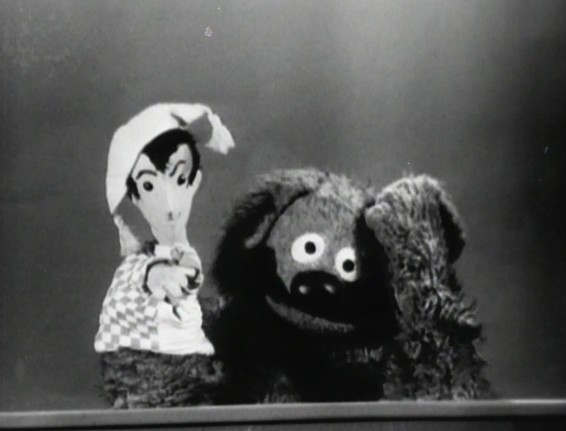
Rowlf struggles to control a simple puppet.

Right from the beginning, we see Rowlf interacting with the audience with his own puppet.  As is the case with the Muppets, it's easy to lose yourself in the fantasy.  You forget that Rowlf is a puppet, and that is exactly Henson's intention.  By emphasizing how lifeless Rowlf's puppet is, the audience begins to assume that "puppets" are just a primitive parlor trick.


Eventually, after showing off the different styles of puppets (hand, string and rod), Henson explains to Rowlf that he too is a puppet, which he doesn't take too well.  But even while this explicit line is drawn between reality and fiction, Rowlf is still alive.  When he exits the stage, we assume he is still going about his day, living his life.

This stands in contrast to the Punch and Judy puppets, whose voices and personalities are so exaggerated that you can "see" right through to the puppeteer beneath.  There is no interconnection between the two.  Anyone can put on a Punch puppet and do the Punch routine.  It is a pale imitation of life.  (Not to say that this portion is not informative.  I like how the crocodile puppet is used to explain the tendency for carnivorous Muppets, and the origin of the term "slapstick" is enlightening.)

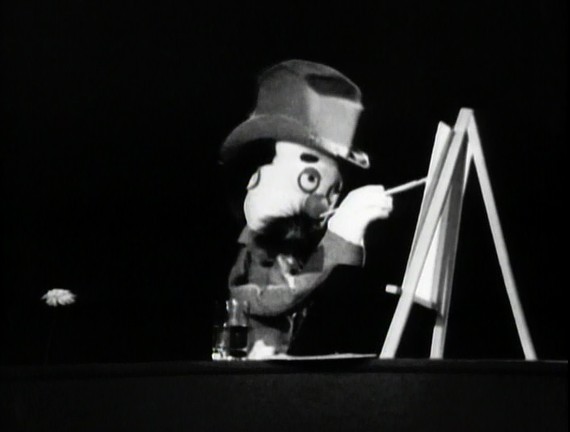
Henson then introduces Frank Oz and has him perform his signature piece "The Sunday Painter."  Unlike the previous examples, this one feels more like a Muppet piece.  It's not completely there, as it lacks humor.  But the puppet's movements have that natural flow that doesn't feel hindered by strings and rods.

The face is a puppet, but the hand is all Muppet.


Afterwards, Rowlf having come to terms with his puppet nature introduces us to the other Muppets.  These include a turtlenecked Kermit (whose flimsy arm rods may not be anything special, but his jaws are powerful), Wontkins, the witch Taminella Grinderfall, King Goshposh (here named Louie), some monsters, and Splurge.  A few of these would become the main cast of Muppet fairy tale specials such as Hey, Cinderella! and The Frog Prince, but, as we all know, only Rowlf and Kermit remain core Muppets to this day.

Speaking of fairy tales, Henson found that his Muppets were often best suited for providing their own spins on these classic stories.  Predating elements from Tales from Muppetland, Sesame Street's News Flashes, and The Storyteller, the Muppets come together to show why they are unique as they present a fractured version of "Cinderella."


As you can see, all the humor we've come to expect from the group is there.  In a rare turn of events, Henson then shows us what the skit looked like from the back.  It's always disconcerting seeing our beloved Muppets out of action, and having Rowlf hung upside down on his hook is particularly jarring after his performance mere seconds ago.  Still, this is a great look into the Henson process, one that has stayed the same in the company for years.

Finally, we get to see how Muppets are actually made.  Don Sahlin, Muppet designer, walks us through a new character, from Henson sketch to foam to fabric.  For anyone who has tried making their own puppets, this is a must-watch.  The Muppet style is so simple in concept, yet Sahlin has perfected it so that amateurs who attempt the signature appearance of a Henson puppet will find that theirs fails by comparison.  He points out how Henson specifically created a style of craft which he calls "the Henson Stitch" because he had never see it done before.


One aspect that was not mentioned in this piece was the importance of the Muppet's eyes.  To me, this is what makes or breaks a "Muppet."  If you look at almost all of a Henson character's eyes, you'll notice there is something similar about them that you can't quite put your finger on.

They are white with black pupils?

If you haven't spotted it yet, try looking at this random assortment of "plain" "Muppet eyes."

Is it the colored eyelids?

Despite the simple appearance of these basic cartoon eyes, there is a purposefully crafted decision that changes them from regular to Muppet.  The pupils of Muppet eyes are almost always placed slightly inwards, creating a subtle "cross-eyed" effect.  This creates the illusion of focus and it's the reason why adults and children alike fall into the habit of forgetting there is a puppeteer attached to the Muppet.  We are naturally drawn to a Muppet's face because they look as if they are actually looking at something.  When they look us, we feel as if they are capable of sight.  They look us in the eyes.

The rest of the special is worth watching and I've posted it here.  In the remaining clips, you'll see Henson and company mix-and-match attributes to create a variety of characters out of a Whatnot puppet, find new inventive ways of creating complex puppets, and perform a new fairy tale performed with puppets made from simple arts and crafts.  This latter skit is great because the "Muppet" feeling comes across solely through the voices and dialogue rather than the appearance.


If there is one thing to take away from this special, it's that Muppets are improved puppets.  Henson took all of the knowledge he learned about puppetry, borrowed the best elements, and invented new construction methods in order to develop characters that move beyond basic puppetry.  These characters are plush toys come to life.  This style, created back in the '60s, has continued through Sesame Street, The Muppet Show, and Fraggle Rock with each show's cast comprised of cartoonishly abstract characters that were unquestionably Muppets.

However, not every Jim Henson puppet can be considered a Muppet.  Where is that line drawn?  Find out tomorrow when we look at the "Creatures."

Friday, May 11, 2012

What's a Muppet? - Part 1: A Frog is Born

Quick!  Who was the first Muppet ever created?

Chances are your mind went to Kermit the Frog, and that would be a pretty good guess.  He's certainly had the largest legacy out of any of the Muppets, and he was in the original line-up of 1955's Sam and Friends, Henson's first television gig.

No, not Sam the Eagle.  He has no friends.

Okay, you might be thinking, if the show was called "Sam and Friends" then Sam must have been the first Muppet. Again, that's a good idea. While Sam was the "lead" of the program, all of the Sam and Friends puppets were created around the same time and it's hard to definitively prove which came first (although we like to believe it was Kermit).

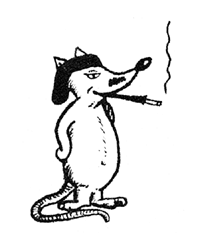
The first Muppet (as far as we can tell) was actually based on a high school cartoon that Henson drew for his school paper known as "Pierre the French Rat."

Oui, oui!

Looking at the earliest work of an artist is a very strange experience. While they probably hoped to present their work to a mass audience at some point, their craft has yet to find what would later become their signature voice. The doodles of a teenager are hardly going to be high-brow art. So, to read the adventures of Pierre the French Rat, one has to remind oneself that Henson as we know him did not exist yet.

This could have been the work of any kid in the '50s, really.  Especially Art Spiegelman.

Henson's dreams were to be a television star and by using puppetry, he was going to establish a niche that he could govern. His first chance at a television spot was on a program known as The Junior Morning Show. It was 1954, a year before the Muppets became fully realized. 18-year-old Jim made up up some puppets and of course he turned to his first creation, Pierre.

  
The shift to the 3rd-dimension caused Pierre to adopt what is referred to in medical communities as "Truman Capotism."

Unfortunately, despite filming a few skits, Pierre never made it to air due to Henson's crew being composed of underage teenagers which prohibited child-labor laws when it came to payment.  This was just a temporary setback for Henson.  He began college at the University of Maryland and started to hone his puppetry skills, majoring in Home Economics so as to take advantage of the costume-making and sewing courses.  Eventually, Pierre and a host of new friends appeared on Sam and Friends.  And it is here that Henson found out what his audience wanted.

The main cast: Harry the Hipster, Sam, Yorick and Kermit.

Each spot was no longer than 10-minutes and usually comprised of the puppets lip-synching to music or other recorded audio. Very little footage remains from this show and all we know for certain is that Kermit is the only puppet to emerge as a star. This is strange because at one point, a poll was taken in which viewers could vote on their favorite character and Kermit came in fourth, after Yorick, Sam, and the mysterious Mushmellon.

Jim and his eventual wife Jane controlling the four most popular puppets.

Yorick's popularity is easy to understand, for he was the first Muppet that ate everything in sight.  The appeal of Sam and Mushmellon is an enigma however, because no footage of either exists, save for one clip in which Sam lip-syncs to "Old Black Magic."

He looks pretty suave. These popularity contests are all about looks.

If one were to ascribe the success of Kermit to one thing, it would have to be the puppet's physical structure.  Just take a look at the surviving cast members and you'll see why Kermit prevailed.

That's Pierre in the back, going through his Albert Einstein phase.

This is just a posed display, yet Kermit seems to be the only one with any life in him. Everyone else either has a wooden head or a blank, fixed expression. A couple, like the Saturn Sandworm down in the corner named Icky Gunk, have a distinct flavor but they aren't going to be your lead characters. The man in the tiny hat is known as Chicken Liver, and while he is soft and plushy, his character was like a proto-Sam-the-Eagle, so no one liked him (except for Jane Henson, who kept the puppet as a toy for her children and it got nearly-destroyed before the Smithsonian swooped in and saved him).

Kermit, Chicken Liver and others play cowboys.

But Kermit, he could do anything. He could change his facial expressions, posture, and character to suit any need. This is how he became the everyman and was able to stand out while everyone else was reduced to lip-syncing.

  Fun With Real Audio!

Kermit was able to evolve as the show stayed stuck. Henson could see that despite the exposure he gained by the whole show, he wasn't going to go very far with his earliest characters.

But they did earn him a sweet set of wheels.

So, it made sense that for the final Sam and Friends show, Kermit was the only one remaining calm about the imminent demise of the program.

 I can't tell who the other character talking is, but it had might as well be "all of them."

After five years, he was the only one who changed and he was mature enough to take Henson and his team to new heights. Kermit is the father of all Muppets. Henson has stated that the term "Muppet" has no origin. It was just a unique word to make his puppets stand out. But, as we all know, there is a distinction between Muppets and the rest of the puppet world. They have that vitality and spirit that emanates from their bodies even when there is no puppeteer around to control them.  So yes, the "M" in the word "Muppet" does stand for something.  Magic.

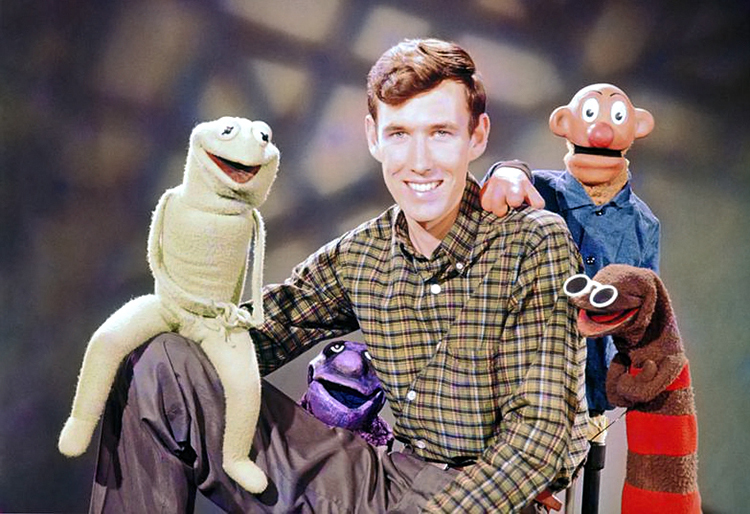
Young Jim Henson, moments before changing the world forever.