Thursday, November 17, 2011

Imitation, Innovation, Imagination

It has been said that nothing can be original anymore.  As a species we have produced so much that we have begun to repeat ourselves multiple times over.  This belief is very popular in the criticism of pop culture as a whole.  The majority of mainstream films are either sequels, remakes, or adaptations of an existing work.  On television, the shows that survive are those that are most similar to what preceded them (in both scripted and non-scripted formats).  Pop music is filled with remixes and samples, repeating age old themes that have been sung about many, many times before.

While all of this may be true, what perplexes me is why we consider unoriginality to be a negative affliction on creativity.  When you think about it, no creation, no thought can be truly original.

Every idea is the result of an inspiration.  Great inventors sought to solve problems that afflicted us.  Early painters recorded life as they saw it.  The very first written stories were based off of oral traditions that had been passed down from generation to generation.  If you look at any creation, you can trace it's genealogy based on the factors that influenced its conception.  Just as matter and energy cannot be created from nothing, neither can ideas.

As we grow older, we receive more information for our brain to process.  By establishing connections between concepts that had not previously been connected, we can create items that seem new and original.  But this is a process that takes time.  While children possess the ability to immerse themselves in imaginative wonder, the products of their playtime are about as unoriginal as one can get.

The writers of Muppet Babies understood this aspect about pre-school aged children.  In watching children play make believe, they really are just imitating what they have experienced before.  Playing "house" involves mimicking parents while playing "doctor" or "cops and robbers" illustrates their limited understanding of these professions.  But for more abstract and fantastical games, children just straight up copy the stories of pop culture.  For people my age, a common playground activity was playing "Power Rangers" or "Teenage Mutant Ninja Turtles."  The game always followed the same pattern.  Kids would fight over who got to be their favorite hero and one kid would always object to being cast as the villain.  They knew from repeated observations that the villain always loses.  As a result, everyday objects like trees and bushes would have to play the bad guys.

The same event would happen with popular movies.  Once it was settled who would be playing the lead character (there was always going to be at least three Aladdins), the story would play out as best as the children could remember it.  Little effort was spent towards creating something new.  Toddlers could only repeat and regurgitate what was given to them.

While Muppet Babies often followed this pattern for its episodes, the best example of this style of play was "Gonzo's Video Show."  The babies are allowed to play with a video camera and they decide to make a movie.  After much deliberation, it is decided that they should pick a movie that has a lot of parts already: Star Wars!


The relationship between the Muppet and Star Wars franchises is almost symbiotic.


Very little is altered from the original story, to the best of the kids' abilities.  Skeeter and Scooter play C-3P0 and R2D2 respectively.  But when Scooter talks to his sister, she reprimands him for not speaking in beeps and boops.  Later on, Piggy recreates Princess Leia's distress signal, yet addresses it to Luke Skywalker (since Kermit is playing that role).  She is reminded that the movie doesn't go like that and she objects saying this is how she wants the movie to go.

While the babies of the show usually behave like miniature adults, they truly capture what it is like to be a child at playtime.  They try their best to stick to the rules as mandated by familiarity.

Another staple of Muppet Babies that everyone remembers is the incorporation of live-action footage with the cartoons.  Sometimes there were just still photographs or stock footage.  Other times it was clips from old films and television shows in the public domain.  But for this episode, clips from Star Wars are actually used, interspersed with the movie that the children make.  (It is this technique that has prevented Muppet Babies from ever receiving a full series DVD release.  With about 5-10 clips from various sources used in each of the 100+ episodes, figuring out copyright issues would be a nightmare!)

Sure, just stick in scenes from the biggest blockbuster of all time.  The future won't mind.

While this hurts reproductions of the show as a whole, the live footage was necessary to complete the world that the Muppet Babies lived in.  Their imaginations were so powerful that they were able to immerse themselves in whatever world they conjured up.  And if that world happened to be identical to one from a movie, then that's what it is.

There comes a point in every person's life when they lose their imagination completely.  They may still be creative and have the power to envision complex universes, but they know in their hearts that what they are imagining is not true.  Children have not reached that stage yet.  Magic is still possible.

Here is the difference between an adult's imagination and a child's imagination.  As much fun as an adult has and as much as they can get caught up in the moment, they can drop it instantly when real life intervenes.  The child can't.  Reality and imagination are one and the same.

Wednesday, November 16, 2011

The Search for a Wild Canuck

As a young child, I was a huge fan of McDonald's Happy Meal Toys.  I enjoyed playing with the miniature versions of my favorite characters and even more so, I enjoyed collecting the many trinkets.  One of my first Happy Meal Toys was Baby Kermit riding on a soapbox racer.

VROOOOOM!

Due to my age, I had missed most of the original run of Muppet Babies and I never managed to catch it on television.  This Kermit toy was my only window into the series.  I do not remember receiving the toy, but I remember playing with it often.  I also knew that there must have been more toys in the series, for a girl up the street owned the Baby Piggy premium.  I made it my goal to complete the set.

In the days before the Internet, one had to be clever in researching Happy Meals.  There was no eBay or Amazon to allow us to look up old items in an instant.  I had to rely on outdated collectibles books with poor photographs and also the official Happy Meal Archive as documented by the McDonald's corporation (my parents arranged it so that I received an updated copy in the mail every couple of months).  This amounted to a large printout of every promotion the fast-food chain had ever done.  It was through these sources that I learned that there were four to the set: Kermit, Piggy, Fozzie, and Gonzo.

The Fab Four

My only source for finding these old toys were through various flea markets, antique stores, and yard sales.  I would just have to get lucky to find my prizes.  Piggy and her bike came easily, and I eventually found Fozzie and his wagon (although the handle is missing).  And when I received Gonzo, it seems as if my search was complete!

Except, something was a little off.  During my search, I kept coming across strange alternate versions of the toys pictured above.  A Kermit in a standing position.  A Fozzie with a tiny head.  A smaller Piggy with squinty eyes.  And when I compared my Gonzo to the one pictured, he too was completely different!

My Gonzo had his eyes half closed whereas the picture shows his eyes fully open.  I did not mind it so much because I preferred that look for the character, but it was nagging me that these other versions existed.  Turning back to my books and archives, I learned the truth.  There had been two sets released, one in 1987 and one in 1990.  The earlier set was a bit off model and the vehicles were made of a cheaper plastic, but if I wanted to make things right, I would have to finish both sets.

And so I did.  I had my two Kermits, two Piggies, two Fozzies and two Gonzos.  But there was still something wrong.  Although I did not have a picture of it to prove it's existence, one of my archive printouts mentioned a fifth item in the 1987 set: Baby Animal.

A truly complete set.

How could this be?  In the multitude of flea markets in which I had scoured for these tokens, I had not once come across a Baby Animal toy.  And then I rechecked my notes.  Animal was a "Canada-only" premium.

For you see, in different markets, McDonald's tries different promotions.  Usually the whole country is on the same page, but every once in a while, regions get "test premiums" to see if the toys sell well.  Things are even more random for international markets, where McDonald's has to choose what would be familiar to a non-American audience.  Often times, the same promotions run internationally.  Sometimes completely new sets are created just for other countries.  And other times, sets will be similar, with one or two of the toys replaced.  But this was the only time in which a near identical set was made with an additional toy that was not in the American release.  And in Canada, no less, which usually receives the same items as America all the time!

For some reason, Canada lucked out and received this bonus toy.  After I had resigned to the fact that I was not going to find Baby Animal in the U.S., I decided that it wouldn't even be worth it.  The 1987 set created such odd deformities in the characters that they probably butchered Animal as well.

But thanks to the Internet, my misconceptions are eradicated.  I now see that Animal actually looks great compared to the rest.  He could easily fit in with the 1990 set.

He looks better than he does in the show!

I have long since stopped collecting Happy Meal Toys.  That part of my childhood is stored away.  My eight Muppet Babies, however, are kept separate from the rest.  They reside in a old-fashioned Muppet Babies lunchbox awaiting the return of their comrade, lost in the far north.

One day, he'll come home.  One day.
Tuesday, November 15, 2011

Born In Sin

While babies may be incapable of harm and destruction, that does not mean they are inherently good.  Due to a limited experience in the real world, a baby's perception of the universe is ever-growing.  But at the beginning, their scale is quite small.  It is limited to only what they can sense.  They cannot envision life outside of their domicile.  They cannot even envision life outside of their playpen.  Peek-A-Boo is such a big hit because as soon as something leaves their field of vision, it ceases to exist.

And so, babies cannot help but be self-centered.  And it is from this perspective that negative attributes form and must be eliminated if we expect babies to enter human society.

"Noisy Neighbors," the very first episode of Muppet Babies, sets the stage and introduces the characters and concepts that will be explored over the run of the series.  It tells the tale of the gang's attempts to keep Baby Animal quiet so as not to wake their police officer neighbor.  Let us meet the stars of this morality play.


Noisy Neighbors, a Tragedy in Three Acts

Starring:

Baby Piggy as Wrath, 
a bossy brute who dishes out pain when things don't go her way

Baby Fozzie as Greed, 
an ambitious joker who puts his desire for fame and fortune above all else

Baby Scooter as Envy, 
a meek nerd who lives in the shadow of his stronger sibling

Baby Skeeter as Pride, 
a competitive show-off who listens to no one but herself

Baby Animal as Gluttony, 
a ravenous beast who always follows his gut (and nothing else)

Baby Rowlf as Sloth, 
a laid-back pooch who only helps out when it will cause him no strain

Baby Gonzo as Lust, 
an amorous weirdo who refuses to let anything hinder his passion

and

Baby Kermit as Job

The episode begins with foray into the make-believe.  A cardboard box becomes a submarine while a couch becomes a battleship.  The two naval fleets battle it out until the Muppets caretaker intervenes to instruct the children to be quiet so as not to wake their sleeping neighbor.

Baby Animal does not listen to these demands, and as soon as Nanny leaves, he begins making a racket. Many parents are familiar with fussy infants who refuse to sleep.  Animal takes this to the next level by pounding the ground causing earthquakes and eating the carpet.  Kermit rallies the troops to calm Animal down, but not much seems to work.

Piggy makes up a fairy-tale involving a dragon that Fozzie and Gonzo fail to slay.  Kermit succeeds through the power of dance, riling Animal up.

Rowlf attempts to calm things down with a lullaby and at first, Skeeter and Piggy fight over who gets to sing.  When it is settled that everybody will sing, a rousing number once agin riles up Animal.

Finally, Gonzo suggests watching TV and imagines himself as a superhero, saving Piggy from a plummeting elevator.  Animal usurps the story as a King Kong figure and is riled up all the more.

After every outburst from Animal, Nanny has appeared to shush the youngsters, claiming the policeman next door is complaining.  Just like any authority figure in a child's life, Nanny's word is law.  There is no arguing or complaining allowed.  She is a giant and must be obeyed.

For you see, Nanny is God.  Although she is not always seen, her presence is constantly felt.  Despite the babies' attempts to remain faithful and good, they always slip up sooner or later, and Nanny is there to smite them.  The fact that we never see her true face only supports the notion that she is the mysterious omnipotent ruler of the universe.

In Nanny We Trust

Although her voice is provided by the calm and soothing Barbara Billingsley, her judgment is swift and no one dares cross her.  Throughout the series, the babies always manage to stay on her good side, fortunately.  She remains understanding in the knowledge that they have much to learn about the world and they will often be led astray and tempted by sin.  She is there to guide them.  And when she disappears, she must rely on her favorite child to lead the masses.

Young Kermit, barely out of his pollywog stage, is already expected to guide his fellow man.  And in his first task, he fails miserably.  It is nigh impossible to keep Animal quiet, but Kermit does not give up.  Failure after failure, he seeks out new methods to keep the Devil at bay.  And finally, when he is about to give up all hope, the Almighty Nanny reappears with words of salvation.

The neighbor has left for work and the kids are free to make as much noise as they wish.  Their efforts have not gone unnoticed and our Lord Nanny smiles upon the infants.  She rewards them with eternal peace and slumber.

And so, despite the permission to raise hell and sin until the cows come home, Kermit and his brethren rest, free from temptation.

Monday, November 14, 2011

Unlimited Potential

Everybody loves babies.  Their big eyes and pudgy cheeks are irresistible to anybody who has a heart.  No matter the species, we find all babies to be adorable, pure, and innocent.

But most of all, we like them because they are new.  Out of nothingness, a new life is created and introduced into the world.  They lack any experiences, have yet to form memories, and are uncorrupted by the evils of the universe.  Although virtually identical upon exiting the womb, each baby will grow into a unique, fully-realized person depending on the different paths they will encounter.

No baby can choose what life they will be born into and by the time their brains are developed enough to form rational thoughts, many of their life's choices have already been made for them.  Their environment, culture and family have already begun their waves of influence over the infants.  As adults progress through their lives, they can be startled to find themselves where they are, especially since all events leading up to the present were based on choices made earlier in life.  The domino effect becomes very clear when looked at in reverse.

Take a person in your life that you care deeply about.  A friend, a partner, a lover, anyone.  Think about what circumstances led to you meeting that person.  Now imagine if that day, that moment you met them had gone differently.  Maybe if you had woken up late that day, or you were distracted by another event, or you just happened to blink and miss it when that person walked by.  You would be leading a quite different life thanks to one missed encounter.

And how about the opposite?  Suppose you had met this person sooner?  They have such an important impact on your life at the moment, would they have been as important had they been there from Day One?  This is a possibility that Miss Piggy considers after reconciling with her beloved Kermit after an argument.  In The Muppets Take Manhattan, Piggy imagines a world in which she and Kermit had known each other as babies, and she sets the stage for a world of infinite possibilities.


She believes that no matter the timeline or universe, she would have been committed in her love to Kermit.  But she does not stop at bringing the frog into her past.  The rest of their friends join them in restarting their lives.

The world's best nursery

As Baby Piggy sings about her affection, she also lists the many accomplishments she hopes to complete in her lifetime.  These range from the mundane (driving a car) to the plausible (learning to scuba dive) to the highly improbable (becoming a beautiful movie star veterinarian pilot who practices neurosurgery and has climbed the Matterhorn).  She may be naive, but she is only a baby.  To her, all of these things are equally complex and manageable.  And who is to say she's wrong?

Although we now know the life Piggy grew into, who says she could not have completed one or more (or all) of the goals on her list?

This is the question that spawned a cultural revolution for the offspring of the Baby Boomers.  Those children who were a part of Generation Y were the target audience of a new Henson production.  A cartoon based on the popularity of the infant Muppets presented in this one movie scene.  Muppet Babies was the first of its kind, taking pre-existing characters and presenting them as toddler versions of themselves to appeal to the younger generation.  While copycats came and went with varying degrees of success, what made Henson the pioneer was that his babies served a purpose.

Besides being so gosh darn cute!

These characters were not simply money-making opportunities based on brand recognition.  They also stood for a poetic and inspirational cause.  If there was one type of person Henson admired, it was the dreamer.  The creative mind who looked beyond themselves to see a greater life ahead.  People who wanted to be happy and to make others happy.  At a basic level, all dreamers need is an idea and the imagination to make that idea work.

As babies, the Muppets did not have much at their disposal.  They were confined to one room without much to keep them busy.  But they had their imaginations.  They encouraged the children at home to use their imaginations to do great things.  Thanks to them, our generation became the generation of dreamers.

Dreamers with big hearts and bigger eyes

And so, for the rest of this week, we shall return to that magical nursery for a deeper look at those lovable rugrats who could envision entire universes before naptime, the Muppet Babies.

Friday, November 11, 2011

The Dark Crystal, Part 5: Destiny Fulfilled

This is it.  The final showdown.  Good vs. evil.  Who will prevail?

(Hint: It's a kids movie.)

(Also, SPOILERS!)

Enjoy your last moments of existence, boys!

As everyone gets into position, Kira spots Jen from across the room and tosses him the crystal shard.  They attract the attention of the Skeksis who alert the Garthim.  Backed into a corner by the bugs, Jen jumps from a conveniently placed platform onto the Dark Crystal, but he drops the shard in the process!

He couldn't hold on to it for one freaking second!  Girl's gotta do all the work!  

Kira glides down to return it to him and succeeds in doing so.  However, the Emperor stabs her in the back, killing her.

"My only regret was not being born with quicker reflexes!"

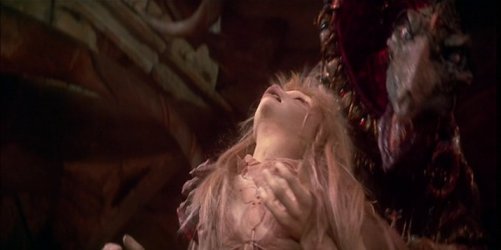
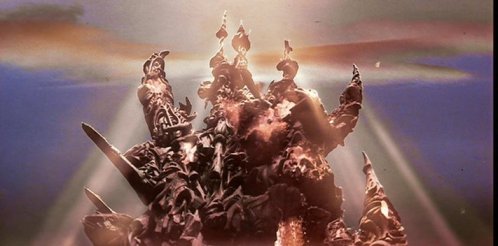
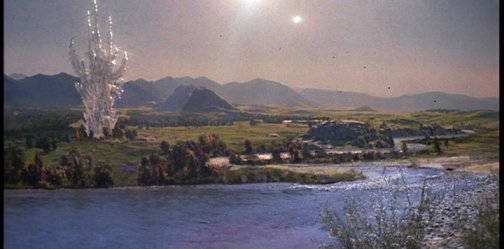
For some reason, everyone stops what they are doing, to contemplate the weight of this situation, I guess.  This gives Jen plenty of time to restore the Crystal.  It becomes Pure once again and causes the walls of the castle to crumble, revealing the bright crystal structure underneath.  This is another one of those really cool scenes that's made even better knowing how it was done.  Basically, there was only one take to set up all of the explosives just right.  It took down the whole set to reveal the prettier set underneath and fortunately, they got it right on the first try.

And He saw that it was good.

Everything starts going back to normal.  The Podling slaves get their minds back.  The...Podling slaves regain their souls.  Um...the Podlings are de-zombified....  Okay, so only one thing really happens.

And there was much rejoicing.

Jen runs over to cry over Kira's body.  Because they are in love.

Who cares that the universe is being fixed?  What about MY universe?

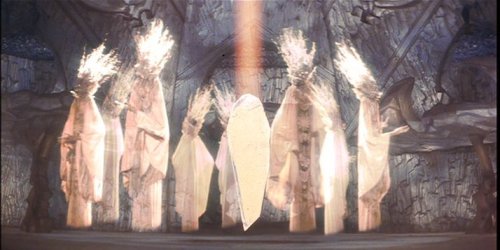
The Mystics all surround the Crystal, which shoots beams of light through them to attract the Skeksis.

It's all starting to make sense now!

The Mystics and Skeksis bond, forming the Urskeks once more.

Just when the movie couldn't get any creepier...

The Urskeks thank the Gelflings for their courage and sacrifice and as a bonus, restore Kira to life.

Only the good die young and are resurrected shortly thereafter.

The Urskeks then depart and leave the Gelflings to start repopulating the world, lest it become overrun with Podlings.

And they all lived happily ever after!

So ends The Dark Crystal.  An ambitious film that Henson hoped would change the face of cinema forever.  Was it successful?  Well...it depends on who you ask.

At the time, critics were fond of it, due to the visual marvels unlike any movie which had come before it. It's box office performance was a bit lackluster, due to the fact that it could not really find an audience.  It was marketed towards children, but the themes were very mature and the characters were scary and grotesque.  There is little by way of action or humor, so few children could sit through it easily.  As for the adults...they found it to be too childish.  It's a weird movie that exists for everyone and no one at the same time.  (Also, it had to compete with E.T. and apparently audiences could only handle one creepy-looking, long-fingered, rubber hero at a time.)

Because Henson set his sights so high, he was bound to fall at some point.  He flaunted the fact that he only cared about the setting and that the story and characters were secondary to him and it certainly shows.  The plot is straightforward and unoriginal and the characters lack personality and the motor-skills necessary to convey emotion properly.  This was Henson's first attempt at breaking away from his cartoonish Muppets in order to create realism, but unfortunately, he could not recapture that spark that he put into his former abstract puppets.  He had created an art form by being able to portray numerous emotions using only one hand inside of a sock.  Even though Kermit the Frog is "simple" he is moldable.  

The Gelflings are not.  Kira looks okay and, at certain angles, Jen isn't too bad.  But their wide-eyed dopey gazes drive home the fact that these are not living creatures, even though they are supposed to be our human connection to the story.

The Skeksis, on the other hand, look phenomenal.  Villains are always more fun, and the Skeksis are no exception.  But while they were blessed with good-looks, they were gypped in the dialogue department. Having them speak broken English hampered their threatening influence and just made them all seem quite inept.  The only character worth following was the Chamberlain, and it was nice to see at least one of the characters have some depth and complexity.  I wish he had played more of a role towards the end of the movie (i.e. he should have been the one to kill Kira).  After he goes back to the group, he falls into the background.  There could have been more ambiguity to his morality as well.  I liked him so much because I never knew what he was going to do.  But as soon as he betrayed the Gelflings, he became no different than the other Skeksis.  Maybe that was the point, but it seemed more like a lack of attention.

I know that this movie took five years to make, but it would have greatly benefited from being much longer, like a true epic.  The story could stay as is, but more time could have been spent developing the characters, rather than have them be cogs in this storytelling machine.  In one interview, Frank Oz gushes over the character of Aughra, noting how "beautiful" she is.  Of course she's grotesque, but he is referring to the amount of detail spent in crafting her appearance.  Had they spent as much time with her personality as they did with her look, I would have agreed with him.

The movie gets by on it's appearance, and Henson at least succeeded in crafting a fully realized world.  It seems like this is his Avatar, which was so focused on the visuals that they forgot to work on the story.  Sadly, Henson missed another crucial point in world-building.  It should be a place that the audience would like to visit.  I'm not saying all movie worlds should be ideal utopias.  Many films with bleak fully-realized worlds are great because the story centers on the corruption (like Blade Runner).  But for a kids film, make it a place kids want to go to.  They can have bleak elements, like Fantasia from The Never-Ending Story or Willy Wonka's chocolate factory, but there should be some whimsy to it as well.  The world of Thra, as depicted in this movie, consists of desolate deserts, barren mountains, slimy swamps, run-down villages constantly under threat of monsters, and hellish dungeons.  Yes, the world is supposed to be in disarray due to the Skeksis' rule, but it can at least be beautiful in it's ugliness.

To end things on a positive note, I appreciate Henson's attempt at creating a new mythology.  Having the good urHu and the evil Skeksis forever linked was a good choice and it was not like any fantasy movie I had ever seen before.  Some movies imply that good cannot exist without evil, but this one was so upfront about it that it was impressive.  For example, when one Skeksis is destroyed in a boiling pit, his Mystic counterpart spontaneously combusts as his brethren look on in contempt.  That's cool!  That's interesting!  More of that please!  Fortunately, the world of The Dark Crystal does live on in manga and there is a sequel in the works!

They actually make the Gelflings look normal!  And is that the Chamberlain I see?

Jim Henson had many good instincts and ideas in creating the world of Thra.  And his attention to detail paved the way for the Jim Henson Creature Shop, which went on to produce many more movies and television shows, and it continues to help out in providing puppets and animatronics for numerous other productions (Teenage Mutant Ninja Turtles, anyone?).

If his movie suffered from anything, it was that it felt incomplete.  There is more to explore and discover.  We want to return as soon as it's over.  And in that regard, the film is a success.

Thursday, November 10, 2011

The Dark Crystal, Part 4: Darkest Before the Storm

Despite the endless possibilities of letting someone as cool as the Chamberlain join his posse, Jen refuses the Skeksis' offer and hightails it out of the ruins with Kira.  She decides to join him on his quest to the castle and reveals transportation method to cut down their questing time:  Landstriders!

Those bats think they're horses!

Kira calls over two of the stilt-walkers draped in fabric with her ability to speak Monstrosity.  Together, the two Gelflings head straight for the castle.

Speaking of the castle, one of the Skeksis decides that now is the best time to show the audience how the Dark Crystal works exactly.  He takes a Podling from a cage and straps it into a device similar to that from A Clockwork Orange.

Except there is no head restraint or eye-lid holder, meaning the victim has to be willing to be lobotomized.

The Skeksis explains, to no one in particular, that this room is situated beneath the Dark Crystal and with a mirror, they can shine the light from the Crystal directly into the Podling's eyes, draining him of his life essence.  This will turn him into a soulless zombie, able to do the bidding of his masters.

I CAN SEE FOREVER!

The liquid life essence drips into a vial, which is offered to the new Emperor to restore his youth.  Unfortunately, Podling essence is not as long-lasting as Gelfling-essence because Gelflings are surperior.

Potatoes are not known for being juicy.

This scene lasted just long enough to allow our heroes to reach the castle, which is guarded by Garthim.  They immediately attack the intruders and in a difficult-to-choreograph-fight-sequence, both of the Landstriders lose their lives.

Really, all they take is a slight push and they're down for good.

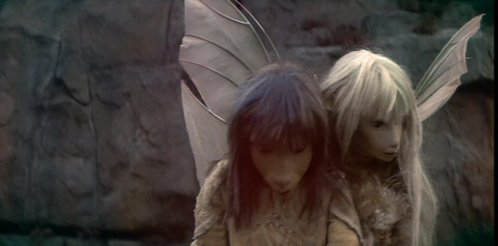
The Garthim back our heroes up against the edge of a cliff.  All hope seems lost when suddenly, Kira grabs Jen and jumps!  It's okay though, because she has wings.  Clearly, all girl Gelflings have wings, Kira points out condescendingly to Jen, despite the fact that just yesterday she learned that there was another Gelfling in the universe so why would she suddenly know the difference between male and female Gelflings?

Um, these would have been a huge help BEFORE our Landstriders were eaten!

Frodo and Sam make their way into Mordor through the back entrance at the base of the cliff and once again run into the Chamberlain.  I would make another nitpick about how they had previously ditched him at the ruins and travelled on swiftly moving animals and somehow he caught up with them easily, but that doesn't matter because the Chamberlain is the best!

By all accounts, it doesn't make sense.

The Chamberlain makes one last appeal for peace and Jen again refuses and attacks him with the crystal!  So it's understandable that he would get rid of Jen by crushing him with a pile of rocks and kidnapping Kira to present to the Skeksis!  He reveals to his former brethren that he has captured the last Gelfling and she is to be sentenced to death!  However, the vain Emperor decides to strap her to the Life-Sucker so he can remain youthful.  Either way, the Chamberlain is welcomed back into the clan and all is forgotten.  But I can't help but wonder if he is aware of the possibility that Jen and Kira may possibly escape.  You never know with this guy.

That crafty bastard.

In the dungeon, Kira is hooked up to the Crystal and the life-draining begins.  While the obvious solution to the situation would be "close your eyes," Kira is cursed with her genetic face-paralysis that afflicted her throughout the film.  So it seems as if all hope is lost.

Curse my creator!  Curse Wendy Midener!

But wait!  Kira has the power to summon animals, remember?  I mean, we've only seen her call the Landstriders once...and she said the Podlings taught her (so why the Podlings never tried this trick before I'll never know).  Anyway, by using the Force, Jen and the caged Aughra tell Kira to use that Thornberry power of hers to free herself.  She dolittles up a frenzy among all the creatures in the dungeon so that they swarm her captor and knock him into the endless abyss where the Dark Crystal resides.

Jen, tired of being trapped by rocks, stumbles into a Garthim nest, which happens to be right next to the Crystal pit.  They destroy part of the wall, and he shimmies up the shaft to escape.

Jen's ascent from Hell

He had better hurry because the Mystics have finally made their way to the castle.  Using their Jedi mind tricks, they are able to saunter past the guards with ease.

It's okay.  We're with the band.

Jen finally makes his way to higher ground where he sees the three suns of Thra converging. He knows his story is about to come to a close.

This is some trippy stuff, man.

The Mystics have arrived, the Skeksis are taking their places, and the suns are in formation.  Come back tomorrow for the conclusion of The Dark Crystal to see if the prophecy comes to light.

DUN DUN DUNNNNNNNN!!!

Wednesday, November 9, 2011

The Dark Crystal, Part 3: You Are Not Alone

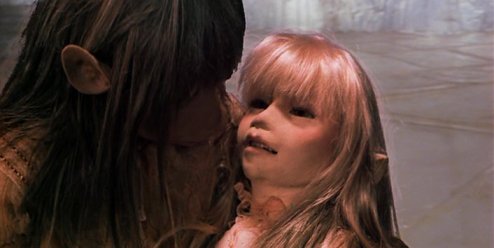
The Gelflings reunited.

There is a new Gelfling!  And it is a girl!  Imagine if you spent your whole life as the only one of your species and suddenly you discovered that there is another one just like you of the opposite sex.  What would be the first thing you'd do?  The correct answer is Dreamfast!


Despite its name, Dreamfasting involves neither dreams, nor fasting.  It is more like a blending of memories between two people at once.  It should really be called a Thoughtbinge.

As the two Gelflings grab hands, they each reveal their side of the story.  After the Skeksis destroyed their clan, baby Jen was adopted by the Mystics and baby Kira (the girlfling) was found by the Podlings.  She grew up with them, aware of the Skeksis threat, but unaware of the mythology of the world.  Kira decides to take Jen to her home, along with her ball-dog Fizzgig.

I am a mockery of life.

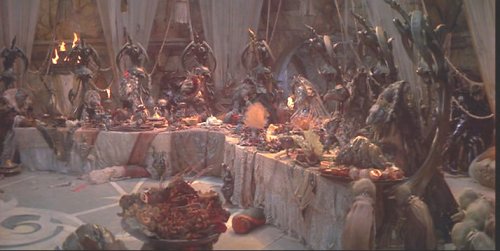
Meanwhile, in the Castle Grayskull, the Skeksis are enjoying a well-deserved feast in an excruciatingly long eating scene that rivals that of Tom Jones.

Come for the atmosphere, stay for the buffet!

Their spread is interrupted by the arrival of the Garthim who present their capture of Aughra.  She yells at them for getting her involved in their silly dispute and then warns them that the prophecy spells out their demise and they have done nothing but act foolishly.  The Emperor then sends out his Crystal Bats who can report back to the castle with better results than the mindless Garthim.  One manages to spot our two new friends sharing an intimate musical moment.

We're on a boat!

This river scene goes by in half a minute, but behind the scenes, this was one of the hardest shots to film.  With multiple animals on the riverside and a huge tank of water, this was highly difficult for the puppeteers to perform.  Because so much effort went into it, I felt it was only right to acknowledge that for a moment.

The two Gelflings are forming a fast bond over the fact that they can barely move their mouths, but they seem to have accepted the whole "not alone in the universe" thing rather quickly.  Dreamfasting was good to speed things along, but this relationship could have been so much deeper.  But no time for the complexities of the Gelflings!  The Podlings are here!

*Enter Star Wars Cantina Theme*

These creatures are like Fraggles before Fraggles were even imagined.  They are small pudgy things with round faces and beady eyes who love to dance and sing and play and seem not to have a care in the world.  Their design was based on potatoes to show how "of the earth" they were.  Originally, they were supposed to have misplaced eyes like potatoes, but that looked too creepy.

Anyway, Jen and Kira enjoy their feast with the Ewoks when suddenly, more Garthim crash in and start kidnapping folks left and right.  Jen manages to hold a few of them of with his crystal, but the monsters are too overpowering.  When all hope seems lost, a surprising hero steps in and allows the Gelflings to escape.  It is the skekSil the Chamberlain!

I couldn't find a picture of the above awesome scene, but rest assured, the Mystics are still walking.

Free from danger, Jen suspects the Garthim had found him again and apologizes for putting everyone in harms way.  In an angsty temper-tantrum, he wishes he had never been assigned this quest and he throws his crystal far away!  Kira tries to calm him by explaining that the Garthim often come to Endor looking for slaves, so nothing is Jen's fault.  But the stiff-faced puppet is too upset to listen and goes to sleep.

All tuckered out.

In the morning, Jen wakes up in the arms of Kira, puts one notch in the flower-bedpost, and discovers that they have made it to some decaying ruins.  Kira tells him that the Gelflings used to live here and now it's just a row of strip malls.  She also finds his crystal, so that sudden plot point was unnecessary.

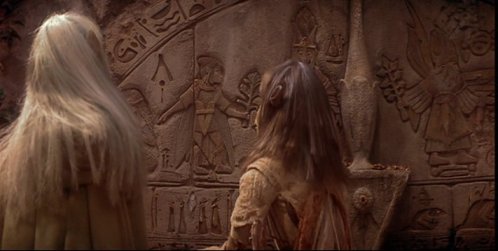
On the walls, Jen spots the ancient prophecy and reads it to Kira, who has never encountered this newfangled "writing" concept before.  He realizes that he must restore the Dark Crystal by placing his shard in it.  I thought we already knew that, but in case you needed your memory refreshed, you're welcome!

"Don't...step...on...the...mome raths?"

Suddenly, the best character returns to the movie!  The Chamberlain appears and tries to speak with the Gelflings.  Kira recognizes him as a Skeksis and tries to warn Jen not to trust him.  But the pitiful creature explains that he is on their side.  He tells them that he had saved them from the Garthim before and that he has been shunned from his group.  He goes on to say that the Skeksis are all frightened of the prophecy because their existence would be erased.  He offers a sort of peace treaty in order to look out for everyone's best interest.

Remember how I said the Skeksis originally did not speak English?  Had that stayed true, this would have been the first time we heard the Chamberlain talk.  His stilted speech would become even more baby-like as he would be speaking his first words.  And since his first words are those of peace, you would have to ask yourself, would you trust him?

His own people abandoned him.  He has no family or friends.  His prophecized demise is about to occur.

Hasn't he suffered enough to earn your trust?


How could you say "no" to that face?

Find out Jen's answer tomorrow during Part 4, where we learn about the true power of the Dark Crystal!