Showing posts with label scooter. Show all posts

Tuesday, February 17, 2015

My Favorite Muppets, Part 3: Richard Hunt

My my, where does the time go?  Let's see...where was I?

Oh yes, my favorite Muppets!  Today I wanted to look at Richard Hunt.  I've discussed this puppeteer at length in my posts on Scooter as well as the failed series Dragontime, but I never actually nailed down who his greatest characters were.

The important things to know about Hunt were that he was born to be a puppeteer.  He never truly felt as free or as outgoing as he did when there was a puppet attached to his arm.  Through his characters, he showed his childlike wonder, his boundless energy, and his array of funny voices.  He loved to help others.  He was often found performing as the extra arm for a live-hand puppet, meaning he'd be right up alongside Henson, Oz, or Nelson as they performed their iconic roles.

But most importantly, he loved to make people laugh.  He was the puppeteer who would most likely entertain guests by grabbing a random puppet and putting on an improvised performance.  These fun-loving elements bled into his characters, and it's a shame that soon after Henson passed away, Hunt followed.  While he may be gone, he is not forgotten.

__________________________________________________________________

10) Belmont - The Christmas Toy


I always try to include one Muppet based on a pure-design aesthetic and to me, none of them are cooler than Belmont the rolling horse.  (Even the builder Ed Christie chose Belmont as his greatest creation in 22 years of work back in 2000.)  Hunt plays him as more of a dim-witted character who is at once easily-excitable and slow-talking, creating a strange speaking pattern.
__________________________________________________________________

9) Gunge - Fraggle Rock


While Hunt is better known for his turn as Junior Gorg in Fraggle Rock, there is another childish ogre character of his that I prefer more.  So instead, I chose Gunge as the representative from this show.  Along with Philo, the two rat-like creatures serve as right-hand-men to Majory the Trash Heap.  Like Hunt, Gunge is the more naive and energetic of the two creatures.  Hunt tends to find himself playing the "child" character to a more mature counterpart, possibly due to his youth when he joined the Muppet repertoire.  (Of the main five original puppeteers, he was the youngest.)
__________________________________________________________________

8) Don Music - Sesame Street


Before I began this blog, I had no idea who Don Music was.  He was cycled out of the show by the time I had started watching it regularly in the early '90s, allegedly due to the bad influence he had on children (namely, banging your head on hard objects when things don't go your way).  Maybe that's true and maybe it was a good thing to remove him from impressionable eyes, but hey, Hunt was an artist.  And artists get frustrated.  And sometimes they need to release that frustration in destructive ways.  Every Muppet puppeteer used their characters to unleash the feelings that they couldn't reveal in public, and Don Music only provided a cushy felt medium that also produced a funny sound whenever Hunt got upset.  If you can't use a puppet to slam against a piano, what can you do?
__________________________________________________________________

7) Right Head of the Two-Headed Monster - Sesame Street


Richard Hunt and Jerry Nelson were quite the dynamic duo.  They portrayed many live-hand puppets and puppet pairs together so it was only a matter of time before those were combined into a single puppet with two heads.  The Right Head (named "Stein" according to some sources) always seemed to be the more light-hearted and bouncy of the two heads, fitting with Hunt's childlike wonder.  He was the brother who was more likely to get his ego hurt and his confidence shattered.  Hunt enjoyed playing vulnerable characters, and he especially enjoyed playing off other characters, and the wide-eyed Right Head allowed him to do both.
__________________________________________________________________

6) Janice - The Muppet Show


Okay, so Hunt has some very impressive voices in his arsenal, but I always felt his choice for Janice was out of place.  It sounded too much like a more masculine Scooter, which isn't quite the persona that Janice was aiming to capture.  That being said, Janice has an impressive wit.  While based on the valley girl stereotype, she is not a ditz.  She holds her own during the "Veterinarian's Hospital" sketches and she really shines with her ad-libs during the Muppet movies.  Hers is a character I would have liked to see more from outside of the hospital and Electric Mayhem appearances.
__________________________________________________________________

5) Placido Flamingo - Sesame Street


Placido Flamingo is just another Sesame Street pun Muppet.  But that bird can sing with the best of them.  It seems as if all of Hunt's Sesame Street characters had a musicality to them (Don Music, Gladys the Cow, even the mute construction worker Sully could play the piano).  But Hunt really showed off his impressive vocal abilities when performing operatic parodies that taught children how to use the phone.
__________________________________________________________________

4) Scooter - The Muppet Show


Oh wait, I forgot.  No one cares about Scooter.
__________________________________________________________________

3) Beaker - The Muppet Show


I'm a bit of a Muppet hipster, so when it comes to extremely popular Muppets, my knee-jerk reaction is to say, "Yeah, he's funny but he's no Link Hogthrob."  So, I'm always trying to come up with ways as to why Beaker is just a one-note Muppet, unworthy of fame.  But, that one note ("Meep") is such a hilarious one that I can't justify my scorn.  Beaker is quite similar to the character Mr. Bill, in that they both suffer with their falsetto screams.  Even as a child, I was instantly drawn to Beaker because he is such a simple character to grasp, and his lack of a consistent language makes him relatable to everyone, regardless of age or ethnicity.  This was one of Hunt's "fun" characters, and it shows.
__________________________________________________________________

2) Sweetums - The Muppet Show


Although he didn't portray him in his first appearance in The Frog Prince, Hunt made Sweetums his own, allowing the giant's heart and excitement to become a central aspect of his character.  (The first Sweetums was a lot meaner initially).  It's clear that Hunt enjoyed playing around in the puppet, as can be seen in behind the scenes photos and footage.  For the first time, Hunt could really get lost inside of a puppet.
__________________________________________________________________

1) Mudwell the Mudbunny - Fraggle Rock


I know it seems blasphemous to place a one-shot Fraggle Rock character above all of Richard Hunt's iconic characters, but Mudwell was a truly special creature.  His personality, his mannerisms, and even his voice were unlike any character Hunt had portrayed before.  Hunt usually tries to find the humor in every scene he is in, filling in the role as resident clown when needed.  But, due to the story line of his signature episode, Mudwell is a more serious and introspective creature.  It's hard to discuss Mudwell without spoiling the storyline of his episode, but it's kind of obvious what's going to happen when his only episode is titled, "Gone, But Not Forgotten."

After getting injured in the deep caves of Fraggle Rock, Wembley is rescued by Mudwell.  Although Mudwell is more mature than Wembley, they still quickly bond over fun games and songs and food.  However, after his injuries heal, Mudwell rudely kicks Wembley out of his home, and tells him never to return.  Upset, Wembley returns to confront Mudwell for his rude behavior and learns that a Mudbunny's life is very short.  Mudwell passes away in front of him, crushing Wembley's spirit.

Yes, Mudwell is the center of an episode teaching the Fraggles (and the young viewers at home) all about death, and having someone taken away from you so suddenly.  Much like Hunt, Mudwell provided as much joy as he could in his short time on Earth.  This episode would have been production right as Hunt became diagnosed with HIV, so it isn't too far of a leap to conclude that this storyline was influenced by the sad news.

Richard Hunt passed away five years after this episode aired, and while he may be remembered for his more wacky characters, this "farewell" will always represent Hunt's softer side.  However, there was one thing I left out of my episode synopsis.  After Mudwell literally turns to dirt and dust, a new creature is born from his remains.  A young Mudbunny who, while different, retains some of Mudwell's memories and philosophies.


Hunt also plays Mudwell's reincarnated form and establishes that while his body may leave, his spirit may live on.  Whether it be through a metaphysical means or just through memories of the past, he will never truly be gone.  I almost interpret this reincarnation as Hunt's acknowledgement that he is survived by his characters.

While characters like Scooter were momentarily retired after Hunt's passing, the Muppets have the gift of immortality.  Scooter will return, Sweetums will return, Beaker will never go away.  Hunt left a myriad of gifts filled with life and energy that allows us to always remember him.  And that's why I appreciate Mudwell as much as I do.  He was real.  As real as the man who loved to play pretend.

Thursday, July 19, 2012

No More Superheroes

Superheroes are our modern myths.  At least, they were.  People with superhuman abilities who could do no wrong were once the ideal heroes for modern culture.  They surfaced and gained prominence during World War II, partly because comic books were cheap to make, and partly because they featured simple stories of good triumphing over evil.  Superheroes weren't people we related to.  They were people we wanted to become.

As time progressed, superheroes behaved less like almighty gods and more liked flawed human beings.  It was as if a gigantic tonal shift had occurred.  And this wasn't just present in the comics.  Take The Muppet Show episode featuring Lynda Carter as the guest star.  At the time, she had just completed five years of portraying DC's Wonder Woman on television and she was ready for a break.  Unlike Mark Hamill, who appeared in character as Luke Skywalker, or Christopher Reeve, who denied he was Superman yet displayed Superman's powers in his episode, Carter did not appear as her iconic character throughout the entire episode.  She left that to the pig.

Wonder Woman's going to be on The Muppet Show?!  I hope they don't just put Miss Piggy in the costume!

The subplots of this episode feature each Muppet wanting to be a superhero, while the actual "superhero" just wants to be a regular person. Scooter orders a manual on how to be a superhero and soon everybody is dressed in silly costumes, attempting to lift heavy objects and see through walls. And they fail miserably.

Well, what do you expect from a hand-drawn pamphlet?
  
Meanwhile, Miss Piggy, envious of Kermit's potential attraction to Carter, tries to make Carter jealous by playing Wonder Woman better than her (and looking better in the suit while she's at it). Carter clearly doesn't care about Miss Piggy's antics, and just humors her. This brings us to the centerpiece of the episode, "Wonder Pig," where Miss Piggy fights a giant chicken. This is still The Muppet Show, remember?


Backstage, the rest of the cast continues their education and Scooter eventually convinces them to climb up a tall ladder and leap off, ensuring that they will fly if they just believe in themselves.

  
This ends poorly.

This is exactly the kind of behavior that injured many children back in the past. Children who wanted to be their heroes so badly that they would leap off their houses, expecting to soar around the sky. As dangerous as it was, it showed how powerful these fictional superheroes truly were. The reason so many superhero movies get made today is because today's adults were once those foolish children, running around their backyard in a cape. Even though all of Scooter's attempts at gaining superpowers fails, he still managed to warrant an action figure made in this get-up.

Complete with a dangerous ladder and everything!

This is an action figure celebrating the childish fanboy. Everyone wants an action figure of themselves, and here one is, for all intents and purposes. This is us. Or rather, was us.

For the shows finale, Lynda Carter sings "Orange Colored Sky." It is her chance to just be who she wants to be. Not a hero, just Lynda. But that doesn't stop the Muppets from interrupting her song with their futile attempts at being superheroes.


In the end, Lynda just can't escape it. She was one of the lucky few who got as close to being a superhero than any of us could ever dream of. She wanted to present her "real" self, but it was too late. She was Wonder Woman, and always would be. And she would have to take the good with the bad.

Embrace the truth!  Accept reality!

Today, our superheroes have been humanized. We no longer see movies with "purely good" heroes. We expect some reality in our fantasy. We need character flaws. It helps us relate to our protagonists, and it gives us something to root for. As I've mentioned before, the Muppets were born to fail. That's why we like them. And that's why we appreciate their behavior in this episode. They want to be the best and cannot achieve it at all. Perfection is an impossibility. We need imperfect heroes to remind us of that.

By being a worse Wonder Woman, she was a better Wonder Woman.

Wednesday, May 30, 2012

The Muppets Take Manhattan, Part 3: Anything Goes

There is something weird that happens when reviewing a movie like The Muppets Take Manhattan one fifth at a time.  It really shows you how disjointed the plot is.  I have seen this movie a few times before, and if I were to summarize it in a paragraph, absolutely none of the following scenes would be mentioned.  It's not that they aren't entertaining.  It's just that the things that are important to the story have been pushed to the beginning and ending edges.  While watching this film, one gets the feeling that the Muppet staff had a book full of ideas that they wanted to see the Muppets do, and now that there was no longer a show, those ideas would have to go into the movie.

So here are some hypothetical excerpts from this fictional Muppets Take Manhattan Idea Journal:

Idea #276:  3-D movies are all the rage now.  (Possible Lew Zealand Cameo?)

Kermit's first letter is from Scooter, who has found a job at a movie theater as an usher.  First we get to see Swedish Chef working the concession stand, which goes exactly as you expect it would.


Then we have an appearance by Lew Zealand, a one-note character whose whole schtick is that he only has one joke: boomerang fish.  So, of course, he loves the 3-D movie about killer fish because it allows him to "interact" with the movie.  Yeah, it's a lame set up for an even lamer joke, but that's who Lew Zealand is.

Apparently, this scene is so iconic that you can get your very own "Usher Scooter" action figure!

"My favorite Muppet action figure is Usher Scooter."

Idea #328:  What if Fozzie met a real bear?

In Fozzie's letter, Fozzie, unable to find work, decides to give hibernating a try.  He finds himself in a den filled with realistic-looking Muppet bears, which presents a very odd contrast with the cartoonish Fozzie.  Unfortunately, Fozzie can't sleep.  Womp, womp.

 That's not a bear.  Bears wear hats.

Idea #12: What if the Electric Mayhem had to play polka music?

 
I miss the Happiness Hotel.

Idea #56: Okay, so Kermit has to pretend to be a big shot producer in order to start some buzz about his Broadway play. And, like, he goes into a fancy restaurant in disguise. It's one of those restaurants where they have pictures of all the famous people who've ever eaten there on the wall. And Kermit replaces his picture with another celebrity (TBD, check our Muppet Show guest roster). And then that celebrity actually shows up and Kermit gets kicked out! Also, rats.

At least this disguise is more tolerable than his "boffo" agent.

So yeah, Kermit decides to start a "whispering campaign" having all the rats hide under the tables of patrons in order to subliminal work Kermit's play into their conversations. And the rats reveal themselves and everyone gets kicked out, making for another funny, yet pointless scene.

  
Oh, and they chose Liza Minnelli.

Idea #1237:  In our last movie, we had Miss Piggy ride a motorcycle.  How can we top that?

In yet another day of spying on Kermit and Jenny, Piggy's purse gets stolen and since her little puppet legs can only take her so far, she has to borrow some roller skates.  Time for an action sequence!


The skating scene I could do without, but the confrontation at the end between Kermit and Piggy with Gregory Hines acting as the supportive mediator is probably the funniest scene in the whole film.

"You didn't say there were huggies!"

Idea #1:  What if the Muppets were BABIES?!

Okay, so this song/scene has no bearing on the movie whatsoever, but it is so iconic and important to the franchise that it's worth making a whole movie just for this moment.  Basically, Piggy imagines the premise of Muppet Babies and it is adorable.

  
The fantastic song that spawned a regrettable genre: famous characters as babies.

We already know why this song is great, so instead check out this weird promotional music video version of the song that aired on The Merv Griffin Show.  It features homages to 2001: A Space Odyssey, Flashdance, and Michael Jackson's "Billie Jean" music video, with a live action pig and frog to boot.  And Jim Henson also has a cameo as...I don't even know.


I don't know what all that extra stuff has to do with babies or love.  Seeing the pig and frog was interesting, but it kind of stepped on the whole premise of the scene, especially since the scene does just fine on it's own.  Maybe that was another idea from the big journal of ideas and they couldn't fit it into the film. (Idea #15,029: The Muppets as actual live-action animals!!!!).  In any case, the actual moment in the movie is great.  And it's the last "random" thing to occur in the film.

Yayayayay!  Bye babies, see you on CBS!

Tomorrow, we finally get back to the story, as Kermit makes significant leaps forward and loses his mind.

Thursday, May 24, 2012

No One Cares About Scooter

The Muppets who appeared in the most episodes of The Muppet Show are:

1.  Kermit the Frog (120 Episodes) - Jim Henson
2.  Waldorf (120 Episodes) - Jim Henson
3.  Statler (119 Episodes) - Richard Hunt
4.  Fozzie Bear (115 Episodes) - Frank Oz
5.  Scooter (113 Episodes) - Richard Hunt
6.  Miss Piggy (111 Episodes) - Frank Oz
7.  Gonzo (106 Episodes) - Dave Golez
8.  Rowlf the Dog (99 Episodes) - Jim Henson
9.  Janice (84 Episodes) - Richard Hunt
10.  Floyd (82 Episodes) - Jerry Nelson
11.  Animal (79 Episodes) - Frank Oz

After that there is a significant drop-off in appearances, so these eleven can be conisdered the "main characters" of The Muppet Show.  From this list, there is an unofficial group of the "Core Seven" Muppets that often appear together in merchandise and media, which is based on their airtime during the original Muppet Show.  These are Kermit, Fozzie, Piggy, Gonzo, Rowlf, Scooter, and Animal.  This is the group that Muppet Babies focused on and it makes sense why these seven were chosen out of the eleven.  Waldorf and Statler would just provide punchlines and not really a part of the group, and Animal was the most marketable member of the Electric Mayhem.  (If you're confused why Janice ranked the highest of the members, remember that she appeared in all of the Veterinarian's Hospital sketches.)

The reason I am pointing out these statistics is to highlight the prevalence of Scooter within the Muppet Gang.  Quieter and less zany than the rest, Scooter won't find himself winning any popularity contests soon.  It's odd that despite his omnipresence in the show and movies, Scooter has such a small fanbase.

"My favorite Muppet is Scooter!" - No one

A group on the Muppet Central forums had to start an appreciation thread for the guy just to highlight this strange situation the character has found himself in.  Throughout the internet, you can find Scooter appearing on "worst Muppet" lists left and right.  What exactly did Scooter do that so many people have found him displeasing?

I have concluded that there are three main causes.

1.  Scooter started as an antagonist.


In the first couple of seasons of the show, Scooter's main purpose was to remind Kermit that his uncle owned the theater, and therefore, he would often get his way.  He took up a job as a "gofer" but despite  his title, he still basically ran the show.  When his uncle J.P. Grosse did appear and threaten to shut down the theater, Scooter was right on hand to assist in the demolition (after learning that he'd still have a job, of course).

Smashy smashy!

Like Smithers to Burns, Scooter was always on hand to carry out his evil uncle's dirty work, not thinking twice about Kermit or his friends.

The family resemblance is uncanny.

2.  Scooter is boring.

After the Scooter as villain schtick had been played out, Scooter eventually just settled into his job at the theater, becoming an assistant stage manager.  He was always ready to spout exposition and other necessary "backstage" talk to keep the show moving.  The reason his episode count is so high is because from Season 2 to Season 4, he appeared in every episode to introduce the guest with his cry of "15 seconds to curtain!"

The guest introduction became the only thing he was really known for on the show, but it allowed him to do this:


When it came time to produce Muppet Babies, the creators realized that Scooter didn't really have a "thing" that made him unique outside of the Muppet Theater.  So, in Episode 105: "Scooter's Hidden Talent," it was established that Scooter was a computer whiz, and, by default, a nerd.

He would be standing on books, that four-eyes!

3.  Scooter disappeared for over a decade.

After the death of his puppeteer, Richard Hunt, Scooter was momentarily retired, much like Rowlf had been with Henson.  But, as with Rowlf, the producers wanted to keep the character in the lineup.  Scooter would make random background appearances, saying only a line or two at most.  By this point, the Muppets had strayed further away from the Muppet Theater, making Scooter less relevant.  He made a brief appearance in A Very, Merry Muppet Christmas Movie, but the less said about that the better.

Really, this happens in a Muppet movie.

By 2008, when David Rudman adopted the character, Scooter was no longer in the public conscious.  A new generation of Muppet fans had entered and none of them knew who Scooter was.

It's hard to have a fanbase when people don't know you exist.

So, why should we care about Scooter?

Because he was Richard Hunt.

Richard Hunt performing Scooter.

Scooter was a young teenager during The Muppet Show (even though Muppet Babies would imply that he was the same age as the rest of the group).  This made him the youngest main member of the show, just as Richard was.  Richard joined the Muppet family at the age of 18, while Henson, Oz, Golez, and Nelson were much older.  They knew the craft inside and out, but Richard was still wide-eyed and just glad to get into showbiz.

He started as a background puppeteer for Sesame Street.  He didn't have any established characters and was mostly a "right-armer," one who helped control puppets that required more than one puppeteer.  But, while on the set, Richard's youth gave him an energy that none of the older puppeteers shared.  Whenever a guest would come to the set, Richard would grab a puppet and start performing for them, no matter the character.

This is the most intense a puppeteer has ever looked.

His sense of play did not go unnoticed and when The Muppet Show was created, everyone knew Hunt would have a special character just for him.  Scooter, like Hunt, was amazed at the world of show business and would do whatever it took to appear onstage.  He wasn't unpleasant or rude.  He just admired the craft.  Scooters most well-known Muppet Show moments were based on this desire to perform.


Scooter was the Muppet that the young audience could related to.  For anyone who dreamed of fame and fortune, Scooter was instantly recognizable.  And, like Hunt, Scooter grew and prospered.  In the most recent Muppet film, it is revealed that Scooter found himself an internship at Google and earlier this year, he appeared at the TED Conference to speak.

So, he's still a nerd, but now he's a cool nerd.

Scooter aims for greatness and succeeds, and that is to be admired.  So, for anyone who says that Scooter is the worst Muppet, reconsider your stance on following your goals.  Scooter may be under-appreciated, but he is not unworthy.

"My favorite Muppet is Scooter!" - Me

Tuesday, February 21, 2012

The Muppet Movie, Part 2: Muppets Assemble!

Now that the plot is set up, we enter the portion of the movie that I refer to as "Collecting the Cast."  While the duo of Kermit and Fozzie is wonderful and "Movin' Right Along" is one of the best songs in the movie, the movie is about the whole group, not just two individuals.  Because the the next few scenes are just a cattle call of character introductions, let us examine them one at a time.

After we take a moment to enjoy the scenic drive.

Big Bird

The third Muppet introduced in the movie proper is not from The Muppet Show.  Stopping in to make a quick cameo, Big Bird informs Kermit and the cast that he is headed for New York City to achieve stardom through public television.  Although his appearance is just for a joke, this segment reminds us that, before The Muppet Show, Henson was best known for Sesame Street.  And, if we are chronicling the symbolism of Kermit's journey as equal to Henson's, this moment implies not only that Big Bird/Sesame Street will achieve fame and recognition before The Muppet Show, but that he is also traveling in a direction opposite to the way Henson wanted to go.  Because Henson wanted to break away from the kid stuff, this was his nod to the previous enterprise, acknowledging that it was important and helpful, but it wasn't his true calling.  (Of course, if it weren't for the revenue that Sesame Street merchandise made for the Henson company, many of his projects would never have gotten of the ground.)

Giving credit where credit's due.

What follows is another interaction with Doc Hopper and his toadie Max (like the Grinch!).  This roughly repeats the same information as the earlier scene, with the added implication that Hopper will stop at nothing until he employs Kermit.  This isn't particularly necessary, but it allows Max to display his first sign of humanity.  Apparently, the actor who played Max wanted a bigger role than just "driver/henchmen" so director James Frawley added more lines to give his character an "arc."

Doc Hopper: "So, you're going to end up betraying me by helping the protagonists, aren't you?"

Max: "Yes, and whenever people think of The Muppet Movie, they'll remember that Max saved the day!"

...Moving right along...

The Electric Mayhem

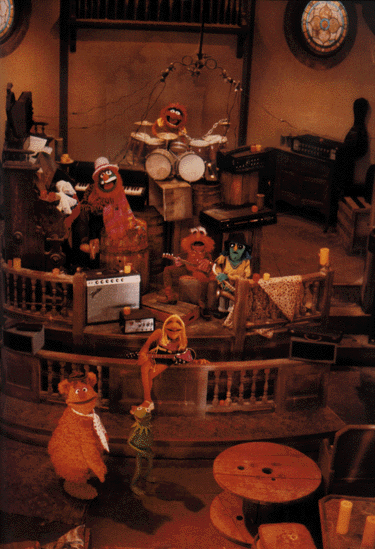
Kermit and Fozzie take a rest at an abandoned church which is in the process of being converted into a coffeehouse by a group of freeloading hipsters.  I mean, rock gods.

Also, this is the third instance of a recurring gag that I never noticed when I was younger.

Each member of the band is introduced succinctly, which is helpful for an audience who is aware of the Muppets, but not too familiar with them.  Since the Electric Mayhem was the first recurring fixture that Henson envisioned for The Muppet Show, they are introduced before the rest of the main cast.  While they won't be joining the road trip just yet, they will have their time to shine eventually.  Since they were always in the back of Henson's mind, he is suggesting that he keep them in the back of our mind for now.  Unfortunately, there is one character who for some reason gets lumped in with the band in this scene, which doesn't do his character justice:

He has to stay isolated up in the nosebleeds, too.

Scooter

Instead of using the backstory created for him in The Muppet Show, Scooter is reintroduced as the band's road manager (as opposed to the nephew of the owner of the Muppet Theater).  I would understand the need to change Scooter's past if he were going to join them on the trip to Hollywood (because he could very clearly pull a lot of strings and eliminate all of the conflict) but the script keeps him saddled to the Electric Mayhem the whole movie!  I feel as if this is unfair to Richard Hunt.  Scooter was his main character, and it just feels odd not to have him travel with the rest of the crew.  At least Jerry Nelson gets to come along as Camilla the Chicken, even if he has little to do.

Also, you can clearly see Hunt's arm in this shot.  Scooter don't get no respect.

Anyway, rather than join the frog and bear on their trip to Hollywood right away, the band and Scooter decide to camouflage their car to help them elude the villains of the movie.  Sure, they use bright, gaudy colors, but at least we get an original Mayhem song to accompany the painting sequence.


And sure enough, the new paint job helps our heroes escape the clutches of Hopper and Max!

That's pretty clever.

The victory is short-lived, because it suddenly seems as if the screenwriter realized the movie was running over time, so the next introduction comes crashing headfirst into the story.

And his vehicle's ornament looks very familiar.

Gonzo and Camilla

Like Scooter, Gonzo gets gypped for his introduction.  With little warning, he is literally thrown into the movie by way of a random collision.  Driving his plumbing van, Gonzo ends up joining the bear and the frog without any hesitation (except Gonzo was actually headed for Bollywood).  While this fast-paced scene is amusing, it would have been nice to hear more of Gonzo's backstory before he joined the caravan, since this is representative of Dave Golez's addition to the group.  He's a plumber?  Where did that come from?  Fortunately, he becomes a permanent traveling partner and his allowed a few moments to shine later on in the film.

This portion of the movie moves so fast that we barely get to enjoy the rainbow Studebaker.

The trio avec poultry decide to trade in their insurance nightmare for a more reliable vehicle (during an ADR'd moment, implying there was probably more to this scene that was cut).  Milton Berle is on hand to play the sleazy used-car salesman, since we haven't had a celebrity cameo in a while.  He calls out his assistant who is another Muppet favorite:

Sweetums

Aww, he's the best.  This is probably why Scooter couldn't join the trip (Hunt plays both characters).

Actually, this is probably Sweetums' best known role for people unfamiliar with The Muppet Show, for reasons that will become clear later on in the film.  For now, he unintentionally aids our heroes by decreasing the price of a car into Kermit's budget (under $12).  This mimics his original role in the Muppet television special The Frog Prince where he played a villain's sidekick-turned-big-ol'-softy.  Kermit extends his offer to give him a lift to Hollywood, and the brute runs off, missing his chance.

"Wait for me!  I want to go to Hollywood!" - Every dreamer's nightmare.

Tomorrow:  The gang meets the most beautiful pig in all of Bogen County.