Showing posts with label jareth. Show all posts

Friday, May 25, 2012

Don't Panic: The Hitchhiker's Guide to the Labyrinth

It's Towel Day, the day where we celebrate the works of the late Douglas Adams, British writer of the Hitchhiker's Guide to the Galaxy series, who reminded us that the most important item a space-and-time-travelling hitchhiker can have is his towel.  Adams is one of my favorite authors as I find his writing to be so charming and witty that I enjoy anything he's ever written, even if it's about a topic I don't care about.  He was a very clever writer so I decided to see if he ever crossed paths with Henson and sure enough, the two were mutually fond of each other.

Douglas Adams (1952-2001)

Adams was actually very good friends with Christopher Cerf, one of the main songwriters for Sesame Street.  It was through Cerf that Adams met Henson and the two eventually began working on a television special involving the Muppets and computers.  Adams was very interested in the world of computers and technology, which is made evident in many of his fictional and non-fictional writings.  The special was called The Muppet Institute of Technology and it aimed to teach viewers about computer literacy.  However, the special never moved beyond the planning stages and was ultimately dropped.

And we never learned how to use computers as a result.

But this wasn't the only work Adams provided for the Henson Company.  Because he enjoyed computers, he also wrote some text-based computer games.  One made in 1984 was based on The Hitchhiker's Guide to the Galaxy and another was an original story called Starship Titanic which was released in 1998.  But in 1986, he was called upon to help write a computer game based on everyone's favorite magic-dancin' fantasy film Labyrinth.

Released by Lucasfilm Games, makers of The Secret of Monkey Island

Rather than play as Sarah, however, you played as a teenager going to see Labyrinth on a date.   Suddenly, Jareth pulls you into the movie and you go through the story, loosely.  The prologue was set up like a regular text-game that Adams was fond of writing.

 Not even popcorn can get your date to stop talking.

The main game would then switch to images and movement, but it kept the "roulette" interface of entering a verb and a noun to make your commands.

And Hoggle is played by Moe from The Simpsons

A particularly Adamsian touch was to include a random word that seemingly does nothing (such as "No tea" found in the inventory of the Hitchhiker's game).  He chose the word "adumbrate" which means "foreshadow" or "overshadow" or "give a faint indication of."  At one point, the player must "adumbrate the elephant" in order to move forward in the game.


This was not the only collaboration between the Henson Company and Adams.  The Jim Henson Creature Shop helped supply numerous characters for the 2005 live-action movie The Hitchhiker's Guide to the Galaxy.  Adams died before completion, but he helped write the script.  I don't know if he ever got to see the creatures, though.

42

The Creature Shop made the repulsive, bureaucratic, Earth-destroying villains the Vogons...

How pleasantly unpleasant.

...the falling whale that is conjured into existence by the Infinite Improbability Drive...

The director thought this was the most impressive visual he had ever seen.

...and everyone's favorite depressed, Alan-Rickman-voiced robot, Marvin the Paranoid Android.

 I could never tell if those were his eyes or his mouth, but he's just so darn cute either way.

The movie received mixed reviews from audiences, critics, and fans of the series alike, but I found it to be an absolutely marvelous movie.  The influence and humor of both Adams and Henson can be felt throughout the film and I think it's a wonderful addition to the collection of fans of either artist.

So, on this Towel Day, do yourself a favor and check out some of Douglas Adams's literary works.  The Hitchhiker's Guide to the Galaxy has appeared in various incarnations (radio show, books, movie, television series, comic books, etc.) so choose one and start appreciating another great visionary.

*      *      *

When I was researching the Labyrinth computer game, I found that there was also a Japanese Nintendo game made for the Famicom that was also based on the movie.  And since I don't see myself finding another excuse to talk about Labyrinth video games, I figured it would be best to mention it here.

This one actually does follow the movie's plot and you play as Sarah in a Legend-of-Zelda inspired world of the Labyrinth.  The game play is virtually identical and you can collect weapons and items from the movie, as well as interact with your favorite characters.  There isn't a health bar but a ticking 13 hour clock that takes away minutes each time you get hit.  But the best part is the music.  While the computer game was nearly silent, this one replicates the film's soundtrack in a glorious 8-bit symphony.  All of your favorite songs are included, giving the player a deeper experience than the comedic computer game.  The game is in Japanese, but some English translations can be found.

 Some are clearly more authentic than others.

Check out the gameplay below, but try not to think about how jealous you are that Japan keeps getting all of these great games that never see international shores.  If I had a copy of the game, I would actually play it and review it in full.  But for now, we have to just watch.

Sunday, January 29, 2012

Labyrinth, Part 5: A Fairy Tale Ending

The goblin army fights Sarah and her friends in a tedious and pointless fight sequence.  The baddies never pose an obvious threat, so it just feels like a lot of filler to get to the end of the movie.  But eventually, they make it to the castle, where Sarah tells her companions that this is goodbye, for she must do this final part alone because "that's how it happens."  Hoggle and Ludo give tearful farewells.  Sir Didymus does as well, but it's rather unwarranted given how he never really got close to Sarah.

Anyway, now we are at the final challenge.  Sarah finds herself in a room filled with multiple staircases, clearly patterned off M.C. Escher's "House of Stairs."  She spots baby Toby and gives chase, but never manages to catch him.

One minute they're crawling and the next minute they're defying the laws of physics.

All during this sequence, Jareth Bowie sings his laments about how Sarah broke his heart.  She eventually spots the baby on a lower level and jumps into the oblivion to rescue him.  Instead she comes face to face with Jareth, still whining over his failure.  He claims that he had done so much for her and he never appreciated it.  Like an abusive boyfriend, he tries to pin all of his faults on her, but Sarah does not give in to his ruses and tells him he has no power over her.

But he is so captivating!  How could you turn him down?

These seem to be the magic words that set everything right, placing Sarah and Toby back at home.  Having learned a valuable lesson, Sarah decides to leave her toys with Toby, since she has outgrown them.  But then, in a weird mixed message of sorts, she returns to her room to find all of her Labyrinthian friends waiting for her.  Then they throw a party, because it's the '80s!

Wubba wubba wubba wubba, woo woo woo!

And that was Labyrinth.  Throughout this entire revisit, I have been tempted to analyze some of the subtle (and not-so-subtle) themes of the story.  However, in my research, I have found that many of the points I wanted to make have already been realized.

First, my inspiration to review the movie was this tongue-in-cheek "analysis" of the film as a Christian allegory, with Jareth as the Devil and Hoggle as Jesus Christ.  It's mostly comedic, but several points are actually pretty fitting (the forbidden fruit, temptation, and the leap of faith at the end).  It even legitimized the ending with all of the characters returning for a party, claiming it is Sarah's knowledge that Christ will always be with her.  A little farfetched, but worth a look.

The themes I really wanted to discuss, however, were about Sarah's transition from childhood to adulthood, the effects of puberty, and the visual and thematic references to sexual maturity, fertility, and dominance that run rampant through the film.  However, a person known as Freya Lorelei wrote such an analysis over six years ago that cover everything I wanted to say and more.  She even took the time to chronicle all of the hidden references in Sarah's bedroom.  This series of essays is a must read for any Labyrinth fan.


So, where does that leave us?  Well, let us return to the beginning.

When Henson created The Dark Crystal, his goal was to create a fully realized fantasy world.  He succeeded in doing this, but he failed to attach it to a story that people cared about.  Even he didn't care about the story.  This resulted in a boring journey through a plot that lacked surprises, originality, and most importantly meaning.  Yes, it is possible to analyze The Dark Crystal, but so what?  The literary criticism you'll find on the subject is vary similar.  There is no disagreement about the themes.  They are obvious, and because the story wasn't well thought out, searching for meaning is a trite enterprise.

But, o, Labyrinth.  You may be lacking clever dialogue and believable characters, but at least you have depth.  On the surface level, it seems like a very childish tale.  But a story doesn't have to be for adults just for it to have meaning.  Look at all of Grimm's Fairy Tales.  None of them are well-written, nor do they make much sense.  But they each contain portraits of human life.  Themes that resonate within us so that we return to them again and again.  Fighting monsters, having our wishes granted, and falling in love.  We need these fairy tales to live out our wildest fantasies.

The attention to detail is so prevalent in Labyrinth that it manages to be unique, despite using every trick in the fantasy genre.  In this story alone, we get references to The Wizard of Oz, Alice in Wonderland, Cinderlla, Beauty and the Beast, Snow White and the Seven Dwarves, Where the Wild Things Are, and the Book of Genesis just to name a few.  If you watch the film with these stories in mind, you can see exactly where each one pops up.  But if you don't, you still have a solid story with memorable characters that creates it's own unique setting and look.

This is the sign of a great pastiche.  It looks at the rules of it's genre and uses them to great effect.  Some scenes are just thrown in for the interesting technological components (like the Helping Hands), but most of them are there to remind us of the stories of our past.  For as cheesy as the movie is, it is a lot more memorable than The Dark Crystal.  And it had nothing to do with how well everything looked.  It was because there were elements we could identify with or elements that were so bizarre we couldn't help but remember them.

David Bowie alone could have carried this film by the way he commits himself to the ridiculous character of Jareth.  Henson smartly built the film around him so that the whole film felt like it could take place inside Bowie's mind.

This earns it's reputation as a cult film.  Quirky yet accessible, able to please a wide variety of people.  I was introduced to the film in high school, when a group of friends decided to check it out, having never heard anything about it.  That night remains permanently etched in our memories as the night we learned the true power of the Magic Dance as well as Bowie's...manhood.  Few films have had such staying power in my memory as this one had.

While I have had plenty of fun poking fun at the flaws in the script, I cannot deny that this is one of Henson's best feature length films.  I would gladly recommend everyone see it at least once because no other film even comes close to presenting what this one does.  The Muppet movies, while each great, are all very similar in tone.  And The Dark Crystal comes off as a poor man's Lord of the Rings which should only be watched to respect the artistry and effort that went into.  But you will never forget your first visit to the Labyrinth.

Friday, January 27, 2012

Labyrinth, Part 4: Losing Your Way

Back at the castle, Jareth explains to Sweet Baby Toby that the fruit he gave to Hoggle will cause Sarah to forget her purpose.  In the very next scene, as Sarah starts feeling peckish, Hoggle gives her the fruit and we immediately see the effects take place.  There was absolutely no reason for Jareth to explain the movie to us.  We're smart enough to understand the hallucinatory effects for peaches!

We aren't all stupid babies!

Hoggle ashamedly runs away as Sarah collapses from her killer buzz.  Jareth unleashes some more of his balls which float like bubbles to Sarah's resting spot.  Sarah is so out of it that she doesn't find it odd when she suddenly appears inside the ball which is holding an actual ball!

Can you believe she had the audacity to show up stoned?

Decked out in a fancy white gown, Sarah ambles through the masquerade party following the soothing tones of Jareth Bowie.  Like all 39-year-old men, he plays hard to get as he continues disappearing behind various guests.  Her brother is far from her mind.  She wants Jareth and nothing more.  Finally, she catches up to him, setting a million fan fictions in motion.

The sexiest scene in the whole Henson library.  It's more alluring than the Koozebanian Mating Ritual.

The two dance closely as the lyrics of Jareth's song beckon her closer into his heart.  She is almost smitten completely when she notices the clock on the wall.  It's nearly midnight, meaning she only has one more hour to save her brother!  She breaks free from Bowie's spell which no person in real life has ever managed.  She runs from the ball, destroying the glass chamber in the process.  It's surprising she didn't leave a shoe behind and jump into a pumpkin carriage to make her getaway.

Let's just stay friends.  I recently got out of a long-term relationship with an Orc.

Sarah's escape deposits her in the middle of the Land of Junk, a vast pile of trash and discarded items.  Her friends are nowhere to be found, but a nice bag lady appears to aid in her quest.  Sarah explains that she was looking for something but can't remember what it was.  The Junk Lady pulls out Sarah's teddy bear Lancelot from the beginning of the film.  Sarah agrees that, yes, this is what she wanted.

"How about a nice....football?"
"Football?  What's a football? With an unconscious will my voice squeaked out, 'Football!'"

The Junk Lady leads Sarah into a cavern which, lo and behold, is actually her bedroom!  It was just a dream the whole time!  Well, that ending was certainly abrupt and there was no closure to the storyline at all, but oh well, I hope you all enjoyed Labyrinth!

The End!  Take this moment to spot all the hidden references to the characters and events in the film.

But wait, as Sarah goes to reunite with her family, the Junk Lady barges in to her room, telling her it's best if she just stay there.  Uh-oh, not out of the woods yet!

The Junk Lady starts handing Sarah all of the toys in her room, telling her how much happier she'll be if she just stays put.  She is slowly transforming into a hoarder.  But no, Sarah realizes that while she once loved her childhood possessions, she will eventually have to grow up and leave the junk behind.  Her brother is what is important and so she must venture forth!

She breaks out of her room and reunites with her friends, including Hoggle who apologizes for being a jerk and poisoning her.  The four make it to the outskirts of the castle, the Goblin City, which is guarded by a Humongous Ax-Wielding Robot!

Staying in the bedroom doesn't seem like such a bad idea now, does it?

The robot closes in on our heroes, barely crushing them/splitting them in two when Hoggle redeems himself (for like the fiftieth time now) and disarms the goblin controlling the metal figure.  He pilots the tin man for a bit before crashing to the ground in a stunt that surely broke all of the actor's ribs.

Word that Sarah has breached the castle makes its way to Jareth (who is baffled at the news, despite her shattering his love spell during their last interaction).  He rounds up the goblin army to take their positions.  The final battle is about to begin!

Let's get ready to rumble!!!!!

Tomorrow, Sarah faces her final test and the true meaning of the Labyrinth is revealed!

Thursday, January 26, 2012

Labyrinth, Part 3: Friends in Need

Sarah and Hoggle discuss the fact that she referred to him as a friend in the previous scene.  However, this tender moment is short-lived as a new menace threatens their well-being.  Hoggle runs away, but not before Sarah can snatch his bag of jewels (Too much symbolism is occurring, I'm not going to be able to ignore it for much longer).

As Hoggle escapes, Sarah discovers a large furry creature being harassed by a group of helmeted goblins with snarly-fetus things on sticks.  Sarah manages to rescue him with the help of magically appearing rocks.  The beast's name is Ludo and he will be playing the role of the Scarecrow.  His dim-wittedness and monosyllabic speech makes him baby-like and audiences everywhere fall in love with the movie's breakout character.

He's so ugly, he becomes cute again.

Ludo establishes that he wants to be Sarah's new friend, and although he cannot help her figure out the Labyrinth, it is nice to finally have someone on her side who isn't so wishy-washy.

The two come upon another set of doors, but these are adorned with sentient door knockers.  More comedy ensues as one of them is deaf (due to the knocker's placement in his ears) and the other one can barely speak (since he holds the knocker in his mouth).  It is moments like this that bring to mind another "girl in a strange land" story, Alice in Wonderland.  The nonsensical nature of these episodic encounters are very amusing, and become more entertaining than the characters who stick around for a long time.

Don't grow too attached to these characters.

Sarah and Ludo progress, but Ludo shortly disappears into a pit.  As Sarah calls out for help, Hoggle hears her pleas and decides to come to her aid.  But Jareth once again stops him and reprimands him for helping Sarah instead of hindering her.  He threatens to place him in the Bog of Eternal Stench if he continues his chivalry.  As if there weren't already enough classic stories being borrowed from, Jareth lays out two more familiar plot points.  First, he gives Hoggle a piece of fruit that he must tempt Sarah into eating.

And yes, the fruit came from one of Jareth's balls.

Second, if Sarah ever kisses Hoggle, he will become a prince....of the Bog of Eternal Stench.  Hoggle gets the message and scurries along his way.

Sarah's searches for her new friend prove fruitless as a gang of creatures known as Fierys surround her and goad her into joining their celebrations.  Although they appear demonic, they are more impish and fun-loving as they sing a song encouraging Sarah to forget her troubles and just lose her head, literally.


You have to forgive the green-screen effect being used to pull off this musical number and instead enjoy the puppetry on display as each creature is able to come apart and form different shapes with their bodies.  Like the Magic Dance, it is hard to fully grasp what is happening in this scene, but the end result is that they want to behead Sarah and she must be rescued.  Fortunately, Hoggle appears in the nick of time.  She thanks him with a kiss and we all get to take a trip to the Bog of Eternal Stench!  Yay!

Not to be confused with the Swamps of Sadness.

The two manage to avoid falling into the marsh which, let's be frank, is just an excuse to through as many fart noises into one 5 minute sequence as possible.  Ludo somehow managed to end up here as well, and they all spy a bridge that leads out.  However, the bridge is guarded by my least favorite character in the film, Sir Didymus.

Hoggle is great.  Ludo is great.  Sir Didymus?  No, just no.

Here we have the Cowardly Lion avatar, although instead of lacking courage, Sir Didymus is too courageous for his own good.  This scruffy dog speaks like an English knight and upholds his duty to protect the bridge.  My biggest issue with this character is that in a film that is trying to distance itself from the Muppets, Didymus as Muppety as they come.  Unlike Hoggle, who deals with the inner struggle of choosing his own safety over Sarah's, or Ludo, who stays quiet yet is capable of showing great emotion, Didymus just has one character trait and never strays from it.  Hoggle and Ludo each form a bond with Sarah.  Didymus just kind of joins the party because four is a better number than three.

Although his design is unique, he is not as complex as Sarah's other companions.  The only special thing he can do is ride on an actual dog while continuing to talk, but the novelty of that wears out quickly.  He is introduced as an annoyance, and he remains an annoyance.  He barely puts up much of a fight.  The bridge collapses anyway, so it's not as if his part was crucial to the plot.

Anyway, without a bridge, Ludo must summon nearby rocks to form a path through the Bog.  See, because he is so lonely that his only friends are rocks, so rocks listen to his commands.  That is a sweet, heart-wrenching and clever notion.  This allows our heroes and Didymus to safely cross the swamp.

Hoggle briefly considers tossing the forbidden fruit into the swamp, but Jareth's disembodied voice prevents him from doing so.

How does he always know?!

Tomorrow, a romance blossoms and childhood innocence is lost.

Wednesday, January 25, 2012

Labyrinth, Part 2: Life's Not Fair

As Sarah ventures deeper into the Labyrinth, she sadly misses out on the greatest part of the movie: the Magic Dance.


The longer I spend trying to comprehend this musical number, the less sense it makes.  It is simultaneously campy, uncomfortable, inappropriate, and genius.  This is the scene many fans remember fondly about the movie and it proves that Henson and Bowie know how to put on a show.

Sarah eventually finds herself blocked by four guards protecting the doors that lead to the next part of the maze.  After complaining about how unfair it is that the maze constantly changes around her, deliberately impeding her progress, she enjoys a brief moment of victory when she solves the classic door guard riddle (one guard always lies and the other always tells the truth).

The other two guards are just for show.

The door she chooses dumps her down a shaft into another memorable scene.  Always one to try new forms of puppetry, Henson creates a very clever environment filled with creatures known as the Helping Hands.  They consist of many puppeteers sticking their arms through a wall, and it's amazing to see it in action.

Let's give her a hand.

The hands not only exist to move Sarah about, but they also can form faces and speak to her.  No two faces are alike, resulting in some very creative images.

It's a pareidolia party!

The hands deposit Sarah in a darkened cave where Hoggle finds her.  It is called the "oubliette," meaning "forgotten."  Sarah is intended to waste away here, but Hoggle takes pity on her.  This movie borrows a lot from fantasy books, and here we get the first hint at the Wizard-of-Oz elements that will help structure the story.  Although Hoggle was introduced earlier, it was not exactly clear where his loyalties lied.  Here, we see that he is the Tin Man of sorts, capable of great sympathy.  He is under instructions to lead Sarah back outside the maze, but when she gives him some of her homemade jewelry, he promises to help her proceed.

Never under estimate the power of plastic.

Hoggle takes Sarah through the underground passageways, but they run into Jareth (cleverly disguised as a puppet) who berates Hoggle for his treason.  Jareth punishes Sarah by shortening her time limit.  When Sarah protests that this is also not fair, Jareth quips that she has nothing to compare this situation to that could be construed as fair.  He's been making up the rules as he goes along the whole time.  Nothing about this whole endeavor is fair.  It's useless to keep bringing it up.

As if to drive this point home, he summons a large drill-like machine known as the Cleaner which will easily crush Sarah and Hoggle in the depths of the tunnels.  Fortunately, Sarah realizes that she'll have to make her own rules and pushes down a wall to escape death.  This uncovers a ladder that lets the two surface in a new part of the Labyrinth, the hedge maze (which is even further away from the castle than the stone maze).  Sarah gets fussy at this new development, especially considering Hoggle promised to get her closer.

A new character appears shortly after, an old wise man with an annoying bird-hat.  The two perform a little comedy routine as they provide "assistance" to Sarah.

Another phallic character to help give Sarah directions.

The old man tells Sarah that she must go backwards in order to go forwards.  The bird however makes it clear that they are being played for fools.  If there is one thing Sarah is learning, it's not to trust anyone at any time.

Especially if they are a puppet.

Tomorrow, Sarah meets a brainless brute who was designed to become the must-have plush toy of 1986.

Tuesday, January 24, 2012

Labyrinth, Part 1: Be Careful What You Wish For

The experiment that was The Dark Crystal did not live up to the expectations that Henson had set.  Despite being a critical success, audiences failed to agree, resulting in a commercial failure.  Of course, there is something to be learned when the documentary about the making of your movie is far more interesting than the movie itself.  But Henson was not one to give up.  He learned from his mistakes and tackled the main issues head on when setting out to make his next fantasy epic.

First, the protagonist would have to be human, not just humanoid.  The Gelflings unfortunately fell smack dab in the middle of the Uncanny Valley, meaning that audiences found it quite difficult to sympathize with them.  The next film would need an endearing hero that was instantly likable.

A 15-year-old Jennifer Connelly is a lot more relatable than a petrified monkey puppet.

Second, the setting would not only have to be visually impressive, but it would also have to be a place the audience would want to visit.  The desolate wasteland of Thra was no vacation.  There was nothing intriguing about the landscape.  The new setting should be just as captivating as the characters.  And what could be more mysterious than a complex maze that defies the laws of physics?  The mythical labyrinth was the inspiration and it sets the tone that this movie will be a journey like no other.

Now this is a story I could really get lost in.

Third, there needed to be humor.  While Henson was trying to break away from his Muppety past and explore new territory, audiences were just confused as to how the man who made puppets explode on a regular basis could produce something so dry and serious.  Henson understood that a fantasy must be fun as well as exhilarating, so he enlisted Monty Python member Terry Jones to write the screenplay, working with conceptual artist Brian Froud from his previous film.

Nobody wants to see a movie with serious goblins.

Finally, the movie needed music.  Not just a score, it needed upbeat songs and enough charm to truly represent the quirkiness of the location and plot of the film.  Henson decided quickly that he should have a well-known musician provide the songs.  Not only that, this person would also serve as the antagonist.  While it is not known how many people Jim considered for the role, he fortunately settled on the best man who would play his villain.  It is impossible to imagine anyone who could bring the fierce presence this role demanded except for David Bowie.

How could you say no to that poster?

With all of these great artists on his team (including fresh-off-the-Star-Wars-trilogy George Lucas), Henson would surely make his dream film once more, and this time, it will be amazing.


This is going to be great!

The movie begins with the opening credits accompanied by a synthesizer arrangement and a spastic owl that is clearly computer animated flying amongst the words.  Okay, so we're off to a rough start.  But surely it'll pick up soon.

We come across young Sarah (Connelly) who, like most average teenage girls, role-plays by herself in the local park, acting out a scene from her favorite book of the moment Labyrinth.  Her behavior is quite awkward and her ADRed voice doesn't help her situation.

I'm acting!

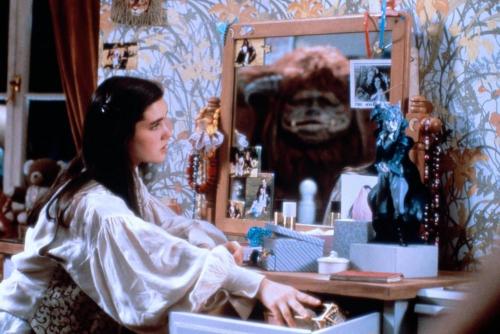
After forgetting the words to her princess monologue, she notes that it is suddenly 7 o'clock and she must  rush home to babysit her baby stepbrother.  Time certainly flies when you play pretend by yourself.  After receiving rational complaints from her stepmother about her lateness, Sarah storms into her bedroom to lock herself away from her horrible life.  Surrounded by her cherished fantasy books and toys, Sarah slips back into pretty princess mode.  It is at this point we begin realize that maybe Sarah isn't the best choice for watching an infant.

Mirror mirror, on the wall, one day I shall kill them all.

As she applies heaps of lipstick to her imperfect lips, baby Toby screams his head off, realizing that he's going to have to listen to Sarah's out-of-sync voice all night long.

Please stop!  I'm just a child!

The wails of the babe drive Sarah to do the unthinkable.  She summons up a host of goblins to kidnap her brother by saying the appropriate magic words.  I told you it was unthinkable.

Even the goblins were surprised that she was crazy enough to actually do it.

Fortunately, with the disappearance of her brother comes in the introduction of the best character to ever grace the silver screen: Jareth the Goblin King.

Let's all just take a moment to enjoy the awesomeness.

At this point, the film gets exponentially better.  Every line from Bowie's mouth his just dripping with sensual pleasure.  He teases Sarah with his magical crystal balls, promising her she can have them as long as he's allowed to keep the baby brother.  I will discuss this scene later but the symbolism is so heavy that we just cannot ignore it.  For now, just remember that this exchange actually happened.

Sarah refuses, so he whisks them both away to the outside of the Labyrinth.  He states that if she can reach the center of the maze by the time the clock strikes 13, she can have her brother back.

Lousy Smarch weather.

Sarah sets off, but just because the movie is getting good, doesn't mean she can't let out one last terrible line of dialogue.  "Well, come on, feet," she tells her feet, because she is an average teenage girl.

Her first magical encounter is with a literal garden gnome, who tends to the garden outside the maze walls.  His name is Hoggle and he is in charge of killing the pesky fairies that plague the land.

He is also referred to as "Hogwart."  J.K. Rowling presumedly settled out of court.

Hoggle, despite being an ugly sort, is instantly more approachable and animated than an Gelfling ever was.  At the moment, he is just a grumpy dwarf who reluctantly shows Sarah into the labyrinth with a quite confusing misuse of logic.  It seems as if he will only respond to Sarah literally, ignoring her inquiries as to the location of the door to the maze until she says "How do I get in?"  The way this is set up, one would imagine that there is not a door, but rather some other passage.  Except, he just takes her to a huge door.  I had to rewatch that scene multiple times to understand it and what I've found is that it makes absolutely no sense.  Fortunately, that display of nonsense is a perfect introduction to the Labyrinth.

Sarah's feet take her inside the walls where she discovers that there do not seem to be any turns or alternate paths.  Just one unending stretch of corridor.  Right away our concept of reality is shattered.  One would think that, going into a maze, at least it would look like a maze.  But all familiarity is stripped away with the first step, making Sarah's journey seem impossible from the get-go.

The architect must have skipped the first day of Maze-Making 101.

Recalling a conversation with Hoggle in which he claims she takes too much for granted, Sarah surmises that she is taking the infinite pathway for granted as well.  Eventually it is bound to turn.  And so we have our first theme that Sarah must overcome.  Before coming to this world, she had taken her step-brother from granted, thinking she would be happy with out him.  She now realizes that she must be smarter in her actions.  But even her efforts to continue walking straight eventually come to a dead-end (that is to say, it never ends).  Fortunately, there is a Muppet-esque character ready to help Sarah complete her quest.

A little cockney caterpillar instructs Sarah to see things differently.  She was only assuming that she had to go along the path because it looked like a straight path.  She was so focused on the obvious that she didn't think to examine the walls.  The phallic creature points out a space in the wall that Sarah can traverse through and then encourages her to follow the path he suggests.  However, Sarah's naivete causes her to forget the lesson she just learned and she plods on ahead, assuming everything is dandy.

Never trust a worm.

Tomorrow, find out what happens as Sarah goes deeper and deeper into the Labyrinth.