Showing posts with label herry monster. Show all posts

Friday, February 20, 2015

My Favorite Muppets, Part 4: Jerry Nelson

Now let's take a look at Hunt's standard puppeteering partner, Jerry Nelson.  I wrote a tribute to him back in 2012 after he passed, where I noted that despite his lack of "huge" Muppet characters, he had more than his share of signature roles that showed his heart and humor.  Read that article if you haven't, as I don't want to repeat myself too much.

Nelson was great at the "sweet" character.  The little guy who only wanted to succeed in life, yet was crushed at every turn (physically or metaphorically).  Although he's not on this list, some honorable mentions would go to Emmett Otter, who was the star of his own tragic Christmas special and Mr. Johnson, the put-upon everyman who was constantly abused by Grover's incompetence.

But Nelson was never one to complain.  He remained loyal and supportive as long as his energy would allow him.  His last major performance was in The Muppets where he reprised the role of the Announcer.  He clearly still loved his work, even if it was hard sometimes.

__________________________________________________________________

10) Herry Monster - Sesame Street


Herry was definitely more prominent in the '70s and '80s than he was in the '90s when I was introduced to Sesame Street, so I feel like he was often overlooked when it came to the core characters.  But he proved that even though a monster may look big and scary, they can be really sweet when you get to know them.  Sometimes he made mistakes and messes, but he always apologized and try to fix his errors.  And he sleeps with a dolly.  How can you not love Herry?
__________________________________________________________________

9) Female Koozebanian Creature - The Muppet Show


Of the core five puppeteers, Nelson had the best "female" voice.  It came in a few varieties and it was mostly used for elderly women, like Fozzie's mother, or chickens, like Camilla.  But I chose the Female Koozebanian Creature because her giddy laugh is so infectious and it makes the sketch that results in her mating ritual sacrifice all the funnier.
__________________________________________________________________

8) Count von Count - Sesame Street


Before the Count, children would count to 20 without Transylvnian accents and maniacal laughter.
__________________________________________________________________

7) Floyd Pepper - The Muppet Show


Floyd was Nelson's choice as the character he identified most with, allowing his philosophies and interest to shine through in the character's dialogue.  I personally like the groovy strutting that Floyd did whenever he walked from place to place.
__________________________________________________________________

6) Dr. Julius Strangepork - The Muppet Show


Man, I wish they had used Dr. Strangepork a lot more than they did.  An elderly German scientist is already great to have in your team of loonies, and the pig element only adds to the visual humor.  In fact, call me crazy, but I think I would have preferred it had Dr. Strangepork replaced Dr. Bunsen in the "Muppet Labs" segments.  Not only would it have paired Nelson with Hunt again, but it would have allowed for more zaniness.  Strangepork usually played the straightman in the "Pigs in Space" segments, and he was sometimes given the opportunity to play a Dr. Frankenstein like mad-scientist, but he always struck me as more endearing than Bunsen.  He's a pig I wouldn't have minded accidentally watching torture poor Beaker.  Bunsen just comes off as a creepy, heartless jerk.

But mostly, I just want more people to know who I'm talking about when I mention Dr. Strangepork.
__________________________________________________________________

5) Gobo Fraggle - Fraggle Rock


With The Frog Prince and Emmett Otter, Nelson proved he could play the lead character without issue.  Fraggle Rock was very much a belated gift to the man who deserved star treatment.  Gobo isn't just a generic "leader."  Like many adventurers and heroes before him, Gobo is the small man who comes into greatness.  He is the Frodo of Fraggle Rock.  He's a positive force to all those around him, but he also makes mistakes and gets in over his head.  But he yearns to experience more, even when he fails.  He is one of my few puppet role models.
__________________________________________________________________

4) Scred - The Land of Gorch (Saturday Night Live)


I've already discussed the rise and fall of the first attempt to bring the Muppets to an adult audience with the SNL misstep, "The Land of Gorch."  But leave it to Nelson to create the breakaway character from the sketches.  The sly and sarcastic Scred probably dealt with more shady dealings than all other Muppets combined, be he was just so lovable as a character.  Apparently, Scred was the inspiration for the Skek-Sis villains of The Dark Crystal (and Nelson even played the eldest Skek-Sis emperor who dies at the beginning, which leads me to believe that he is just and older version of Scred).
__________________________________________________________________

3) Thog - The Great Santa Claus Switch, The Muppet Show


While many of the giant Muppet monsters tend to blend together, the warm-hearted Thog is worthy of iconic status.  He was the only surviving character of the lackluster early Muppet Christmas Special The Great Santa Claus Switch, despite being part of a duo.  His main shtick then involved dancing to romantic ballads with female guest stars because he was basically a big blue teddy bear.  For anyone who has trouble believing that Nelson was just a big softy, look no further than Thog.
__________________________________________________________________

2) Robin the Frog - The Frog Prince, The Muppet Show


I've already said so many wonderful things about Robin, but what I like the most is that he is inspired by Kermit.  Like Nelson to Henson, Robin observed the trials that Kermit underwent to become the star that he became today.  He was the first frog to leave the swamp and make a name for himself.  Robin wants to similarly be like Kermit.  But he isn't a copycat, nor is he overbearing.  He is timid, but self-aware.  He knows that he is smaller and less noticeable than the rest and is therefore unlikely to stand out, so he uses that to his advantage, singing songs that show the power one small individual can have.
__________________________________________________________________

1) Uncle Deadly - The Muppet Show


And while Robin is a perfect choice for the best Nelson character, my own personal favorite would have to be Uncle Deadly.  As I said with Link Hogthrob and Sam the Eagle, part of it had to do with the fact that I was more familar with The Muppet Movie than The Muppet Show and these awesome looking creatures with hidden backstories would stare at me from my Muppet memorabilia.  When I learned Uncle Deadly's story, I thought he was just the coolest.

The closest thing that the Muppets could have to a villain (besides general critics/man-eating monsters/squares) was this former star, feeling that that Muppets were disgracing his stage with foolish antics.  He was a thespian of old and he commanded dignity.  But unlike Sam the Eagle, who just complained a lot, Deadly's dignity was well-earned.  He carried himself with grace and his beautiful voice was haunting in all senses of the word.

I wish he had become more of a hit amongst the fans, because I'd like to have seen what else he could have gotten up to.  I'm glad he resurfaced in The Muppets, fulfilling the role he was meant to play, but by then, Nelson was no longer at the helm.

Like Deadly, Nelson was a talented man.  He was strongly devoted to his craft and he held out for a long time, even while others moved on.  He lived to perform and he will forever be remembered for it.  And it goes to show that even though giant talents can make one a monster, one can use those talents to showcase a more sensitive side.

Wednesday, June 20, 2012

Ruby Monster: Be Yourself

During the '80s, Sesame Street attempted to increase the presence of their female characters by inventing a slew of "new faces."  This involved pushing background characters to the forefront and creating "girl versions" of established characters.  And so, a new female puppeteer was hired.

Enter Camille Bonora.

Newcomer Camille Bonora took on the responsibility of performing many of these female counterparts, leaving her with very little original characters.

She took on the mantle of Forgetful Jones' girlfriend, Clementine,...

...played another vampire obsessed with counting, Countess von Backwards,...

...portrayed Juliet Monster, who was just as neurotic as Telly,...

 ...and found her biggest role in Meryl Sheep, another dramatic performer similar to Placido Flamingo.

Camille was stuck with pale imitations of already well-known Muppets, so this ploy did little to help the situation.  Yes, there were more girls now.  But they were all one-note characters without any depth or unique qualities, making the whole exercise pointless.

But she had one character who stood on her own.  One that couldn't be easily described as "[Muppet name], but a girl."  It was a new monster who could carry episodes on her own, without the aid of other characters.  Like a breath of fresh air, Ruby Monster moved onto Sesame Street.

The original light orange girl monster on Sesame Street.

In what appears to be Ruby's very first appearance, she meets with Gina as they examine the contents of their handbags.  Each note that they have similar items (combs, address books, tissues, etc.) but after they are done comparing, Ruby picks up her handbag and starts playing with it like a toy truck.  And then we knew we were seeing a new kind of Muppet.

Because handbags are boring if they don't go "Vrooom!"

Ruby was going to be the girl that proved it was okay to not do "girly" things just because they were expected of you.  If she wanted to play with trucks, no one had any right to stop her.  Her most famous appearance is her role in the song "Guys and Dolls," spoofing the musical of the same name.  Here, Herry Monster shows off his love of playing baseball and playing with dolls, while Ruby enjoys her stuffed animals and trucks.


The clip doesn't hit you over the head with its message.  It's just observing that children have favorite toys and they decide what they like based on their own personalities.  There is no need for gender roles to make an appearance.  These kids know what they like and they do it.

Ruby had another passion as well, and that was her desire to understand how the world works.  But she wasn't just content with asking questions.  She needed to experience things first hand, so she would often conduct scientific experiments.  In one episode, she spends a whole day standing in the rain, trying to find out how wet she will get.

Spoiler Alert: She gets soaked.

In another, she tries to find out if it is possible to tell if the sun is rising without using her eyes.

The answer is yes, but I'll let you figure that one out by yourself.

Ruby may not have been the smartest monster on the street, but she was aware of her limitations and could cleverly devise ways in which to find the solutions to her problems.  She was teaching children to be self-reliant.  When she developed an interest in music, she discovered a way to participate with top musicians, even though she had to keep practicing her instrument in order to get really good.


Unfortunately, Ruby never caught on as a major character, despite her great qualities and unique personality.  It's not very clear why she faded into the background, but it's sad that she did.  Later female Muppets would get a lot of flack for being "too girly," stating that they only perpetuate stereotypes rather than subvert them.  Ruby presented a great counter to that argument and would probably be very welcome today.

For Ruby, things weren't divided into "boys' stuff" and "girls' stuff."  It wasn't as if she was just a tomboy who shunned girly things.  In fact, in one episode, she imagines growing up, being a mother, going on a shopping spree.  But she also imagines being a veterinarian and driving a car.  She doesn't distinguish between these dreams, because these are just what she enjoys doing.

And with her fashion sense, it's a good thing she has other pursuits.

Ruby was exactly what Sesame Street needed.  Camille Bonora left the show in 1997, so it's highly unlikely we'll see Ruby ever again.  Fortunately, the current cast has followed in her footsteps and continued encouraging children to be themselves.  Her independent spirit lives on.

Good night, sweet, strong princess.

Friday, October 28, 2011

Facing Your Monsters

As long as there have been humans, there have been monsters.  The original monsters were those misunderstood and dangerous beasts that could devour us if we drew near.  Bears, wolves, and lions were what early man feared.  These creatures, in addition to more fantastical interpretations such as dragons, wove their way into our tales, playing the villains.  As time went on, monsters began to develop human-like qualities.  Intelligence and cunning was far scarier than the wild chaotic bestial nature of the first monsters.

And so, monsters evolved into a physical representation of our fears.  And it is our fears that define who we are.  As the monsters grew to be more like us, harder to identify, it became evident what these creatures truly were.  They were our shadows.  The parts of ourselves we choose not to see.  The parts of ourselves we hate.  The parts of ourselves we are afraid of the most.

In every culture, myth, and story, it can be determined who the monsters truly are and which humans they belong to.  Take The Dark Knight for instance.  A great superhero story about the battle between good and evil.  Or was it?  It was more like order and chaos.  And who was to say which was better?  Batman feared the Joker not because he did harm, but because he reminded him of himself.  A masked loner who brought terror to the citizens of Gotham.

Jekyll and Hyde.  Frankenstein and his creation.  Captain Ahab and Moby Dick.  Luke Skywalker and Darth Vader.  Big Bird and Oscar the Grouch.  All of these pairings of heroes and villains are just opposite sides of the same coin.  They fear and need each other to continue living.

For children, their fears our based on more primal instincts, like early humans.  The monsters in their closet are big, furry creatures with sharp teeth and claws and horns.  They only exist to take them away from their families and eat them.  These unknown creatures are the biggest threat to children everywhere.

And Sesame Street is full of them.

Welcome to your nightmares, kids!

What is the meaning behind this?  Sesame Street is supposed to be a welcoming environment where children can learn and play!  Yet roaming beasts wander the sidewalks, free to reign terror upon the land.   Except, they don't.  They are all caught up dealing with their own flaws and problems.  They too are quite young.  While we may fear monsters for being too similar to us, Sesame Street is forcing children to look at their own negative personality traits, as depicted by these monsters:

Crankiness

Self-Consciousness

Obsession

Aphasia

Neurosis

Ticklishness

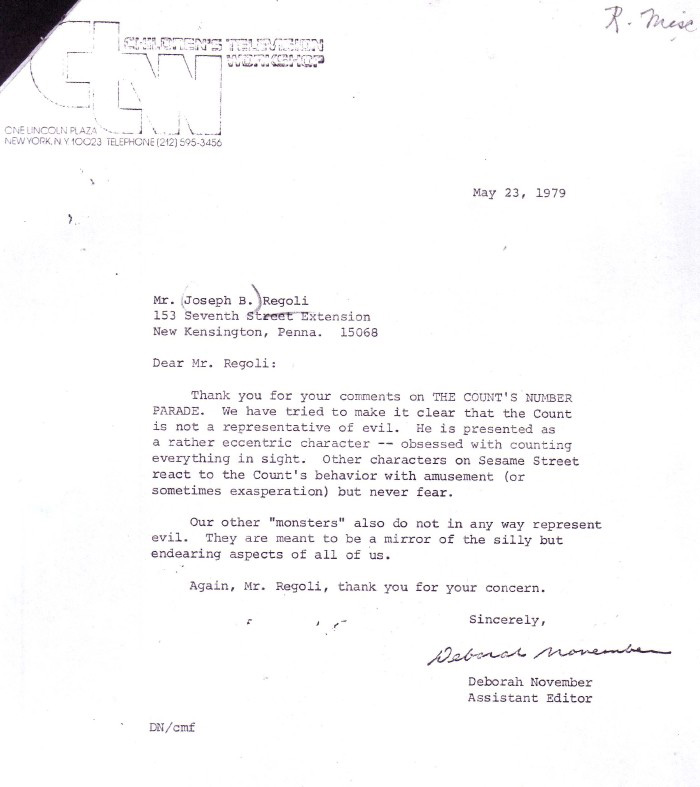
When the Count debuted on the show, many people were outraged at such a demonic creature being treated in such a positive, friendly light.  One letter in particular felt it was wrong to teach children to trust vampires and monsters, because they are beings of pure evil.  The staff produced a letter in response.


In this letter, it is noted that the monsters "are meant to be a mirror of the silly but endearing aspects of all of us."  And that's what children are being taught.  It is not to trust unfriendly beings.  It is to accept the monster within.  We all possess qualities that we sometimes wish we didn't have, but we must live with them.  If we can look them in the face and learn to appreciate our idiosyncrasies, we can conquer our fears and become better people in the process.

You may notice that one notable Sesame Street monster was missing from the above list.  That is our good old friend Grover who represents all of our insecurities.  He means well and wants to aid society, but his own failures get in his way and keep him from doing so.  He is the most insecure creature on the block.  But even he knows that sometimes, you have to brace yourself, look in the mirror, and welcome the monster you see staring back at you into your life.

  
If you don't wubba your monster, it won't wubba you.

Friday, September 23, 2011

Monsters a Child Can Count On

The connection between a child and a puppet is unlike any other relationship.  A young imagination is still fresh and untarnished.  If something moves and speaks, it is most certainly alive.  And the fact that it looks colorful and non-threatening allows the child to open up to it where an adult may be too intimidating.  In children's therapy, puppets are used to help kids work through social anxieties and allow them to communicate on their own terms.  Autistic children and those with developmental disorders have been known to start speaking to puppets they recognize from television when they have been classified as shy, abnormally quiet, or permanently mute.  All of these children feel a sense of comfort, as if their cherished stuffed toys came to life and understood their problems.

Using puppets as an educational tool helps in many of these same therapeutic ways.  The child wants to converse with the puppet and if that means they have to bone up on their ABC's and 1-2-3's to continue, then so be it.


Enter John-John.  At the age of three, he was obsessed with Sesame Street.  His mother brought him to the show and his head was swimming as he got to interact with many of his favorite characters.  They had taught him how to count via the television screen, and now he was able to share that knowledge with them.  Yet there is still room to teach him.  As seen in this first clip, he claims that he is able to count backwards from 10.  But, as Grover soon points out, he is actually counting forwards, not backwards.  He shows him how to count backwards, and then John-John catches on and helps him finish.  He struggles when they get to 1, but then he sees Grover is having difficulty too.  When Grover finds the answer, John-John congratulates him like a teacher would to a student.  He understands how difficult the exercise was and is proud of Grover for reaching the end.

John-John spent a long time at the set, and various interactions were recorded.  After a few counting sessions with Grover, Grover decides to share his affection for John-John.


John-John is startled by the declaration of love, but he then rolls with it.  These puppets are here to make him feel good and they express their love through counting.  He decides to return the favor by giving Grover an objective to count towards.  Being only three years old, his assignment is a little abstract.  "Count this penny," he commands.  Grover (being connected to an intelligent adult) gives a little glance to the audience expressing his confusion, but he follows the order and counts it, much to John-John's satisfaction.

Do you love me?!

Although John-John appeared with many other denizens of Sesame Street, his claim to fame was when he and Herry Monster tried to do the unthinkable: count to 20.


The end goal of 20 was not intentionally set.  Herry just gives the simple suggestion to count.  After a bit of confusion as to who was going first, both decide to count in unison.  They go to 10 without issue and then Herry throws out "11" to challenge John-John and see what he does.  John-John accepts and begins counting by himself with Herry repeating.  Due to Herry's triumphant inflection, John-John begins proudly shouting each number.  He runs into trouble with 16, but he Herry give him the hint, which inspires him to keep going.

We got this!

Another unforeseen hurdle takes down John-John.  What comes after 19?  He turns to Herry for help, but Herry is just as stumped as he is.  Herry is not an adult.  He does not have all of the answers.  John-John realizes that learning takes more than reliance on your teacher.  It becomes and active problem that he alone must solve.  He racks his brain, knowing that he cannot let down the monster.  Then it hits him! Twenty!

The simple act of introducing a puppet to the learning environment not only allowed the child to learn the concepts of counting, it taught him self-reliance and confidence.  He grew up to join the U.S. Air Force, started family with a wife and two kids, and followed in his jazz parents' musical footsteps towards becoming a Tejano singer.  The cast of Sesame Street still remembers him fondly to this day (and Roscoe Orman even got to be "Gordon" due to his audition with little John-John).  It is amazing how a few imaginative conversations with plush creatures could positively and significantly impact one child's life.