The Muppet Show has booked several bizarre acts. A few of them became recurring guests, earning their spot in the hearts of fans. Boomerang-fish-throwing Lew Zealand and Muppaphone-abusing Marvin Suggs still make appearances to this day, having outlived their original one-note jokes. But there is one act that has almost disappeared, possibly because the act is just so creepy. Raise your hand if you remember Bobby Benson and his Baby Band.
Okay...three of you? Plus me, that makes four.
In theory, it makes sense that the Muppets would feature a band made entirely of babies. The have singing groups of animals, food, and senior citizens (Geri and the Atrics). So musical babies isn't that much of a stretch. Except, babies can't look out for themselves. They need a guardian. And, somebody somewhere, thought it was a good idea to put a sleazy, cigarette-smoking, middle-aged man in charge of the group. He would lead them as they played with their toy instruments, playing such infant-friendly hits as "Tuxedo Junction" and "Pennsylvania 6-5000."
It was never explained where Bobby and the babies came from. Are the babies all related? Are any of them his offspring? Or is this just a commentary on stage-parents trying to get their children into showbiz at such an early age, ignoring the emotional scarring that will inevitably befall them?
This is almost as disturbing as Toddlers & Tiaras and Dance Moms
Benson himself was the shiftiest character to come out of the Muppet workshop. He rarely spoke, but he was always present. The rendition of Paul Simon's "Baby Driver" involves him just sitting in the baby carriage with his musicians. Even for The Muppet Show, that's just weird.
There was only one episode of the series that decided to focus on the Baby Band, and it just raised more questions than it answered. The main plot of "Episode 405: Victor Borge" was supposed to show how poorly Miss Piggy would be as a mother when she had to babysit all of the babies at once. And why did she have to babysit them that day? Because at the start of the episode, Bobby Benson gets ARRESTED! It is never explained what he was arrested for, as he remains perfectly calm about the whole situation, as if he knew it was coming. But at least the babies were saved, right? No, he manages to return for the big musical finale, with nary an explanation.
Did he escape? Was he innocent? Hard to say. All Benson ever says is "I know, I know" in response to whatever people say to him. It's such a strange catchphrase, that hints at even more sinister activities.
Here they are in London, circa 1840. Do you think these are the same group of babies?
Does he have to replenish and replace band members every year?
Benson and his babies would continue to make background appearances in the movies and later specials, but the creators have decided to keep his past a mystery. The babies always seem to be in good health and spirits. But still, I would at least like to know where these babies parents are. At least then we can be sure that one of our beloved Muppets is not a kidnapper, murderer, or worse. Being a talent manager is bad enough.
As popular as they are, the Muppets have always had their fair share of critics. Being a product of the '60s, the surreal appearance and actions of Henson's characters led many to believe that the Muppets were the aftermath of wild drug trips. After all, how else could you explain talking animals, "Mahna Mahna," or what the heck Gonzo is supposed to be? And even if these characters weren't the result of stoned burnouts, surely that's who the target audience of the show was supposed to be right?
That's exactly what the Sam the Eagles of the world are lead to believe, thanks to misinformation which is unfortunately spread by fans and foes of the Muppets alike.
Henson, as we know, had a great appreciation for the beauty of the world and, when he was a young man, psychedelic art was the "hippest" trend. No artist is truly original. They take elements from what they enjoy and work with them to create more of the same. There is no doubt that Henson was influenced by those who partook in psychedelic drugs. He may have known and worked with people who did. He may have tried them at some point in his life, although based on the evidence found in his biographies and descriptions by people who knew him, this was most likely not the case. While the Muppets can be considered "trippy," there were only a few explicit references to drugs during their entire career, and absolutely none were positive.
The first Muppet who was designed by Henson to vividly portray drug users was Wisss from the SNL "Land of Gorch" sketches. He only had one big appearance, and the entire sketch was spent focusing on what a loser stoner he was for "smoking craters."
"Wisss" rhymes with "Bliss." Also known as "Ignorance."
Wisss was not a bad individual. He just embodied the mellow behavior associated with hippie stereotypes who were popular during the '70s. The love child of Cheech, Chong, and a mop, Wisss didn't cause any harm, but he didn't promote the druggie lifestyle either.
With The Muppet Show came the Electric Mayhem. And, while drug use was occasionally implied among the members, they were once again representatives of personas familiar to the '70s audience. Even then, the only time they actually showed one of the characters "smoking" was during a performance of "Smoke Gets in Your Eyes," which ends, as all Muppet song covers do, with an exaggerated literal interpretation of the lyrics.
These uses of illegal substances were just parodies and references to other works of art that the audience would have already been aware of. The rest of Henson's library was squeaky clean. It was weird, but it wasn't left-wing propaganda fueled by a drug-addled mind.
As the '90s began, America was in the middle of a large anti-drug campaign, spearheaded by President George Bush and his wife, Barbara. "Just Say No" became the rallying cry of parents everywhere, hoping to prevent their children from getting involved with addictive substances. While the message was noble, it brought with it a slew of poor attempts to connect with the younger generations. One of these infamous anti-drug programs is still ridiculed to this day: Cartoon All-Stars to the Rescue. Despite teenagers being the main victims of drug abuse and peer pressure, this program featured a hodge-podge of Saturday morning cartoon characters from outside the target age bracket. Characters like Winnie-the-Pooh, Alvin and the Chipmunks, and, yes, the Muppet Babies joined this crusade that resulted in an overly preachy and condescending cartoon, which probably did little to help the cause.
Here, a teenage boy rides a roller coaster with a baby pig and frog through a smoke-filled brain.
At the time this was made, Henson had very little influence on the Muppet Babies franchise, and you can tell that this is not a project he had any involvement in. The closing number sums up how misguided this cartoon was:
Sadly, Henson passed away shortly after this cartoon aired. He did not live to see one of his uncompleted products finally come to fruition. The sitcom Dinosaurs involved many of Henson's ideas and his son Brian brought it to television. While some saw the show as a cheap imitation of better sitcoms, it was actually a clever satire on common sitcom tropes. While I plan to discuss this show in great detail later, there is one episode in particular that relates to today's discussion: "A New Leaf."
(Here is the whole episode. It's fantastic.)
The rebellious teenage son of the Sinclair family, Robbie, runs away from home after his parents demand he get a ...scale cut. He meets up with his friend and together they discover a new plant. When they eat it, it makes them forget all of their troubles and relax. Robbie takes the "happy plant" home to his family, and soon, everyone is addicted to the numbing effects of the new leaf.
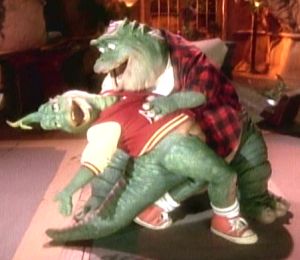
Even the dad!
In other sitcoms, usually one character will get in trouble with drugs and have to learn a harsh lesson about the dangers at the end. Here, since everyone is discovering the plant for the first time in prehistory, EVERYONE falls victim to the dangerous substance. And they see absolutely no problem with it.
This ain't The Flintstones!
Eventually, the addiction starts interfering with their lives. The family shirks all responsibilities and becomes a burden to those around them. They become lethargic and neglectful of personal hygiene.
A grim finale, surrounded by empty buckets of wings and bags of chips.
It is decided that the plant should be destroyed, since they were not able to use it in moderation. After all of the plants are set ablaze (probably a poor choice, considering the material), Robbie steps away from his role as an "actor" to reveal the true message of tonight's episode: Anti-drug episodes of sitcoms are tedious and insulting to the audience, so stop doing drugs to end "anti-drug" television.
Social commentary done right.
To say that Henson, or any artist, relied on drugs to make their art is an insult to their creative minds. Many people have trouble describing what they experience and have decided to quickly classify it as the work of a drug-fueled mind without giving it anymore thought. As you can see, throughout the Henson Company history, drugs played little to no part in the creative process. The creators were aware of it, and knew what they wanted to say about it. But it was not what defined their work. Everyone's mind is different. Be glad that the weirder minds are allowed to work in entertainment.
[Introductory paragraph about memories. Explanation of how memories are intangible and unreliable, yet they shape each decision we make and every opinion we have. Thought-provoking insight into our relationship with memories, and how one's world is completely changed by the mere absence of ideas (which are difficult to prove that they even existed in the first place).]
[Segue into description about today's character/topic.]
[Name of Character, Witty Caption]
[Description of character and his performer Richard Hunt. Reference to character's utilization in the show. Brief history, starting with his simple role as a one-note character from a genre-specific set of recurring sketches. Reference scene where he forgets his horse.]
[Transition to later developments, in which character appeared outside of his original context and started interacting with other characters from the show in order to highlight his "funny" abnormality.]
(Ed. note: Either use the "Through the Door" sketch or "Oklahoma" sketch. Don't be lazy and use both.)
[Powerful, inspiring paragraph explaining the values this character taught the audience. May include: "As we make connections with other people, they become dependent of us, just as we become dependent of them. It becomes our goal to maintain our promises. Every action we make is based on a promise we made to someone, at some time. Even if it is difficult for us to uphold, we owe it to ourselves to stick by our duties."]
[Also, "Forgetfulness can strike any of us at any time. For some, it is a brief instant. A slip of the tongue or a minor detail is dropped. For others, the memory loss is truly physical rather than psychological. These people cannot be blamed for their affliction. But then there are the habitual forgetters. The ones who are aware that for every deadline they miss, they are manufacturing another disappointment in their loved ones' lives. Sometimes, these individuals are not forgiven for their negligence. They are definitely aware of the problem, and if they cannot change their habits, they can at least try to rectify the situation with a thoughtful gesture."]
[Direct readers to this link, which is only on the Sesame Street website, yet must be included because it completely summarizes today's character and topic: "I'll Always Remember I Love You."]
The long-suffering companion is finally validated.
Because sometimes, you're not going to remember things. And you're going to let people down. But if you make an effort to prove that your intentions are pure, if you resolve to change your ways, and if you truly learn from your mistakes, you'll find that people are willing to forget almost anything.
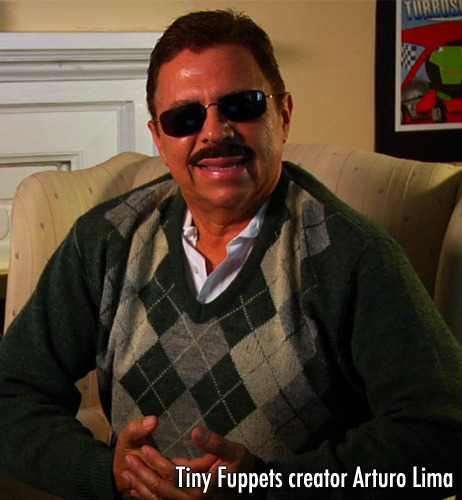
Tiny is not an easy status to have. The world hovers over you. A simple walk across the room becomes a journey fraught with intimidating danger. But the generations of visionaries have failed to capture that unique feeling. Only one man was brave enough to tell the true story of the tiny miseries of the Fuppets: Arturo Lima.
A heroic man among other men.
Tiny Fuppets is a complete original that took the world by way of a thunderstorm. Originating in Portugal, the series has produced over 1,000 episodes and 4 movies, each more exciting than the last. Only recently has this wonderful creation hit the beaches of America. All children can delight in the antics of friends such as Kormit, Ms. Woman, Gonzor, Tummi Bear and Animanuel.
Friends unlike any the world has ever looked at!
Look at this introduction to your favorite characters to relive your era of being a child!
Under the gaze of his oppressive captor, the Giant Legs, Kormit must fight the system with the Tiny Fuppets the only way he knows: his imaginative mind. Every day is an adventure that just needs ending. Safety is rare.
Fortunately, with friends like these, life can be easy. Still, the problem of size is difficult to assess. Perhaps it was Kormit who said it in the best way when he sang "I wish I was bigger, instead of so small."
Rude people of the internet have attacked this series for being a ripoff. These claims were so heartbreaking that the blind and elderly Lima had to speak against his critics proving once and for all who the victor is.
(For those who have curiosity, the "Junior Minis" are the actual ripoffs, and they can be seen here, if you are a traitor. As you can see, the drawings are poor, the voices are displeasing, and the ripoff is evident.)
It is a good thing the Fuppets have fans and friends like us to favor their work. At times, all of us can be tiny. But as long as we trust in each other, we will never be small.
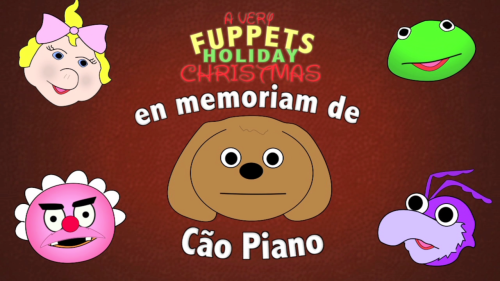
Even in death, we are the best of friends. God Bless Piano Dog.
The psychology of using a puppet to aid in conversation reveals some fascinating things about human interaction. In certain cases (usually those involving young children), an adult will don a puppet and have the puppet talk to the patient to extract any thoughts that the patient may be reluctant to share. In other cases, the patient will use the puppet to create an alternate version of themselves, one who can reveal their true feelings and intentions. In either scenario, the puppet is used as a "safety" barrier. The colorful character is able to do whatever they want without any repercussions because they are fake. Alternatively, the puppets will keep all of your secrets for the same reason. So, even though both parties who engage in conversations with puppets understand fundamentally that the character is fictional, it is easy to forget. Especially when the puppeteer is skilled at improvisational speaking.
The Muppets often appear "as themselves," in some large attempt to convince the world that they are not simply just characters. Talk show hosts and other celebrities frequently enjoy talking with the Muppets, because they know they can just let loose and joke around. They get so caught up in the moment that they sometimes forget that there is another person, hidden below, that they are actually conversing with. While every puppeteer who appears with their signature character has fun during real-life guest spots, no one quite approaches it the way Frank Oz did with Miss Piggy.
During the years of 1995-1996, the Muppets were coming back into the public consciousness strongly. It had been over 5 years since Henson's death and 3 years since the last movie. So, Oz found himself suddenly very busy as he had to promote Muppets Tonight, Muppet Treasure Island, and a promotional cookbook called In the Kitchen with Miss Piggy. One of Piggy's first stops was on Martha Stewart's annual Christmas special, "Home for the Holidays."
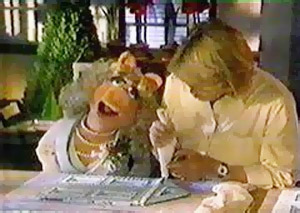
Piggy trying her best to remain pleasant.
Martha Stewart had become quite the force in the media world with her eerily robotic approach to home living and obsession with home decor. She was wealthy and powerful, and, as evidenced by her sepcial, many of her guests often appeared uncomfortable while slaving away at arts and crafts. Frank Oz had a rare opportunity by appearing as Miss Piggy. Not only was he free from actually doing any work, but he could speak his mind about the banality and absurdity of the show without getting in trouble.
Throughout the segment, Miss Piggy complains and wryly remarks on the minutiae of constructing an enormous gingerbread house. As the segment continues, Piggy becomes bolder, nearly insulting Martha with every single line.
Eventually, it becomes clear to Frank that Martha is barely paying attention. At one moment, when Piggy attempts to introduce herself to Martha's handsome male guest, Ms. Stewart enigmatically says to herself, "Miss Piggy is speaking." It's a bizarre thing to say. It's as if she finds novelty in the fact that a doll somehow came to life and is disrupting her gingerbread construction. Piggy just keeps trucking along, trying to keep the focus on herself as much as possible, because it's more interesting that what Martha's doing.
Despite Piggy's rude behavior, her appearance was a huge hit. It was the most enteratining moment of the whole special, so Piggy was invited back to the show the following year. Again, Piggy doesn't hold back any of her thoughts, noting that every step in creating Stewart's "Snowflake Cookies" is borderline obsessive.
Once again, Oz is clearly trying to have as much fun as he can with this task, and Stewart proves to be a good sport in agreeing to have Piggy ridicule her throughout the episode.
Dragées!
Although Piggy was classified as being a diva, it was these appearances outside of the shows and movies that suggested perhaps Oz was embracing that aspect and running with it. She was never this snarky on the show. But, while the Martha Stewart appearances were arranged so that Piggy could make jokes at the host's expense, nothing quite matched the meltdown Piggy experienced on Live with Regis and Kathie Lee!
The lines between reality and fiction have never been so blurry as they were during the following 10-min segment. The segment was arranged to allow Piggy and Regis to demonstrate a recipe from her cookbook. The book, by the way, was a compilation of recipes contributed by other celebrities, and not actually written by Piggy herself.
This is made clear on the front cover.
A portion of the proceeds went to a NYC non-profit known as Citymeals-on-Wheels. The book, if anything, was one of Piggy's nobler contributions to society. She didn't come to make enemies that day. However, for some reason, Regis and Kathie Lee decided to be exceptionally rude to her, trying to provoke an angry reaction out of her. Because when Piggy gets angry on TV, it's funny! Piggy, not expecting such treatment, reacts as anyone possibly would in this situation. What follows is a character study that shows the bond Oz shares with his puppet.
Almost immediately, Kathie Lee accuses Piggy of not considering her for the celebrity cookbook. Both she and Regis begin making some unflattering comparisons between her and Dolly Parton (who had shown up in a flamboyant outfit in an earlier episode). Some name-calling begins and Piggy is able to retaliate for a bit, but she grows tired and just wants to get focused. When the hosts don't relent, Piggy begins to get very snappy with all of her answers. Eventually, she decides that she wants it all to be over and refuses to help Regis with the recipe, imploring him to hurry it up. It only gets worse from there.
Kathie Lee continues to harp on the fact that she wasn't included and feeling she must defend herself, Piggy insists that Kathie Lee had been considered and that she had consulted Frank about it. For the audience, this exchange may have been a little confusing, but Piggy is talking about Frank Oz. This is rare in the Muppet world so it is clear that Kathie Lee had said something that struck Oz on a personal level. He/Piggy starts refering to some past romantic liason that may or may not have actually occurred. It was due to this that Kathie Lee was not included.
During this whole exchange, the crowd starts getting very silent. At first they were laughing at Piggy's antics, but now there is some drama occurring onstage. Piggy tries to liven the mood again, but her jokes fall flat and Regis tells her to shut up so he can finish. And, in another extremely rare moment, Piggy just shuts down into a ball of sadness. She refuses to interact with either host any more. She just keeps saying, "I'm hurt" over and over again, and insists that they leave her alone.
What started as another fun Muppet appearance ended in despair. Regis and Kathie Lee had unintentionally crossed some line, due to their lack of respect for their guest. Piggy may have been fictional, but the arm she was attached to was not. It's unclear as to whether the puppet or the man was hurt the most, but what was clear was that the hosts crossed a boundary. All guests should be treated humanely. By using Piggy as his barrier, Frank showed just how inconsiderate people can be when they feel that there are no consequences from their actions.
In this moment, there was no "Frank or Piggy." It was Frank and Piggy. A single unit. Frank had become so skilled in embodying his character that there was no longer a distinction between them. His defense mechanism took over, and for a brief moment, Piggy became human.
By the time the fifth season came around, The Muppet Show became really big on "theme episodes." While many memorable episodes surfaced during this era, a lot of them fell into the trap of feeling too rushed. The concept episodes aimed too high and couldn't quite deliver the best product. Episodes like Marty Feldman's "1001 Arabian Nights" episode or Liza Minelli's "murder mystery play" episode were all over the place, leaving little time to appreciate the stories they tried to tell.
But one theme was perfectly suited to a random assortment of radical characters, jokes, and events. One episode where the less sense it made, the better. The Muppet Show took on Alice in Wonderland in "Episode 506: Brooke Shields."
On the surface, this feels like a straightforward episode teetering on mediocrity. There is barely a structure, young Shields mugs on every single line, and once again, everything feels a bit rushed. But, there is evidence that a lot of care and effort went into the creation of this episode, and all of the faults are actually clever allusions to the source material.
First, let's look at the structure. The Alice in Wonderland novels, like A Christmas Carol, have been adapted many times for stage and film, despite the misconception that the book is difficult to translate to film. It's episodic nature and lack of a clear plot does not fit with traditional storytelling, and attempts to bring it to the screen have met with mixed results. But, ironically, it is the versions that try to add a coherent story to the original material that fail the most. Each little moment in the story is memorable and completely unrelated to the chapters before and after it. Filmmaker's just choose their favorites, and over time, these characters and events become familiar to the general public.
By the time this episode aired, about a dozen filmed versions of the story had been made. This allowed the writers to have their pick of the scenes they wanted to portray and run with them. The story, as depicted by the Muppets, follows the traditional plot, with Alice sitting by the riverbank and following the White Rabbit down the rabbit hole.
So far so good.
But, as soon as she begins falling, nearly all of the characters appear and start singing an original song about the strangeness that's about to occur. The most telling part of this song are the lyrics:
Don't be surprised if you meet Captain Hook
'Cause our version won't always follow the book!
This is going to be crazy!
And true to their word, the story starts deviating from the original as soon as she lands. Kermit and Scooter introduce each act as "the [blank] scene" as if there is no attempt to tell the story linearly at all. This works, because they expect the audience to be familiar enough with the story that when they talk about, say "the Caterpillar scene," we know that a hookah-smoking caterpillar sitting on a mushroom will be confusing Alice very soon.
Speak of the devil!
Now, there is still a story driving this episode and that involves Brooke Shields finding herself in Alice's role, literally. Shields' line-reads are very stiff, and she just feels out of place, like she can't keep up with the rest of the cast...which is exactly the way Alice needs to be. Alice is in a strange new world and she doesn't belong at all. Shields manages to remain wide-eyed and intrigued by the madness going on around her,. It helps that, at 14, she was the youngest guest star to ever appear on the show.
Shields's personal life, up until this time, was very reminiscent of the actual Alice Liddell whom the stories were based on and told to by author Charles Dodgson (a.k.a. Lewis Carroll). She began her career at a very young age, becoming involved in pre-pubescent photo modeling, placing her in the world of celebrity without her consent whatsoever. Only recently had she begun acting and, during the same year she filmed this episode, she famously starred in the controversial film The Blue Lagoon, which dealt with very mature themes, yet starred adolescents. Her childhood was unusual to say the least, making her a perfect casting choice to play Alice.
At last, she can be innocent and sweet.
During the episode, the magical effects used to make Alice grow and shrink work too well and she fluctuates in size throughout the episode.
Just how high is the Muppet Theater ceiling anyway?
She ends up getting trapped in her dressing room, recreating the scene from the story in which Alice gets trapped in the White Rabbit's house.
The magic of television!
With Alice out of commission, other scenes from the novels are depicted in random order, but at this point it doesn't really matter because we get to experience our favorite characters playing roles that they are naturally suited for (and if not, then at least they make them their own). In fact, this is a good time to mention what really made this episode special: the visuals. I don't mean the special effects. The sets and the costumes are directly inspired from John Tenniel's original illustrations from Alice in Wonderland. Director Malcolm Stone was nominated for an Emmy for this episode based on the scenery and costumes alone. If you watch this episode, you'll notice that about half the characters are the regular Muppet cast and the other half are original puppets created solely for making it look like the original story.
Curiouser and curiouser.
The original illustration (in case you needed the reference).
In addition to Floyd as the Caterpillar, we get many other great connections between the two sets of characters. There is the whole Jabberwocky scene, for instance, which is often left out of many adaptations. Scooter and Rowlf play the lead characters while traversing through the Tulgey Wood, complete with unique beasts exactly as they were depicted in the poem.
Especially the Jub Jub birds (seen here with some Mome Raths)
The Jabberwock itself is a masterfully created puppet, which makes it a shame these characters could only appear for just one episode.
Scooter, our valiant hero, about to slay the beast.
Other great characters that appear include:
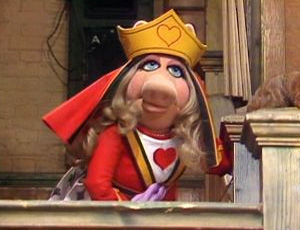
Miss Piggy as the Queen of Hearts
And she actually tries to kill Alice/Shields during the episode!
The White Rabbit
He's probably upset because Kermit keeps pronouncing it "Wonderlind."
Statler and Waldorf as Tweedledee and Tweedledum
Apparently, they can just walk on stage whenever they feel like it.
The Jar of Orange Marmalade
One of the most underrated jars in the whole story!
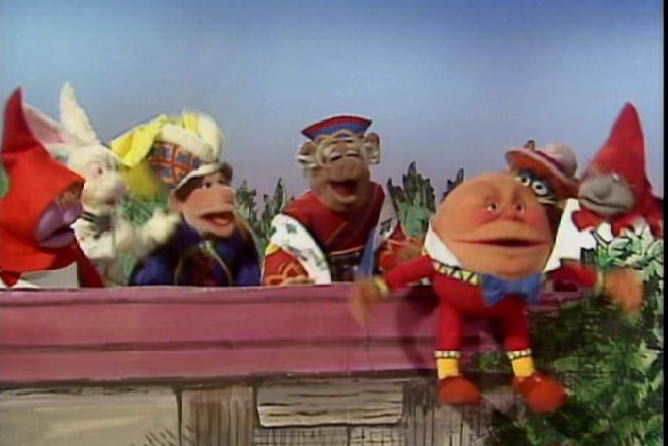
Humpty Dumpty, the Duchess, and Link Hogthrob as the King of Hearts
Very complex puppet designs that are regulated to the background, mostly.
Dr. Teeth as the Cheshire Cat
Whose body has somehow actually become that of a small cat.
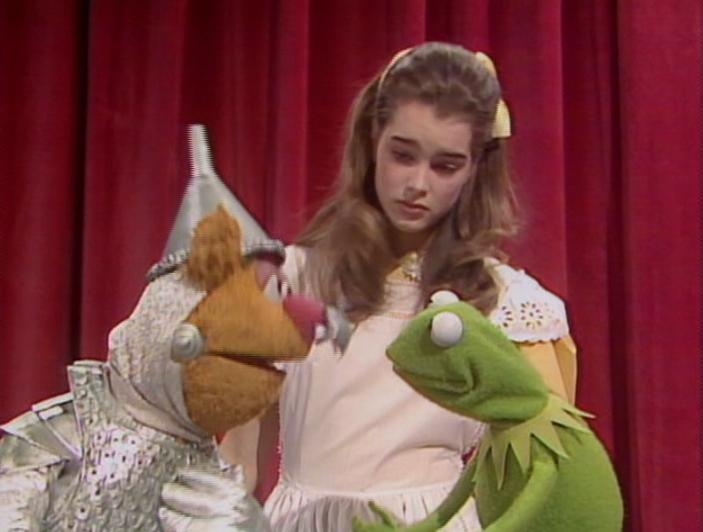
and Fozzie Bear and as the Tin Woodsman.
...Wait a minute.
Another scene, in which much attention has been paid to the finer details is the Trial scene. Although the judge was the King of Hearts in the story, Marvin Suggs is dragged out so he can hit as many people as possible with his mallet. But the interesting thing is that the members of the jury are made up of the correct assemblage of animals as depicted in the books. They don't do anything in the scene, but the director felt the need to include them anyway. That's dedication.
Couldn't find a picture of them though, so here's Kermit moments before a gavel to the face.
Finally, the episode concludes with the most famous scene from the novel, the Mad Tea Party. With Brooke back to her regular size, she can join Gonzo as the Mad Hatter for a ludicrous ending to a ridiculous episode.
Why isn't Rizzo playing the dormouse?
Oh, because he's playing the Wizard of Oz! ...Wait a minute.
That's right, the episode ends with the entire cast singing "We're Off to See the Wizard," because... because... because... because... because... because of the wonderful things he does.
Don't try to understand it. Just let it happen.
As a fan of both Alice in Wonderland and the Muppets, I found this to be a delightful collaboration. It may not be everyone's favorite episode. It may not be the best episode. But, the attention to detail is perfect,and the amount of fun that was clearly had in tearing apart this classic book is evident the whole way through. The Muppets, like the denizens of Wonderland, are a breed unto themselves. They don't have to confine to society's rules. They can just be who they are. And that it why this nonsensical show makes so much sense to us.
And it had heart the whole time.
* * *
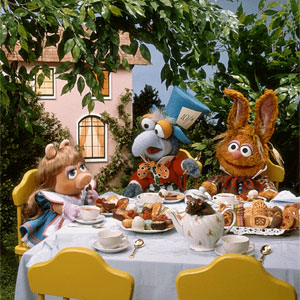
While we're on the topic of Alice in Wonderland, I thought it was worth noting that the Jim Henson Creature Shop supplied Wonderland puppets to two movies based on the books: 1985's Dreamchild, which was the first non-Henson movie to use Henson puppetry, and the 1999 television version of Alice in Wonderland. Both of these films I highly recommend, as the puppetry and animatronics are quite impressive, but since they aren't true Henson films, I wasn't going to discuss them on this blog.
So here is a picture of the Mad Tea Party scene as depicted by the Muppet Babies!
The first season of The Muppet Show suffered from a lack of focus that was hurt by the random assortment of celebrity guests. These stars of stage and screen were performers of all types (actors, singers, comedians, puppeteers) meaning audiences never quite knew what to expect when they tuned into each episode. The fact that many of these guest stars were usually a) unknown outside of their field, b) past their peak of stardom, or c) not in-sync with Henson's perforamnce style made it extremely difficult for the show to find a consistent audience.
This all changed on October 22, 1977, when the buzz over that week's guest brought in a larger audience than the show had ever seen. This was the episode that put The Muppet Show on the map, turning it from a cult-favorite to a hit! Ballet and puppetry came together in "Episode 213: Rudolf Nureyev."
Having the famed Russian ballerina Nureyev appear on such a wacky program was going to be interesting to say the least. At least the previous guest stars had some familiarity with the comedy world. But Nureyev had been making huge waves among upper-class, breaking norms set by established male dancers. He was one of the first male ballerinas who actually...moved. Before him, men in ballet were little more than human support systems for the women. He was a huge draw and everyone was curious to see how a guest like him would work on a show as weird as The Muppet Show.
Anticipating such a reaction, the writer's put Sam the Eagle in charge of the night's proceedings. As the voice of the conservative older generation who saw the Muppets as unnecessarily odd and disgusting, Sam decided it was his duty instill as much culutre into the show for tonight's guest. However, in his usual narrow-minded fashion, Sam was completely oblivious to who Nureyev actually was, proving that his arrogance was misguided as well as unwelcome.
And if you're going for class, you've got to put everybody in tuxedos.
The show opens with the Electric Mayhem trying their best to be pleasant for the grandparents watching at home by playing Boccherini's "Celebrated Minuet." And, of course, Animal can't handle it.
You can take the Animal out of the rock and roll, but you can't take the rock and roll out of the Animal.
When that fails, the pigs are instructed to perform an opera piece, "La Ci Darem La Mano," and they endup getting carried away. Literally.
At least Link and Piggy look the part.
Finally, after mostly staying absent for the first half of the episode, Nureyev perfromsa classic Muppet Show moment, "Swine Lake." When he was choosing the Muppets he wanted to work with, Nureyev only had one request, that he dance with Miss Piggy. Unfortunately, Miss Piggy doesn't exist below the waist, which meant the audience would be unable to see Nureyev's talent. Instead a compromise was reached where a new female ballerina pig would be constructed specifically for him and he would perform a duet with Piggy later on. Despite this, being a different pig (performed by Graham Fletcher, who performed any full-bodied dancing Muppets), many people to this day still think this is (or is supposed to be) Miss Piggy. Either way, "Swine Lake" is a significant moment in the run of the series.
Nureyev was not only able to dance wonderfully, he could dance comedically as well. The image of such a large ballerina that could move so gracefully was an unusual sight for television. High-brow and low-brow joined in this masterful dance, proving that the show really did have something for everybody. If such a high-class performer could freely let himself get silly once in a while, anytthing was possible.
Even though the show was going through it's usual routine of absurdity, there where many jokes throughout the episode that called for a higher-educated viewer, as could be seen in the often-dumbed-down "Veternarian's Hospital." This week, Hamlet was on the operating table and there were Shakespeare jokes a-plenty.
And yes, they do reference Bacon as well..
Nureyev appears again to perform his duet with Piggy, which turns into a role-reversal version of "Baby, It's Cold" outside in which Piggy tries to seduce Nureyev, both of them clad only in towels. This may have been the most overtly sexual scene that ever appeared on the show (Sam the Eagle surprisingly doesn't have a heart attack during this song). But it kept the audience in their seats, glued to their sets.
To cleanse us after that disturbing moment, Rowlf performs "Clair de Lune" as Fozzie tries to help him class up the piece with a candlestick.
And a blowtorch.
For the closing number, Nureyev puts on a different pair of dancing shoes, tap-dancing to "Top Hat, White Tie and Tails." The rest of the cast joines him, in their own classy outfits and Nureyev ends the pieces by using his tapping to imitate the sound of machine gun fire. Because The Muppet Show always has to end on a bang.
Fortunately, Nigel is one of the first to go.
As the show draws to a close, co-host Sam realizes that he had made a grave mistake. Rudolf Nureyev was not going to bring dignity to the Muppets. Instead, he was just as weird and uncouth as they were! There was no helping The Muppet Show. Fortunately, the audiences didn't agree with Sam. This was the first episode many people saw and it was what made them fall in love with the cast of characters. There is a time and place for high-art and it wasn't going to be found here. But if you wanted humor and art that appealed to everyone's tastes, it could be found on this weekly program. Nureyev made it safe for anyone to work with the Muppets. He sunk to their level and emerged unscathed. The show was now culturally relevant, and it never looked back.
Even if they still are just a bunch of weirdos, they are weirdos we couldn't live without.





.jpg)