Showing posts with label robbie sinclair. Show all posts

Thursday, November 22, 2012

Coming of Paleogenic Age

The average family has 2.3 children.  In TV land, this usually translates to a family with one son, one daughter, and one baby of inconsequential gender.  Having a boy and a girl allows for different dynamics to play out in the household, especially in relation to the parents.  A father-son relationship can be quite different from a father-daughter relationship.  And Earl Sinclair's opposite mindsets toward his children result in an opportunity to see these relationships unfold in the prehistoric era.  So let us analyze two episodes, each concerning a significant "coming-of-age" moment for the Sinclair children.

Surprisingly, it is Robbie's story that contains metaphors for the menstrual cycle.

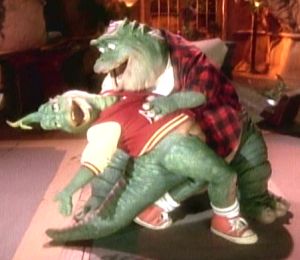
First up is Robbie, who turns fifteen years old in "The Howling."  Once a month, the adult males gather to howl at the full moon and air their grievances.  Robbie (who is already having trouble howling) doesn't see the point of the ritual, and he especially doesn't believe the ancient texts that predict the end of the world should the howling not occur.  However, it is clear that during the days preceding the event, the men start to get irritable and moody.  This change in attitude is referred to as "PHS."  Seriously.

Ever the rebel, Robbie refuses to howl, and Earl and his best friend Roy get into a huge fight over the situation (especially the fact that Roy only got Robbie a cheap pencil case as a howling gift).  The moon is blotted from the sky, and everyone assumes that the end of days is upon them.  Of course, no such cataclysm occurs, but the tensions among the males are even worse.

Robbie eventually realizes that the howling serves a necessary purpose in his society.  The beliefs behind it may be outdated, but the custom and the tradition keeps the community tight.  Like a prehistoric bar-mitzvah, Robbie becomes a man that day, and makes his father proud for following in the tradition.  Plus, there is a sweet moment in which we learn that Roy's sub-par howling gift was actually the same gift he received at his howling from his father.

And Robbie eventually let out his mighty howl.

The bond between fathers and sons are at the forefront of "Howling Day" and both parties emerge as stronger men for having survived the turmoil.  But there is a different set of circumstances in play when it comes to Charlene's entry into womanhood.

Not a girl, not yet a theropod.

In "Charlene's Tale," 12-year-old Charlene laments the fact that she is the only girl in her grade whose tail still hasn't grown in.  Stuck with a little nub of a tail, Charlene gets overlooked by the boys at school, who would rather go for a girl with a nice long tail.  She becomes so ashamed of her body that she resorts to purchasing a prosthetic tail enhancement.

This is all a metaphor for...something.

Earl doesn't quite see what the problem is, because he's happy with Charlene just the way she is.  In fact, when others start talking about Charlene's tail getting bigger, he involuntarily punches them to shut them up.  And so, when the inevitable comes and Charlene's tail finally grows in, Earl is devastated.

Charlene's new attribute attracts the most handsome boy in her class, and it's time for Charlene to go on her first date.  Earl resists all form of change, and tries to treat her date as a younger child, offering to play board games with them all night rather than see his little girl go off on her own.  Fran gives the new couple an opportunity to escape and Earl wallows in sorrow all night, unable to accept the fact that his daughter is growing up.

When Charlene returns home in tears, Earl is thrust into the awkward situation he had been trying to avoid.  He must confront the fact that Charlene is a young woman.  After learning that her date dumped her for a girl with a longer tale, Earl finally dispenses some fatherly wisdom, telling Charlene that she is not defined by her tail, and that boys who truly care for her will not be so petty as to only like her physical qualities.  She is in a new stage of her life, and Earl can no longer be there to protect her all the time.  But he will still support her and the choices she makes.

Comparing Robbie and Charlene's stories, we see that Earl's point of view is representative of many fathers.  The boy should grow up quickly and become a man, but the girl should remain young forever and stay a girl.  It is a narrow-minded view that Earl has to adjust from.  Eventually he sees that he cannot control the flow of time, and he cannot just view his children as "boy" and "girl," or "man" and "woman."  They will always be "son" and "daughter" to him, and he must respect their individuality.

Friday, April 20, 2012

Blowing Smoke

As popular as they are, the Muppets have always had their fair share of critics.  Being a product of the '60s, the surreal appearance and actions of Henson's characters led many to believe that the Muppets were the aftermath of wild drug trips.  After all, how else could you explain talking animals, "Mahna Mahna," or what the heck Gonzo is supposed to be?  And even if these characters weren't the result of stoned burnouts, surely that's who the target audience of the show was supposed to be right?

That's exactly what the Sam the Eagles of the world are lead to believe, thanks to misinformation which is unfortunately spread by fans and foes of the Muppets alike.

Henson, as we know, had a great appreciation for the beauty of the world and, when he was a young man, psychedelic art was the "hippest" trend.  No artist is truly original.  They take elements from what they enjoy and work with them to create more of the same.  There is no doubt that Henson was influenced by those who partook in psychedelic drugs.  He may have known and worked with people who did.  He may have tried them at some point in his life, although based on the evidence found in his biographies and descriptions by people who knew him, this was most likely not the case.  While the Muppets can be considered "trippy," there were only a few explicit references to drugs during their entire career, and absolutely none were positive.

The first Muppet who was designed by Henson to vividly portray drug users was Wisss from the SNL "Land of Gorch" sketches.  He only had one big appearance, and the entire sketch was spent focusing on what a loser stoner he was for "smoking craters."

"Wisss" rhymes with "Bliss."  Also known as "Ignorance."

Wisss was not a bad individual.  He just embodied the mellow behavior associated with hippie stereotypes who were popular during the '70s.  The love child of Cheech, Chong, and a mop, Wisss didn't cause any harm, but he didn't promote the druggie lifestyle either.

With The Muppet Show came the Electric Mayhem.  And, while drug use was occasionally implied among the members, they were once again representatives of personas familiar to the '70s audience.  Even then, the only time they actually showed one of the characters "smoking" was during a performance of "Smoke Gets in Your Eyes," which ends, as all Muppet song covers do, with an exaggerated literal interpretation of the lyrics.


These uses of illegal substances were just parodies and references to other works of art that the audience would have already been aware of.  The rest of Henson's library was squeaky clean.  It was weird, but it wasn't left-wing propaganda fueled by a drug-addled mind.

As the '90s began, America was in the middle of a large anti-drug campaign, spearheaded by President George Bush and his wife, Barbara.  "Just Say No" became the rallying cry of parents everywhere, hoping to prevent their children from getting involved with addictive substances.  While the message was noble, it brought with it a slew of poor attempts to connect with the younger generations.  One of these infamous anti-drug programs is still ridiculed to this day: Cartoon All-Stars to the Rescue.  Despite teenagers being the main victims of drug abuse and peer pressure, this program featured a hodge-podge of Saturday morning cartoon characters from outside the target age bracket.  Characters like Winnie-the-Pooh, Alvin and the Chipmunks, and, yes, the Muppet Babies joined this crusade that resulted in an overly preachy and condescending cartoon, which probably did little to help the cause.

Here, a teenage boy rides a roller coaster with a baby pig and frog through a smoke-filled brain.

At the time this was made, Henson had very little influence on the Muppet Babies franchise, and you can tell that this is not a project he had any involvement in.  The closing number sums up how misguided this cartoon was:


Sadly, Henson passed away shortly after this cartoon aired.  He did not live to see one of his uncompleted products finally come to fruition.  The sitcom Dinosaurs involved many of Henson's ideas and his son Brian brought it to television.  While some saw the show as a cheap imitation of better sitcoms, it was actually a clever satire on common sitcom tropes.  While I plan to discuss this show in great detail later, there is one episode in particular that relates to today's discussion: "A New Leaf."

(Here is the whole episode.  It's fantastic.)

The rebellious teenage son of the Sinclair family, Robbie, runs away from home after his parents demand he get a ...scale cut.  He meets up with his friend and together they discover a new plant.  When they eat it, it makes them forget all of their troubles and relax.  Robbie takes the "happy plant" home to his family, and soon, everyone is addicted to the numbing effects of the new leaf.

Even the dad!

In other sitcoms, usually one character will get in trouble with drugs and have to learn a harsh lesson about the dangers at the end.  Here, since everyone is discovering the plant for the first time in prehistory, EVERYONE falls victim to the dangerous substance.  And they see absolutely no problem with it.

This ain't The Flintstones!

Eventually, the addiction starts interfering with their lives.  The family shirks all responsibilities and becomes a burden to those around them.  They become lethargic and neglectful of personal hygiene.

A grim finale, surrounded by empty buckets of wings and bags of chips.

It is decided that the plant should be destroyed, since they were not able to use it in moderation.  After all of the plants are set ablaze (probably a poor choice, considering the material), Robbie steps away from his role as an "actor" to reveal the true message of tonight's episode:  Anti-drug episodes of sitcoms are tedious and insulting to the audience, so stop doing drugs to end "anti-drug" television.

Social commentary done right.

To say that Henson, or any artist, relied on drugs to make their art is an insult to their creative minds.  Many people have trouble describing what they experience and have decided to quickly classify it as the work of a drug-fueled mind without giving it anymore thought.  As you can see, throughout the Henson Company history, drugs played little to no part in the creative process.  The creators were aware of it, and knew what they wanted to say about it.  But it was not what defined their work.  Everyone's mind is different.  Be glad that the weirder minds are allowed to work in entertainment.