Showing posts with label muppet classic theater. Show all posts

Monday, August 27, 2012

Muppet Classic Theater, Part 3: Silly Stories

5) The Emperor's New Clothes

The Original Story:

An arrogant emperor hires some tailors who are actually swindlers.  They take advantage of the emperor's pride and convince him that they have crafted clothes out of a fabric that is invisible to those who are too unworthy, elegant, and intelligent.  The emperor naturally cannot see the clothes, but he doesn't want to appear unfit for the crown so he pretends that he can see the clothes.  His royal staff also claim to see the clothes, so that they appear worthy of their regal positions.  When he goes through town to show off his fine new clothes, a little boy states the obvious that the emperor is naked and the emperor carries on, although deep inside, he realizes that he's been hoodwinked.

The Muppet Twist:

The story plays the same note for note, with Fozzie as the emperor and Rizzo as the swindler, although there is an added message of not following along with everyone else in an attempt to appear "cool."

Also, the emperor is clearly wearing underwear.

But there is a subtle difference that once again ignores the original message, probably to make room for the new one.  It has to do with Robin playing the little boy.

How Does the Twist Affect the Original?

Well, we all know that Robin is very mature for his age.  As such, his character is celebrated as being one of the most intelligent children in the land.  Which is fine and all except in the original, the boy wasn't supposed to be wise.  He was just supposed to be normal.  It was his innocence that made him speak the truth.

Robin's too smart to play this role.  Bring back Andy and Randy Pig.

Because everyone recognizes Robin's smarts, the emperor's shame is quickly covered up and a big deal is made out of the situation (with Rizzo and his partners ending up in prison).  The original at least sticks to the whole pride angle, where the emperor's ego can't suffer any embarrassment, so he keeps his reaction bottled up and continues his parade through the town, grimacing all the while.  But by casting Fozzie (who wears his emotions on his sleeve), the emperor must be frightfully silly and imbecile.  It's not that he is arrogant, he just is surrounded by too many yes-men.

And he has too many beauty marks.

Rating:  Once again, the message is changed and once again, it's a step in the wrong direction (and it makes an already ludicrous story even crazier).  2/5

(A final thought on this story: Emperor Fozzie tries to make "Pop-pop-pop" a catchphrase.  He was years ahead of his time.)

6) The Elves and the Shoemaker

The Original Story:

A poor but kindly shoemaker is struggling to make ends meet.  Although his business is suffering due to lack of materials, he still shares his meager food and earnings with those less fortunate than him.  One night, when he has only one scrap of leather left, a group of elves secretly come in and make the most amazing pair of shoes.  It sells for a lot of money the next day and the shoemaker, after buying more materials, gives the rest to the poor.  The elves return and make more shoes as a reward.  With the shoemaker's business now booming, he works late into the night to meet demand.  There, he encounters the elves, returning for work.  To thank them, he makes them special outfits and they leave, never to be seen again.

Just like in Harry Potter!

The Muppet Twist:

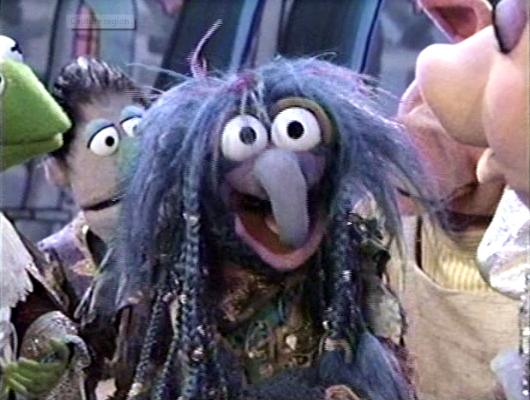
Instead of elves, they are Elvises.

Thank you very much.

How Does the Twist Affect the Story?

This is what I've been waiting for.  This is what the Muppets are best at.  They take two familiar premises and mash them together and present the results.  Nearly every song/sketch on The Muppet Show had to do with the incongruity of two elements, often inspired by a pun.  They took pigs and made them vikings singing "In the Navy" by the Village People.  They took pigs and made them eskimos singing "Lullaby of Broadway."  They took pigs and made them the stars of a Star Trek-esque series.  They did a lot with pigs.

But nevertheless, "The Elvises and the Shoemaker" seems just like one of the old bits.  And the pairing works, because, of course, the Elvises get to work making blue suede shoes.

What else would they be doing?

And at the end, the outfits that the shoemaker presents to the Elvises are their rhinestone jumpsuits.

It all makes perfect sense.

I'm willing to forgive this story for dropping the charitable aspect of the shoemaker's character because we need to spend as much time as possible with these Elvises.  These bizarre creatures that don't seem entirely aware of the world around them and only act like Elvis out of a sense of duty (much like the original shoemaking elves, who are obligated to make shoes for some unknown reason).

Rating:  Easily the best of the bunch.  It's a hunka burnin' love.  5/5


So, Muppet Classic Theater.  It's certainly a joyful, non-threatening little treat.  And it played a large role in keeping the Muppets on people's minds during the hiatus between feature films.  If you grew up with it, I'm sure you have a favorite story and fond memories of this little endeavor.

For me, the stories from best to worst are:
1) The Elves and the Shoemaker
2) Rumpelstiltskin
3) King Midas
4) The Three Little Pigs
5) The Emperor's New Clothes
6) The Boy Who Cried Wolf

But really, my only qualms are where the stories deviate from the original.  Those that do it with a clever purpose fare better than those that just shoehorn in new morals for today's kids.

It's worth checking it out if you need a quick Muppet fix (and if you're a fan of Gonzo and Rizzo's relationship).  Otherwise, just stick with some old episodes of The Muppet Show because it has a lot more pigs in it.

Sunday, August 26, 2012

Muppet Classic Theater, Part 2: Faulty Fables

3) The Boy Who Cried Wolf

The Original Story:

A young shepherd who often gets bored when tending to his flock takes great amusement in scaring his neighbors by repeatedly shouting that a wolf has come to eat his sheep.  The villagers eventually grow sick of his practical joke and learn not to trust him.  When an actual wolf does terrorize his flock, the boy's cries for help go unheeded and he loses his sheep.

The Muppet Twist:

The boy is not intentionally deceitful.  He is just prone to overreactions.  So, after scaring the townspeople with stories about impending earthquakes and tidal waves, they don't believe him in the threat is justified.

Also, since we can't kill off all the sheep in a children's video, a giant ram named Norman is recruited to fend off the wolf.

BAAAAAAH!

How Does the Twist Affect the Original?

Well, the original moral and entire point of the story is eliminated and changed to "don't overreact."  I suppose that's a necessary lesson to teach children, although it is always better to be safe than sorry.  But teaching children not to intentionally lie lest people will lose trust in them is a far more important message.

Because of the new take on the story, the wolf even comes in and explicitly tells Gonzo (the boy) that he wants him to learn how his overreactions will get him in to trouble.  For "dramatic tension," he gives Gonzo a day to convince the townspeople that the wolf is real, but since they ultimately don't believe him anyway, this addition to the story is just a pointless excuse to add a musical number.

We're too busy singing to acknowledge your credible photographic evidence!

And yet, by the end, after the giant sheep takes out the wolf, the town treats Gonzo like a hero.  Because everything has to end up nice and sweet.

Congratulations for doing nothing and letting a deus ex machina save you!

Rating:  The story misses the point of the original and the characters behave strangely in order to pad out the very short tale.  1/5

4) Rumpelstiltskin

The Original Story:

To impress the king, a miller claims that his daughter can turn straw into gold with a spinning wheel.  To test her skills, the king places her in a room of straw and if she is unable to perform the task by the next day, she will be imprisoned in the dungeon.  The daughter cannot spin the straw but a magical imp appears and offers to do it in exchange for her necklace.  A deal is made and the next day, the king tests her again with more straw.  The imp reappears and creates gold in exchange for a ring.  On the third day, the king tests her on more time (because he's got issues) and the imp agrees to do it in exchange for her future first-born child.

The daughter is saved from imprisonment and goes on to marry the king.  When her first child is born, the imp appears to reclaim the baby.  The queen pleads to break off the deal and the imp decides to give her a day to guess his name.  If she cannot guess correctly, the baby will be his.  The queen tries desperately to come up with the correct name, but fails.  However, she later overhears the imp singing a song in which he reveals his name to be "Rumpelstiltskin."  She then guesses his name correctly and he disappears.

The Muppet Twist:

The stories are virtually identical except the queen (Piggy) guesses the correct name by checking the tags of his clothing, since she surmised that his mother would have written it on there when he went to weirdo camp.

What a twist!

How Does the Twist Affect the Original?

Well, it's not the most clever solution, but it beats the idea that the clever imp was just foolish enough to shout his name out loud.  Plus, it gave us a funny joke in that Piggy's first guess is "Ralph Lauren."

The story is a strange one because nothing really makes sense.  This magic man can just turn straw into gold without explanation.  And even though he had made a deal to take the baby, he still gives the queen a chance to revoke the original deal.  Maybe he's just a compulsive gambler.

That's the look of a guy who spends all his time at the slots.

There seems to be somewhat of a message in the story, in that you should get to know the people from whom you request help.  Otherwise, you'll just be selfish.  This is kind of built up at the beginning when Piggy just brushes Rumpelstiltskin aside, claiming she doesn't care what his name is, she just wants the gold, but they never follow up on this idea.  But this is the only reason (that I can tell) that this story would even exist.

Rating:  The story remains straightforward and is slightly improved with the added twist.  Also, the name-guessing song is really fun.  4/5

Coming up, new clothes and new shoes.  Well, new shoes, at least.

Thursday, August 23, 2012

Muppet Classic Theater, Part 1: Twisted Tales

The Muppets of the '90s continued their quest to remain in the public eye with a callback of sorts to the original Muppet specials.  Since Henson gained a lot of popularity through his fairy tale adaptations, it was time for the Muppets to return to the well of traditional stories.  Sure, Sesame Street had been dealing with these fables for years, but no one was complaining.  What spawned was a direct-to-video feature called Muppet Classic Theater.  Six short stories were acted out on a "stage" with our main Muppets playing the roles and Gonzo and Rizzo alternately narrating.  It wasn't quite as long as the previous films and the production quality isn't even up to Muppet Show standards, so I hesitate to call it a canonical "Muppet movie."

Marvel at the direct-to-video splendor!

But this video played a major role in defining the Muppet aesthetic for the decade and it would even introduce some characters who would appear in later projects with more substantial roles.  So let's look at the tales.

1) The Three Little Pigs

The Original Story:

Three pigs build their own houses to protect themselves from the Big Bad Wolf.  The youngest pigs build a house of straw and a house of sticks while the eldest and smartest pig builds one of bricks.  The wolf is able to blow down the houses of the first two pigs, but is unable to destroy the brick house.  He decides to come down through the chimney where the pigs wait with a pot of boiling water.

The Muppet Twist:

Miss Piggy plays the eldest pig, Sandy, to her dimwitted brothers Andy and Randy.  Both them and her father don't expect her to be intelligent or crafty because she is just a girl.

Oh, and the wolf is taken out by a rocket.

How Does the Twist Affect the Original?

The story is no longer about being practical and prepared and instead emphasizes that girls are just as capable as boys.  Piggy/Sandy even sings a whole song about how she deserves respect, although, coming out of diva Piggy's mouth, the whole number is very self-serving.  But at least her heart is in the right place.

It's hard to be a positive role-model for young girls when you exhibit caustic behavior 90% of the time.

The rest of the story is as straightforward as a Muppet adaptation can be, with slapstick, jokes, meta-references to the original text, and (implied) explosions.

"I'll huff and I'll puff and I'll blow myself to smithereens."

The characters of Andy and Randy Pig first appear here and their numbskullery must have been popular.  They repeatedly headbutt each other, making them dumber and dumber, which is interesting because the Muppets never really had such moronic characters before.  We'll address them more later when they become semi-permanent additions to the Muppet cast.

At least they are smart enough to run away from predators.

Rating:  This whole story goes exactly as one would expect, and even with the intended positive moral and amusing characters, it doesn't have much substance to it.  3/5

2) King Midas

The Original Story:

King Midas finds a satyr passed out drunk in his garden and takes him in, treating him well.  As a reward for his kindness, the god of wine Dionysus grants him a wish and Midas wishes that anything he touches will turn to gold.  The wish is granted and soon Midas enjoys all of his new riches.  But he quickly discovers this blessing is a curse as he can no longer touch food to eat.  Even worse, he accidentally touches his daughter, turning her to solid gold.  He asks to reverse the wish and he is told to wash his gift away in the Pactolus River, where the sand slowly turns to gold.

The Muppet Twist:

King Midas (Kermit) only wants peace in the world but his wife (Piggy) interrupts him and requests the golden touch power.  Also, Midas accidentally turns HIMSELF into gold, leading Piggy to give up all her new riches in order to save her husband.

WHOOPS!!!

How Does the Twist Affect the Original?

Once again, Piggy is the main focus of the story.  And since Kermit wouldn't be the greedy type, she has to be the one to even make such a claim.  Although, in the original, Midas wasn't particularly greedy.  He just thought that would be a good way to become richer.  Even Kermit uses this power for good, by helping the people of his kingdom by providing them with golden items.  But, that moral isn't as clear cut as "don't be greedy" so Piggy has to stand in for the tragic role.

I do like the costume design choice that all of Piggy's clothes are now golden as well.

Also, there is a bizarre twist with the satyr character.  Gonzo plays the satyr and he is also the one to grant the wish, removing Dionysus's part of the story.  As a result, there has to be a reason he gives Midas the opportunity for any wish he desires.  So, after he is discovered sleeping in the garden, Midas, instead of taking him in and offering him hospitality, threatens to execute him for damaging the flowers.  Why is Kermit getting so murder-happy in all of these story adaptations?  He claims that he doesn't agree with that law but HE'S THE KING AND HE CAN JUST REMOVE THAT RULING!

You picked the wrong place to nap.

At the end, he gives Midas one more chance for another wish and once again Piggy blurts in (despite having just learned a valuable lesson) and asks for a juicer.  That's...pretty funny.

Rating:  The twists are creative and in keeping with the Muppet characters, so although the story isn't improved, it is still a solid funny version.  Although, one thing kept bugging me.  The back curtain that the set is painted on keeps getting bumped into by the Muppets and rippling, creating a warped, trippy effect that makes it hard to physically watch at times.  4/5

Tomorrow, we have another story with wolves and another story with weird wish-granting creatures played by Gonzo.