The group finally makes their way to the Emerald City and we finally see where the budget of this film went.
Brought to you in glorious CGI!
But as impressively massive as the city appears, the sets manage to shrink once again as the Guardian of the Gates appears to grill the travelers at the door to the city. Totopepe convinces him to let them in since Dorothy managed to kill a witch with her bare house. This excites and scares the Guard and he decides to take them to the Wizard.
Once again, swell casting choice.
So, who is going to play the Wizard? This is where Kermit would have been great, but at this point, it's up in the air. The chair swivels around to reveal...
Ta da!
Just kidding! Scooter is only the assistant to the regional Wizard. He prepares the characters for their Emerald City apparel, just like in the book. Now, everyone will be getting green glasses and Dorothy will be getting a green dress, but rather than simply reach into a closet, we need to stick Bunsen and Beaker in here for their mandated cameo. So, the glasses and a "makeover machine" are their inventions and we are able to move forward.
Each character meets the Wizard one at a time, and each time, the Wizard appears as something the character fears the most. The Cowardly Lion gets a scary dragon who hates his jokes...
The world's worst critic.
...the Scarecrow gets a ball of fire...
Um...and Kermit hates being green?
...and the Tin Thing gets a seductive woman who becomes a seductive chicken.
Uh oh, they ran out of their effects budget as well.
The Wizard denies all of their wishes and only seems interested in Dorothy the Witch Slayer. He promises to fulfill Dorothy's dreams, provided she travel over the Deadly Mountains in the west and obtain the Wicked Witch's magic all-seeing eyeball.
Also, Dorothy's greatest fear is apparently Boss Nass.
Dorothy and the troops gather themselves and prepare their journey. Meanwhile, the Witch spies on them and prepares to send out hoards of obstacles to destroy them. In an amusing joke that fans of the story will appreciate, she lists all of the plagues that she initially sends out in the book (like wolves and crows and bees) that are ultimately stopped by the heroes, but all of them are on vacation so all she has left are her flying monkeys. Sorry, I mean, her biker gang, the Flying Monkeys.
Made up of the recycled cast of Muppet Treasure Island.
Wearing her mind-controlling biker cap, she controls the gang to attack and kidnap the heroes, singing "The Witch is in the House." Again, the song's nothing too special, but the fights is pretty exciting and gruesome. The Tin Thing loses his head and the Scarecrow is shredded to bits while the more meaty travelers are abducted. That's pretty scary for kids.
This witch don't mess around!
What will happen to our maimed heroes? Check it out tomorrow, as the surprisingly accurate retelling of The Wonderful Wizard of Oz continues.
Alright, it's time for the introduction of Dorothy's travel companions. While most versions enjoy spending time with each character by themselves, things feel a little rushed this time around, leaving me to wonder what the other 3/5ths of the movie are going to focus on.
First up is Kermit as the Scarecrow. I know we have to have Kermit as this character because Gonzo and Fozzie fit so well with the other two travelers, but Kermit never really strikes me as a Scarecrow. The Scarecrow has to be somewhat of an idiot savant, seemingly dumb, but capable of brilliant insights due to his simple approach to complex ideas. Kermit is already smart. So, he has to be dumbed down a bit at times, which just doesn't work. Link Hogthrob would have been a great Scarecrow, but that ain't happening.
I do like how they incorporate his collar into the costume.
Kermitcrow and Dorothy bond over their dreams of becoming a star and Kermit reminds her to follow her dreams. Thanks for the advice!
Down the road, Gonzo is frozen as the Tin Thing. Unlike the Tin Woodman, the Tin Thing is a robot created by the Wicked Witch to spy on Oz's inhabitants. He knows everything with his computer brain, but wishes he has a heart like when he was a human...er...a whatever. Gonzo fits perfectly for this role because, like the Tin Woodman, he is capable of great, subtle compassion.
Good casting choice and a great design.
Finally, we run into the Cowardly Fozzie Bear-Lion. Fozzie often gets stuck with this role and it works because he is such a weak-willed character, but when his friends are in trouble, he defends them to the end. Also, the Lion wants to be a stand up comedian, but he has stage fright. Of course.
This movie might just work out after all.
With our team assembled, it's time for a song! Unfortunately, it is no "If I Only Had a Brain" or "We're Off to See The Wizard." So, lets move right along.
Next scene!
Our group encounters their first obstacle, a precarious bridge that is guarded by the Kalidah Critics. The Kalidahs are your typical Oz monsters, but now, instead of being physically intimidating, it is a mental attack on our heroes psyche. This scene works very well. It's not perfect, because there is never a point in which the characters are in any real danger, but the fact that the monsters are harsh critics fits with the new theme of achieving one's dreams and over-coming self doubt.
Finally, a valid role for these two!
Of course, the Lion has the hardest time crossing the bridge, but this results in a super sweet moment in which the Tin Thing goes back across the perilous canyon in order to calmly talk his friend through it and support him. It's very genuine and the moment isn't overly broad or played for laughs. It's just Gonzo doing what Gonzo does best.
Across the bridge, the gang makes it to the nightclub Poppyfields, referencing the deadly, sleep-inducing poppy fields from the story. This seems to be the hangout spot for the Electric Mayhem and leftover characters from Muppets Tonight.
Hey, Clifford's got his shades back!
The band plays a hypnotic song called "Nap Time" that causes Dorothy, Toto, and the Lion to fall asleep. Now, as in the original, the flowers don't affect the non-organic Scarecrow and Tin Woodman, although it isn't really explained why the song won't affect them this time.
We went deaf, momentarily?
Nonetheless, the Muppets are too small to carry the sleepers through out of danger, so they must call upon the mousy Munchkins from earlier. So, basically, the mice from the original are combined with the Munchkins. That's clever.
Good job, movie!
Up next, our friends wake up and we make it to the Emerald City!
The scary thing about tackling a classic is that any adaptation is going to be compared to what has already been labeled "perfect." There have been many film versions, sequels, and (now) a prequel to The Wizard of Oz, but while some have been critical successes, none have come close to eclipsing 1939's masterpiece.
But in the hands of the Muppets, there is still new ground to be broken, correct? Surely that would be a recipe for success, like The Muppet Christmas Carol or Muppet Treasure Island. Well, let's go over the rainbow with 2005's The Muppets' Wizard of Oz.
This is going to be good!
The film opens with Ashanti aggressively singing to the camera about wanting to get out of Kansas.
Uh-oh...what's happening?
I'm not too familiar with Ashanti's repertoire, so I don't have any opinions on her as a performer, but a quick glance at my research shows that she eventually went on to perform in The Wiz. That makes sense, because I am getting a strong Wiz vibe from this set up. We have a modern-day Dorothy who is tired of working at her Aunt Em's diner and she just wants to be a star. Aunt Queen Latifah is not very supportive.
Auntie Em!
Her Uncle Henry is much more supportive, and encourages her to go to her audition with the Muppets and...wait, the Muppets are the ones aspiring singers turn to in order to begin their careers? What fantasy land have we stumbled into? It does take a longer-than-average while to introduce the Muppets into the plot, but it could have been a little truer to the Muppets' raison d'être. Dorothy makes it to the audition just as the Muppets' bus drives away, but Kermit promises to listen to her demo.
I'm calling it right now, I bet he'll love it and let her join them at the end of the movie.
Even though Kermit agreed to listen to her tape, Dorothy still considers her audition a bust and yells at her aunt and only takes comfort in her pet Toto. Toto is a king prawn. So, this movie is writing itself, I take it.
FORESHADOWING!!!
Of course, a tornado comes to pick up Dorothy's house and carries her to Oz. This is what we came for! And, it's a lot smaller than one would usually imagine Oz to be. I know it's a TV movie, but everything feels so cramped. Even the limited sets of usual Muppet movies are a bit bigger than this.
We're here! Can you see us?
Well, first, we must reveal that Toto the Prawn has become Toto the Pepe the Prawn. Um...so, Dorothy is familiar with the Muppets, but doesn't realize that her pet has become one? Well, the original movie treated the trip to Oz as a dream, so everything absurd element that follows can be labelled as dream logic.
This a dream come true!
Dorothy and Pepe exit the house and the rats of Munchkinland gather around and celebrate the destruction of the Wicked Witch of the East. Well, she wasn't quite destroyed. Since Miss Piggy is going to be playing all of the witches in the film (there are no other female Muppets, remember?), we get a chance for the East Witch to have her day in the sun.
Oh, she's alive! Wait, doesn't that totally change the story?
But the Witch of the East has to be dead, right? Well, I guess Dorothy can still go on her journey without being an accidental murderer. Actually, nope. The witch still dies because even with Piggy's strength, she can't hold the house forever and it crushes her. That's...way more gruesome than just having the death offscreen like usual.
Arriving a tad too late, the Good Witch of the North, Tattypoo, arrives for her daily Munchkin visit. Now, most people think Glinda is the North Witch, due to the 1939 version combining the two good witches into one character. So I'll give the film credit for bringing back the original character.
A slightly nicer version of Piggy.
Tattypoo reminds Dorothy to take the magical silver slippers and when she refuses, there is a great bit of lampshade hanging in which she tells her not to pick at every little detail or else this story would go nowhere. I'll give the film credit, the original story is absolutely bonkers, despite being a classic.
Dorothy sets off down the Yellow Brick Road to return to Kansas/become a singer, whichever comes first. And so we're off to see the Wizard, the Slightly-Off Wizard of Oz!
Tune in tomorrow to meet some brainless, heartless, courage-less friends!
I have hesitated to do a "Best Muppets" list for as long as I've written this blog. But, after perusing other lists of a similar ilk, I've noticed that everyone tends to pick the same handful of characters. There is a large population of characters that deserve recognition. Limiting myself to just top 10 or 20 feels wrong, mostly because the popular ones will end up getting all of the top spots anyway.
So I shall break it down by puppeteer. 10 per person seems reasonable. And, who better to start with than dear old Jim Henson?
Be warned, some of your favorites may not appear. The Top 10 List is a cruel beast.
One of Henson's earliest creations, Yorick proves that sometimes the simplest ideas cannot be topped. Paving the way for every Muppet with a voracious appetite, Yorick is just a skull that eats. With his unwavering blank stare, Henson managed to create a character that was equally terrifying and endearing. Part of me wishes that the film Kermit, Prince of Denmark had seen the light of day just so that Yorick could appear as his namesake.
The Muppet News Flashes fulfill humanity's desire to see stiff and proper individuals get their feathers ruffled and violently injured. Sure, each segment was exactly the same, but it was schadenfreude at its finest.
What I love about Guy Smiley is how passionate he is to his craft. He has taken the concept of a game-show host and made it its own species. Guy Smiley is very similar to another Henson character, Convincing John from Fraggle Rock, but what makes Smiley more appealing is his total lack of awareness of life outside of entertainment. Convincing John always seems to have a personal goal to his energetic ravings. Guy Smiley just lives in the spotlight.
7) Mahna Mahna - The Muppet Show, various variety shows
Mahna Mahna is Henson's creative mind in a physical form. My most well-received post is about this character, so it's clear that something about this creature appeals to a lot of us. Besides, who can hear the words "Mahna Mahna" and not want to break into song? (And yes, I know I used an image of Bip Bippadotta, but they are virtually the exact same character, so calm down.)
6) Rowlf the Dog - The Muppet Show, The Jimmy Dean Show
Although Rowlf gets lost behind the other Muppets with his go-with-the-flow outlook on life, there was a lot more life to him in those early days. He could verbally spar with the likes of Groucho Marx back in his Jimmy Dean days (and even his Veterinarian's Hospital days, although those were mostly flatlining puns). Eventually he found his calling in the piano, but it always seemed as if Henson used Rowlf to say that which he couldn't say normally.
The designers of Fraggle Rock created Cantus as a caricature of Jim Henson. All of the other Fraggles looked up to Cantus and his words of wisdom, even if they were difficult to comprehend. Henson's musings often made their way into Cantus's persona, and just like the Fraggles, this caused the production staff to treat the character as a prophet and mentor. Cantus is like Rowlf to the nth degree, which is why I placed him slightly higher on the list.
4) Delbert the La Choy Dragon - La Choy commercials
If the next three spots weren't such important characters, the La Choy Dragon would have swept this list. Even though he was a brief character, he is the funniest mascot I have ever seen used to sell a product. They way he frightens customers and destroys merchandise is such an avant-garde approach to advertising that I can't help but consider him to be the perfect representation of mindless consumerism.
If each puppet on this list represented a different facet of Jim Henson, Ernie would be his childlike sense of wonder. While Ernie is supposedly older than the other Muppets on the street, he loves life and doesn't let anyone get him down, even if he annoys others in the process. He's always willing to find humor in any situation because he realizes that a good laugh can be cathartic in the most distressing situations. Ernie may have a lot to learn, but he's got life all figured out.
And out of all the Muppets Henson has portrayed, Link is his polar opposite. A buffoonish clod who disrespects those he finds inferior to him, Link is what happens when Henson has the chance to play to the extreme. He gets to indulge in a persona that is so unfamiliar to him that you can tell he has a wonderful time playing him. I'm sad that Link never really took off as his own character, even though Henson tried his best to include him in the gang right until the very end. With Kermit taking up most of his time, Link had to shine in his "Pigs in Space" and "Bear on Patrol" sketches, not to mention his covers of Village People songs. I personally cannot hear "Macho Man" without picturing a leather-clad Hogthrob prancing about town.
And "In the Navy" is the greatest Muppet Show sketch of all time. I've always wanted to talk about it, but I've never had much analysis administer to it. It is just a wonderful piece, enhanced by the fact that Link plays the leader of the Vikings.
It's so wrong. It's so right. Just like Link Hogthrob.
On the Muppet Wiki, there is a "Random Muppet" button which sends you to the page of one of the thousands of Muppets in existence. I will press the button and discuss the importance of the Muppet that comes up, no matter how obscure. No skips. No redos. This is the Random Muppet Challenge.
Random Muppet #35: The Cat in the Hat
The feline in the chapeau.
Performers: Bruce Lanoil and Martin P. Robinson
Muppet Universe of Origin: The Wubbulous World of Dr. Seuss
Most Significant Appearance: The Wubbulous World of Dr. Seuss, November 17, 1996, "The Simplifier"
Dr. Seuss's world-famous 1957 story The Cat in the Hat introduced us to a meddlesome troublemaker whose attempts to entertain and delight result in chaos and destruction, before he is faced to clean up the mess that he has created.
A children's icon is born.
The Cat in the Hat became the face of Seuss's enterprise, because America loves a good story in which horrible disasters are made and then fixed. There was always something slightly sinister about the Cat, due to the way he shows up out of nowhere to cause mayhem. He is most likely the corporeal form of Loki the trickster god.
When the Henson Company decided to make The Wubbulous World of Dr. Seuss, all of Seuss's famous creations would be included. The Grinch, Horton the Elephant, Fox in Socks, Sam-I-Am, and Yertle the Turtle were all featured. But the star had to be the Cat in the Hat, of course. Unfortunately, he took more of the host/narrator role as he focused on various new stories around the world of Seussville.
What a place to live.
Unlike Seuss's classic stories, very few of the episodes served as metaphors for mature issues and themes, like environmentalism, racism, and war. Instead, epsiodes focused on kids show fare like "don't be afraid of the dark" or "let's cure a hiccup." Each episode still had it's fare share of nonsensical rhyming, but a lot of the heart was missing.
In one episode, however, the Cat returned to his former glory. In "The Simplifier," a harried husband and father frets over being too busy. The Cat introduces a new product known as the "Super Deluxe Simplify Machine." The more parts that are added to the machine, the greater effect it has in simplifying your life.
Ironically, the way it works is quite complicated.
As the father becomes more and more obsessed with building the machine, he begins to neglect his family, his job, and his health. Finally, our nightmarish becapped-feline from hell has returned with another moralizing warning.
Never let this Cat into your house.
The Cat however makes one last deal, allowing the father to return the machine, thus simplifying his life...back to where it was at the beginning of the story. But least now he has a newfound appreciation for life. All thanks to the Cat in the Hat.
Why Is He the Most Important Muppet?
"The greatest trick the devil ever played was convincing the world that he did not exist."
- Charles Baudelaire
As the Cat in the Hat became more commercialized, many begin to forget that his origins were in a cautionary tale about the dangers of letting strangers into your home. Everyone viewed the Cat as a hero, due to his remorse at causing suffering. But as this episode reminds us, we should not be fooled by his charming exterior.
The Cat in the Hat is a demonic force and should be avoided at all costs.
The original Slenderman.
Theodor Geisel was an amazing creator, much like Jim Henson, and his characters have stuck with us and will continue to be a part of our culture for generations to come. As stated before, he did not just create stories for children. He wrote warnings for adults disguised as children's tales. Like many folkloric artists before him, Geisel had a gift. I'm not saying that his story is akin to the legends of Robert Johnson, but there is no denying that the Cat became more powerful than the man.
Who is in control here?
In all seriousness, the fact that Seuss's work can house such deep meanings his a testament to the man's craft. So grab your favorite picture book today and celebrate the birthday of the man who made reading fun and rewarding.
On the Muppet Wiki, there is a "Random Muppet" button which sends you to the page of one of the thousands of Muppets in existence. I will press the button and discuss the importance of the Muppet that comes up, no matter how obscure. No skips. No redos. This is the Random Muppet Challenge.
Random Muppets #33 & #34: Joey and Davey
These monkeys are BANANAS!
Performers: Joey Mazzarino and David Rudman
Muppet Universe of Origin: Sesame Street
Most Significant Appearance: Sesame Street, February 8, 1993, "Episode 3071"
In 1993, a pair of twin monkeys appeared on Sesame Street, and they had a message for us. Sponsorships by letters and numbers would be a thing of the past. Instead, episodes would now be brought to us by bananas.
Our unbiased spokesmen.
Named after their relatively new performers, Joey and Davey only cared about bananas, and they usurped the show for a day to make sure only banana-related programming reached the viewers.
Full Version (but really, it's just more of the same)
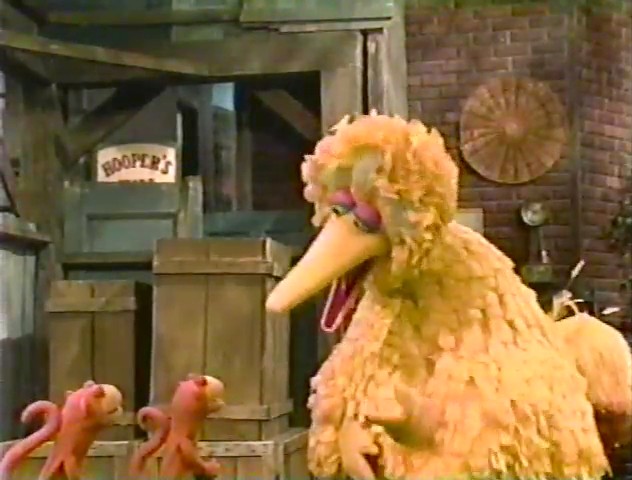
Their obsession grew to be so great that they managed to steer any conversation to their favorite fruits. It seems as if the whole reason they even came to the neighborhood was because they assumed Big Bird was of banana-descent.
Add them to the alarmingly growing list of Muppets who want to eat Big Bird.
Why Are They the Most Important Muppets?
Joey and Davey are virtually interchangeable. At first glance, it seems unnecessary to have two of the exact same character. They often speak in unison and have absolutely no defining characteristics to set them apart. That's what makes them tolerable.
It's fun to see them hanging around.
Each one builds upon the other's excitement, forming their own little club that one can't help but want to be a part of. Much of this steps from their delivery of the word "bananas." Rather than shout it obnoxiously, the two place an unnatural emphasis on the first syllable rather than the second, turning a single word into their own catchphrase. Coupled with the brief pause before the word, it seems as if bananas are a lot grander than we had originally intended them to be.
All hail the banana!
They were perfect additions to the supporting cast because, when used sparingly, they could add a great punchline to any scene. They bring to mind the simple pleasure of making a puppet out of a sock and just popping it out at random moments to say a quick, funny word. This is comedy distilled to it's basic form.
Unfortunately, characters on Sesame Street only stick around if they are able to grow in complexity. After 3 years, no one wanted to here them lyrically pronounce "BANANAS" any more. It's a shame because life could always stand to be a little bit more bananas.
On the Muppet Wiki, there is a "Random Muppet" button which sends you to the page of one of the thousands of Muppets in existence. I will press the button and discuss the importance of the Muppet that comes up, no matter how obscure. No skips. No redos. This is the Random Muppet Challenge.
Random Muppet #32: Tula the Hoob
An inquisitive, British alien.
Performer: Julie Westwood
Muppet Universe of Origin: The Hoobs
Most Significant Appearance: The Hoobs, 2001, "Smells"
The Hoobs are alien creatures that travel around the Earth in their Hoobmobile, learning about "peeps" and their offspring, the "tiddlypeeps." All data is gathered into the Hoobepedia. The show promotes scientific discovery, so whenever a Hoob asks a question, the Motorettes that operate the Hoobmobile sing their question (The Five W's and How) to keep the vehicle moving. Like the Smurfs, the Hoob language employs many variations of the word "Hoob" in place of verbs, adjectives, and adverbs. If you are not careful, you can find this show highly annoying.
But they're so adorably British that you can easily forgive them.
In "Smells," Tula laments that she doesn't smell nice enough for an up coming tiddlypeep party. She isn't sure what smells that tiddlypeeps enjoy, but she knows that it must be something better than her boring old Hoob odor.
The Hoobs decide that cheese has such a strong fragrance that it would make an excellent perfume. But the Earth children teach Tula the error of her ways and introduce her to proper, pleasant smells.
Why Is She the Most Important Muppet?
The Hoobs has one big issue. It's too derivative compared to other Henson children's shows. Sesame Street was groundbreaking in that it made the pre-school curriculum a part of its world. It manages to combine real-life with basic concepts in a way that didn't talk down to its audience. Fraggle Rock focused on society, interpersonal relationships and self-worth. And Bear in the Big Blue House brought exactly what pre-pre-schoolers needed with characters that babies/toddlers could identify with, being nurtured by the parental Bear.
The Hoobs just feels like any other kids show. It's not terrible, by any means. But nothing sets it apart from other shows. It's a hodge-podge of elements we have seen before.
A supernatural educational vehicle? Seen it.
The only thing that can save the show are the characters. The three leads are the dim-witted Groove, campy Iver, and Tula the girl. I'm ashamed to admit it, but Tula is the least developed member of the show. In the many, many clips available to view, only "Smells" features her as a main role in the story. And what we learn is that she is concerned with the way she smells. (Another clip features her concern over her hair.)
Now, she is very intelligent and polite, so she has redeeming qualities. But what makes her tick? At least characters like Zoe and Abby Cadabby, who are attacked for being "too girly," have depth and personality quirks. Even her bland travel mates manage to overshadow her. In one episode, Groove is upset about something and the mystery of the day is about what's making him so depressed. That's intriguing! Tula's issues over perfume and hair care are just disconcerting.
So, why is Tula the most important Muppet? Well, it's like the interesting number paradox. If there are any "non-interesting numbers," then one would have to be the lowest-valued non-interesting number. And that would make that number interesting, disqualifying it from the non-interesting number list.
Tula is the lowest-valued non-interesting Muppet. And that's what makes her so important.