Showing posts with label bob mcgrath. Show all posts

Wednesday, October 17, 2012

Love Any of Thy Neighbors

A few of the most memorable Sesame Street songs have been around since the very first season.  And, based on the premise of the show, it is quite fitting that one of these songs is...

5. The People in Your Neighborhood - Bob and the Anything Muppets


This song appeared many times, with many variations of singers, puppets, and occupations.  But each served the basic function of introducing children to the various people they might encounter when walking around their neighborhood.  Sesame Street was supposed to be the street that everyone could identify with, so the song went to great lengths to keep things familiar to the audience.

But rather than simply trot out various occupations, special puppets were used to drive home the concept of the song.  They are known as the "Anything Muppets," meaning that they start with a basic, colorful body shape upon which eyes, noses, hair, and other accessories can be affixed.

During the very first iteration of the song, the two puppets that Bob encounters (played by Henson and Oz) start out very nondescript.  It is not until Bob adorns them with some iconic imagery (a mail bag and a fireman's helmet) that the characters "become" productive members of their society.

Yep, all you need is the right hat and you are fully prepared for the job.

The first few incarnations of this song reused the same blue and orange Anything Muppets played by Henson and Oz respectively.  The ideas was not only that there are many interesting and helpful people in the neighborhood, but also that one person could be anything they wanted to be.

Except Bob.  He could only change his shirts.

The official audio release of this song is probably the best.  It takes the postman/fireman version of the song and includes some confusion as the two Anything Muppets struggle to identify their occupation (both think they are portraying Santa Claus at one point).  Still, you can view any clip of the song and the message comes along loud and clear.

As time went on, more occupations were added and different Anything Muppets were used.  But the core of the song remains the same.  Because as long as there are neighborhoods, there will be people that we should get to know.  That's what being a good person is all about.

You can be a doctor or a grocer, but you'll always be a neighbor first.

Tuesday, June 12, 2012

Love in the Fix-It Shop, Part 2: Forced Engagement


"I bet you will." - Big Bird.

That was the ending of yesterday's episode, where Luis and Maria fell in love and already we have a theme of Luis and Maria being bombarded with questions about marriage, whether they like it or not.  This continues for the next 51 episodes!  Not every episode is directly about Maria and Luis, but the buzz about their impending marriage is ever present.  But for the new couple, all they want to do is love in peace.

Luis serenades Maria with a cover of the Sesame Street theme.  Seriously.  What else would you expect?

At the forefront of "Operation Fix Up the Fix Its" is Big Bird the Subtle. When the two don't move fast enough for his liking, he takes matters into his own hands and starts mailing out fake wedding invitations to his friends. Bob receives one and becomes dead set on performing a song at their wedding called "Love in the Fix-It Shop." I thought the song was pretty good, but Luis and Maria are less than pleased.


Big Bird's influence has spread like wildfire and soon everyone takes this Luis-Maria relationship personally.  With Luis's resistance to accept the inevitable, Sesame Street's local lothario Placido Flamingo swoops in and tries to croon his way into Maria's heart.

He has the voice (and feathers) of an angel!

Despite the fact that Maria could have made a different sort of Sesame Street history by accepting Placido's advances, she tells him off.  Like Pepe le Pew, he insists in his pursuit because Luis isn't around to stop his love.  Even when a Maria-voiced duck is brought in to appeal to the Flamingo's avian persuasion, Placido blows her off, stating that he'll only love the one true Maria.


But Muppet-on-human lechery can only go so far, and eventually, Placido must resign to the truth that he and Maria are of two different worlds.  If only Luis had been more forward in his love and not taken it for granted, none of these issues with their neighbors would keep popping up.

Finally, the tension on Sesame Street builds to a boil as everybody else takes over Big Bird's duties of asking an unrelenting series of marriage questions.  Even Oscar gets swept up in the gossip, and he hates love!  With so much pressure from all their friends, it seems kind of wrong to force these two into marriage.  They have not had one day to themselves when they can just enjoy each other's company.

Taking a break from all the noise and bothersome puppets, Luis and Maria sit down to a quiet dinner with Big Bird.  Big Bird remains on his best behavior, knowing that he should no longer push and pry.  But, it is in this moment of peace that Luis has a Freudian slip, implying that this dinner would be good at a wedding.  Well, you can't really expect Big Bird to just ignore a statement like that!

He starts asking a whole slew of questions, trying to discover the meaning of Luis's choice of words, until eventually, Luis and Maria just accept it that, yes, they are going to have to get married because there isn't any good reason why they shouldn't.  And isn't that truly the best reason of all?


Finally!  They admitted that they want to get married!  And that they want me to be the best man!

So, like all good marriages, Luis and Maria began the next step of their journey after another one of Cowboy-Detective Big Bird's famous interrogations.  I wonder how many children who watched this episode grew up to be lawyers or politicians.  Or cowboy-detectives.

When relationships are made public among a tight group of peers, the inevitable questions of marriage will rear their ugly head.  As we learned from Sesame Street, it's best to just go with the flow and say yes to the dress.  Otherwise, the two of you will have to endure days/months/years of never-ending annoyances and your love will grow from your mutual disdain of your friends.  You can't argue with results!

Saturday, February 4, 2012

The Fascinating Species of Sesame Street: Grouches

Scientific Classification:

Animalia Chordata Mammalia Primates Hominidae Monstrum Grouchus

Anatomy and Physiology:

To the layman, a Grouch is indistinguishable from any other monster on Sesame Street.  But there are key characteristics that help set Grouches apart.  They all lack visible noses, sport thick unibrows, and possess flatter craniums than the round-headed monsters.  In addition, their unhygienic lifestyle results in matted fur, with unkempt hair and dingy colors.  They also carry a permanent scowl on their face, due to their outlook on life.

A group of grouches.

A Grouch who spends enough time covered in filth will have the color of his coat change to a dismal green shade.  This can help you spot which Grouches live in the dirtiest environment.

World famous Oscar the Grouch was originally orange when he moved to Sesame Street.


Habitat:

Grouches are attracted to the foulest parts of the world, wear pests and vermin reside.  Trashcans, dumpsters, landfills, and wastelands provide them with the rotten sustenance they need to survive.  Cities that are plagued with pollution and pestilence are hotbeds for Grouch activity.

There is also a subterranean world known as Grouchland which exists as an inverse of life on the surface of the Earth.  Grouches are the main species here, although humans also inhabit this land.  In Grouchytown, there is a local human known as "Nina the Nice," who is the necessary positive force that keeps it running (much in the same way that Oscar the Grouch stays negative on Sesame Street).

She is just as unwelcome there as Oscar is upstairs.

Grouchytown and the surrounding Grouchland can be accessed via portals found in the bottom of any trash can.  Like the Snuffleupagas tunnels, it is unclear how vast this system actually spreads, and it is unknown whether each country has its own Grouch-run area.

Despite being underground, a smoggy sky is visible.  And it is possible to drive there.


Behavior:

A Grouch is just that.  Every negative emotion a person can experience is what a Grouch expereiences daily.  They exist in a paradoxical state, enjoying the aspects of life that humans hate.  Their pleasure arises from displeasure.  They find comfort in discomfort.  One could consider them optimistic, if they weren't so pessimistic.  By appreciating the despicable, Grouches show that they are capable of morality and even love.  Allowing a Grouch to discuss his passion can make him more genial and agreeable.

In a rare moment, a happy Grouch sings "I Love Trash."  Everyone has their weakness.

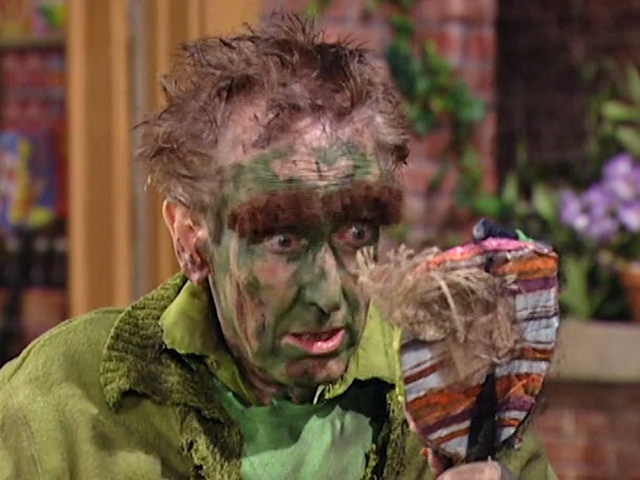
Although Grouches produce offspring like other species, there are some hints that a human can become a Grouch over time, based on their lifestyle and attitude.  For example, Vincent von Grouch is nearly human in appearance, but he lives exactly like a Grouch, suggesting that the two species are not too different from one another.


Perhaps the earliest Grouches evolved from humans.  There are no fossil records of Grouches before 1969, and baby Grouches weren't observed until much later.  Every human has the potential of being a complete Grouch.  If they dwell on their negative side for too long, changes in their behavior can lead to biological abnormalities.  To avoid turning into a Grouch, be sure to keep your emotions in check.  It can start small, playing mean-spirited pranks or complaining about the weather.  But if you don't nip these feelings immediately, they can fester and grow into an uncontrollable power, transforming you completely. 

Not even the nicest man on Sesame Street is safe from succumbing to his inner Grouch.

If someone you love is showing signs of Grouchiness, please treat them with caution.  You do not want to aggravate or encourage the behavior.  Instead, remind them of the pleasantries of life.  And remember, it helps to stay clean.

Please, think of the children!